
Now Reading: Comet R3 PanSTARRS is brightening! Pics and chart here
-
01
Comet R3 PanSTARRS is brightening! Pics and chart here


EarthSky friend John Ashley shared his video of Comet R3 PanSTARRS rising before the sun in Arizona on April 12, 2026. John wrote: “Comet PanSTARRS rises beyond the Smithsonian’s Whipple Observatory. The comet is barely visible to the eye but an easy target with binoculars. And it’s getting brighter each morning. In the timelapse video, you can see the observatory spin, and you can also tell when the quarter moon rises as it colors the atmosphere blue.” Thank you, John!
Comet R3 PanSTARRS is brightening!
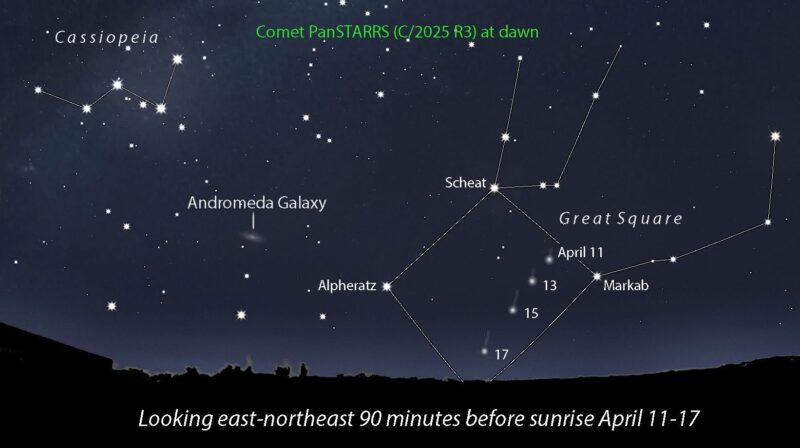
Comet C/2025 R3 PanSTARRS is now visible in the morning sky just before the sun rises. You’ll want binoculars or a telescope to see it. Current brightness estimates put it at about magnitude 4.6. Use the finder chart below to help locate the comet in the constellation Pegasus. It’s inside the asterism of the Great Square of Pegasus.
Comet R3 PanSTARRS will be closest to the sun on April 19, 2026. Then it will then pass closest to Earth just a week later, on April 26. The comet will get as close as 45.5 million miles (73.2 million km) from Earth. That’s slightly closer than half the Earth-sun distance. When Comet PanSTARRS passes closest to Earth, it will be in the direction of where we see the sun. That’s because the comet will be passing between Earth and the sun at that time.
Observers in the Southern Hemisphere will have to wait until late April to try to spot Comet PanSTARRS low in the western horizon just after sunset. But the situation rapidly improves from there in early May as the comet gets higher just after dusk.

Images of the comet from our community


More comet pics


Did you catch a pic of the comet? Submit it to us!
Bottom line: Comet R3 PanSTARRS is now visible in the morning sky for those with binoculars or a telescope. Will it get brighter? See pics and a finder chart here.
The post Comet R3 PanSTARRS is brightening! Pics and chart here first appeared on EarthSky.










Related Posts
Stay Informed With the Latest & Most Important News
Previous Post
Next Post



Advertisement
-
 01Two Black Holes Observed Circling Each Other for the First Time
 -
 02From Polymerization-Enabled Folding and Assembly to Chemical Evolution: Key Processes for Emergence of Functional Polymers in the Origin of Life
 -
 03Astronomy 101: From the Sun and Moon to Wormholes and Warp Drive, Key Theories, Discoveries, and Facts about the Universe (The Adams 101 Series)
 -
 04True Anomaly hires former York Space executive as chief operating officer
 -
 05Φsat-2 begins science phase for AI Earth images
 -
 06Hurricane forecasters are losing 3 key satellites ahead of peak storm season − a meteorologist explains why it matters
 -
 07Binary star systems are complex astronomical objects − a new AI approach could pin down their properties quickly