
Now Reading: ESA begins next phase of ‘fibre in the sky’ optical communications project with Canada
-
01
ESA begins next phase of ‘fibre in the sky’ optical communications project with Canada



15/04/2026
345 views
7 likes
Actionable data from space could be delivered in seconds in the future, thanks to progress towards the European Space Agency’s (ESA) faster and more secure laser communications network, HydRON. At the 41st Space Symposium in Colorado Springs, Canadian satellite communications company Kepler was awarded a contract to lead the next phase in the project’s evolution.
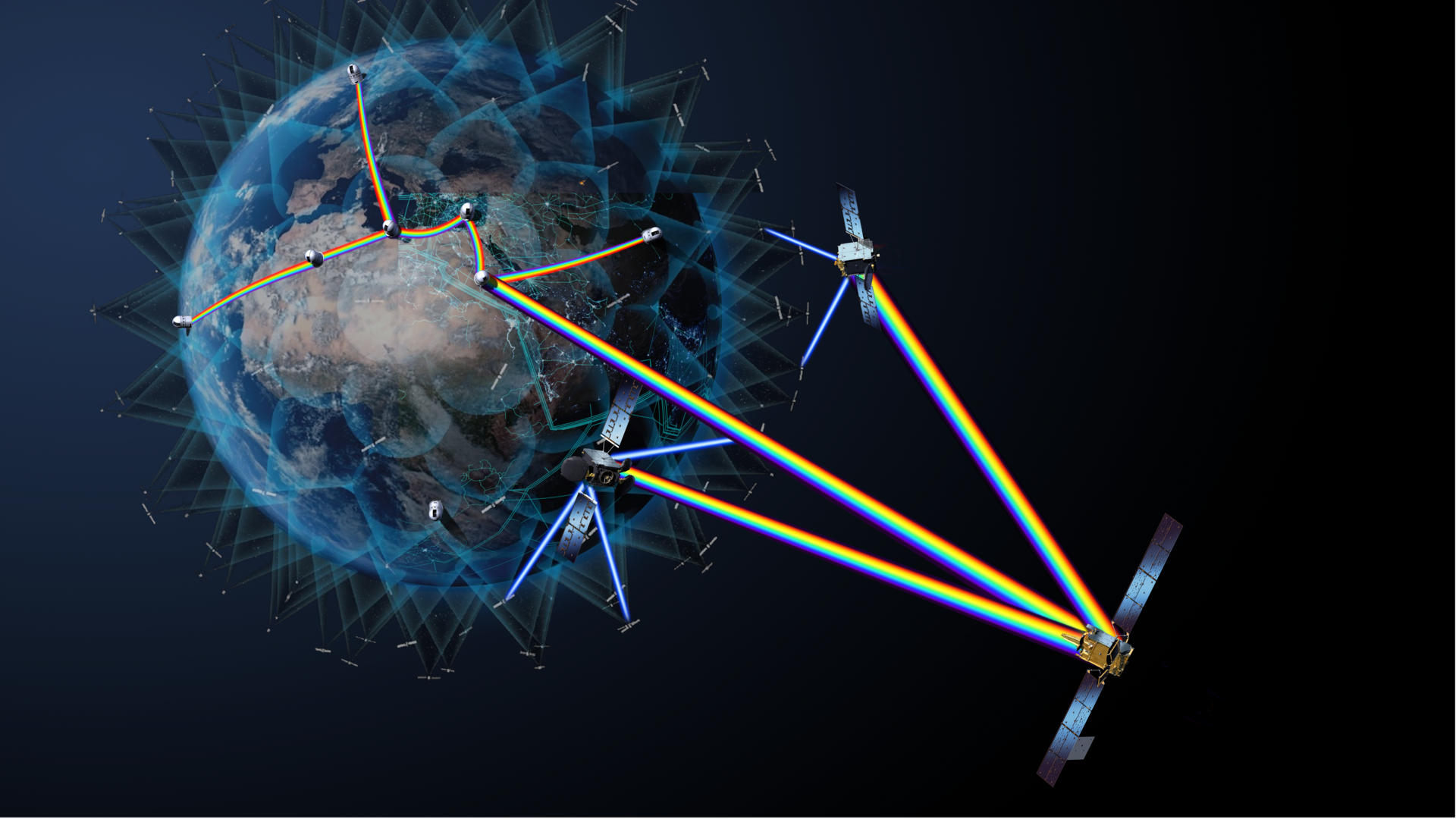
ESA’s High‑thRoughput Optical Network (HydRON) aims to enable real‑time data transfer between satellites and ground systems, across multiple orbits. Essentially, it seeks to extend fibre‑based internet infrastructure into space. Rather than relying on traditional radio links and limited ground station contacts, HydRON uses laser technology to move large volumes of data quickly and efficiently.
The programme is structured in multiple parts. The first establishes a constellation of satellites in low Earth orbit that relay data using optical links. The second extends this capability to higher orbits, connecting different orbital layers and ground infrastructure. The third focuses on bringing industry into the network, validating how different technologies and services can operate together in orbit.
Under an €18.6 million contract awarded on 14 April, Kepler will start the activities under this third part. Using their satellites, the company will host payloads from several European partners. Vyoma GmbH will contribute a space situational awareness payload, designed to monitor objects in orbit and help track satellites and debris. TESAT, MBRYONICS Ltd and Astrolight UAB will each provide optical communication hardware.
The contract was signed between Laurent Jaffart, ESA Director of Resilience, Navigation and Connectivity, and Mina Mitry, CEO and Co-Founder of Kepler in the presence of ESA’s Director General Josef Aschbacher and Lisa Campbell, President of the Canadian Space Agency, the German Aerospace Center (DLR), and Kepler’s industrial partners Astrolight, TESAT, Vyoma and MBRYONICS. It builds on Kepler’s earlier role in HydRON’s first element and supports ESA’s wider objective of developing a resilient, European‑led communications infrastructure in space.
Optical communications complement traditional radio frequencies, which are becoming increasingly congested. By contrast, laser links allow more data volumes to be transmitted, with reduced interference and higher security.
HydRON will demonstrate data rates in the terabit‑per‑second range and show how space‑based optical networks can integrate seamlessly with ground fibre systems. Beyond faster data delivery, the programme is also about interoperability, namely ensuring that technology from different European companies can work together within a single network. This is a key step in keeping Europe competitive in optical communications and in preparing future flexible space systems.
“HydRON will serve as the world’s first multi-orbital optical communications network with a terabit per second capacity, offering resilient and efficient data transfer to address the challenges of bringing connectivity to multiple users securely, quickly and reliably,” said Laurent Jaffart, Director of Resilience, Navigation and Connectivity. “Today’s signature with Kepler Communications continues our collaboration on the project, as they contribute their expertise in concert with their consortium to deliver within Element 3; the component of HydRON that’s key to building new industrial capabilities, demonstrating new service concepts, fostering system extensions, and promoting international cooperation and interoperability.”
“HydRON is a key initiative in advancing sovereign optical communications and enabling high-capacity data transport,” said Mina Mitry, CEO and Co-Founder of Kepler. “Element 3 represents a critical step in broad interoperability testing and delivering real-time access to data for various applications.”
“With HydRON Element 3 and further HydRON evolutions, ESA will respond to the needs of its Member States for high speed and secure communications across air, High-Altitude Pseudo-Satellites (HAPS), maritime and – in the longer term – deep space communications,” said Harald Hauschildt, Head of the Optical and Quantum Communication Office in charge of ESA’s Optical and Quantum Communications – ScyLight programme line.










Related Posts

Stay Informed With the Latest & Most Important News
Previous Post
Next Post
Previous Post
Next Post




Advertisement
-
 01Two Black Holes Observed Circling Each Other for the First Time
 -
 02From Polymerization-Enabled Folding and Assembly to Chemical Evolution: Key Processes for Emergence of Functional Polymers in the Origin of Life
 -
 03Astronomy 101: From the Sun and Moon to Wormholes and Warp Drive, Key Theories, Discoveries, and Facts about the Universe (The Adams 101 Series)
 -
 04True Anomaly hires former York Space executive as chief operating officer
 -
 05Φsat-2 begins science phase for AI Earth images
 -
 06Hurricane forecasters are losing 3 key satellites ahead of peak storm season − a meteorologist explains why it matters
 -
 07Binary star systems are complex astronomical objects − a new AI approach could pin down their properties quickly