
Now Reading: Ash creeps across Mars
-
01
Ash creeps across Mars


15/04/2026
636 views
12 likes
Noticeable change on Mars often takes millions of years – but the European Space Agency’s Mars Express has captured a blanket of dark ash creeping across the planet in just decades.
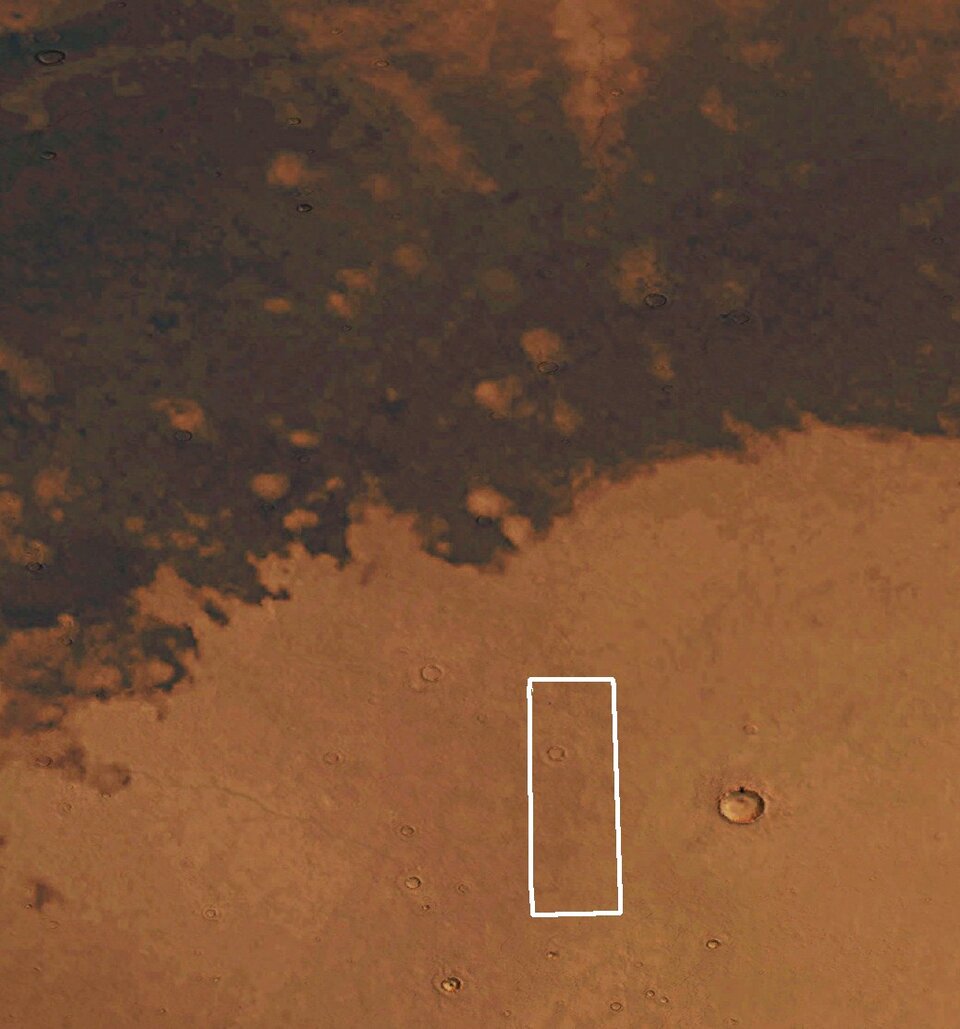
A new image from Mars Express’s High Resolution Stereo Camera (HRSC), shows a scene of two halves, with Mars’s bright tan-coloured sands butting up against dark deposits of volcanic ash.
When this part of Mars was seen by NASA’s Viking orbiters in 1976, the ash was noticeably less widespread than it is today (see comparison below).


Dark meets light
So – what makes the dark part dark? Differing from the ochre-coloured dust and broken up rock that covers most of Mars, this dark material is thought to have been made and distributed by volcanoes. Mars has a known history of volcanic activity; it even hosts the largest volcano in the Solar System – Olympus Mons – which stands at more than double the height of the largest on Earth (Mauna Kea).
The volcanic material is rich in ‘mafic’ minerals that form at high temperatures – olivine and pyroxene being key examples – and give the layer of ash its dark colour. The spread of the ash over the last 50 years has two possible explanations: either it has been picked up and moved about by martian winds, or the ochre dust that previously covered the dark ash has been blown away.
A large crater can be seen within this blanket of ash (see image below). It is surrounded by a striking ring of material that is lighter than the surrounding landscape – this is known as an ‘ejecta blanket’, and is made up of material thrown out by the impact that formed the crater itself. This crater is about 15 km across and has interesting squiggly lines within it, marking where icy material has crept about within the crater.
Constant change
Mars has a few colossal impact basins, all initially formed as large rocks collided with the planet. This scene lies in one of them: Utopia Planitia, an ancient basin with a diameter of around 3300 km (just under twice the north-south size of Earth’s Sahara Desert).
Once upon a time, Utopia Planitia is thought to have hosted a body of water, possibly a lake or even an ocean. It’s now filled with rock and sand, but still holds a lot of water beneath its surface in the form of ice. Many features across the landscape still show signs that water once flowed here.
Some such signs can be seen to the lower right of the main image, in the dark blanket of ash. Here, we can see vaguely rounded pits with wavy edges. Known fittingly as ‘scalloped depressions’, these features are very common in this part of Mars, and indicate that the region is periglacial (on the fringes of glaciers or in cold-climate landscapes, undergoing cycles of freezing and thawing, typically featuring lots of buried ice).
Scalloped depressions form as ice below the surface melts or escapes to the air, causing the covering ground to become unstable and collapse. They don’t occur in isolation but rather merge to form larger areas, providing a perfect example of how Mars’s surface is constantly changing.
A labyrinth of fractures
It may not command our attention in the same way as the dark ash, but the left half of this two-toned scene is just as fascinating.
Far on the left lies a curious feature seen often across Utopia Planitia: a series of shadowy ditches around 20 km long and 2 km wide stretching out across the surface, meeting to form a giant shape (see close-up below).
These ditches – also known as grabens – are formed when the surface cracks, either because layers of wet sediments form weak points or because of tectonic activity. The grabens of Utopia Planitia are also featured in a 2016 image release by Freie Universität Berlin (where the working group behind these new images is based).
Decades of Mars exploration
This image was captured by HRSC, one of eight state-of-the-art instruments aboard Mars Express.
Mars Express has been capturing and exploring Mars’s many landscapes since it launched in 2003. The orbiter has mapped the planet’s surface at unprecedented resolution, in colour, and in three dimensions for over two decades now, returning insights that have drastically changed our understanding of our planetary neighbour (read more about Mars Express and its findings here).
The Mars Express High Resolution Stereo Camera (HRSC) was developed and is operated by the German Aerospace Center (Deutsches Zentrum für Luft- und Raumfahrt; DLR). The systematic processing of the camera data took place at the DLR Institute of Space Research in Berlin-Adlershof. The working group of Planetary Science and Remote Sensing at Freie Universität Berlin used the data to create the image products shown here.










Related Posts

Stay Informed With the Latest & Most Important News
Previous Post
Next Post






Advertisement
-
 01Two Black Holes Observed Circling Each Other for the First Time
 -
 02From Polymerization-Enabled Folding and Assembly to Chemical Evolution: Key Processes for Emergence of Functional Polymers in the Origin of Life
 -
 03Astronomy 101: From the Sun and Moon to Wormholes and Warp Drive, Key Theories, Discoveries, and Facts about the Universe (The Adams 101 Series)
 -
 04True Anomaly hires former York Space executive as chief operating officer
 -
 05Φsat-2 begins science phase for AI Earth images
 -
 06Hurricane forecasters are losing 3 key satellites ahead of peak storm season − a meteorologist explains why it matters
 -
 07Binary star systems are complex astronomical objects − a new AI approach could pin down their properties quickly