
Now Reading: Discovery Of Unexpectedly Large Organic Molecules from Asteroid Ryugu
-
01
Discovery Of Unexpectedly Large Organic Molecules from Asteroid Ryugu


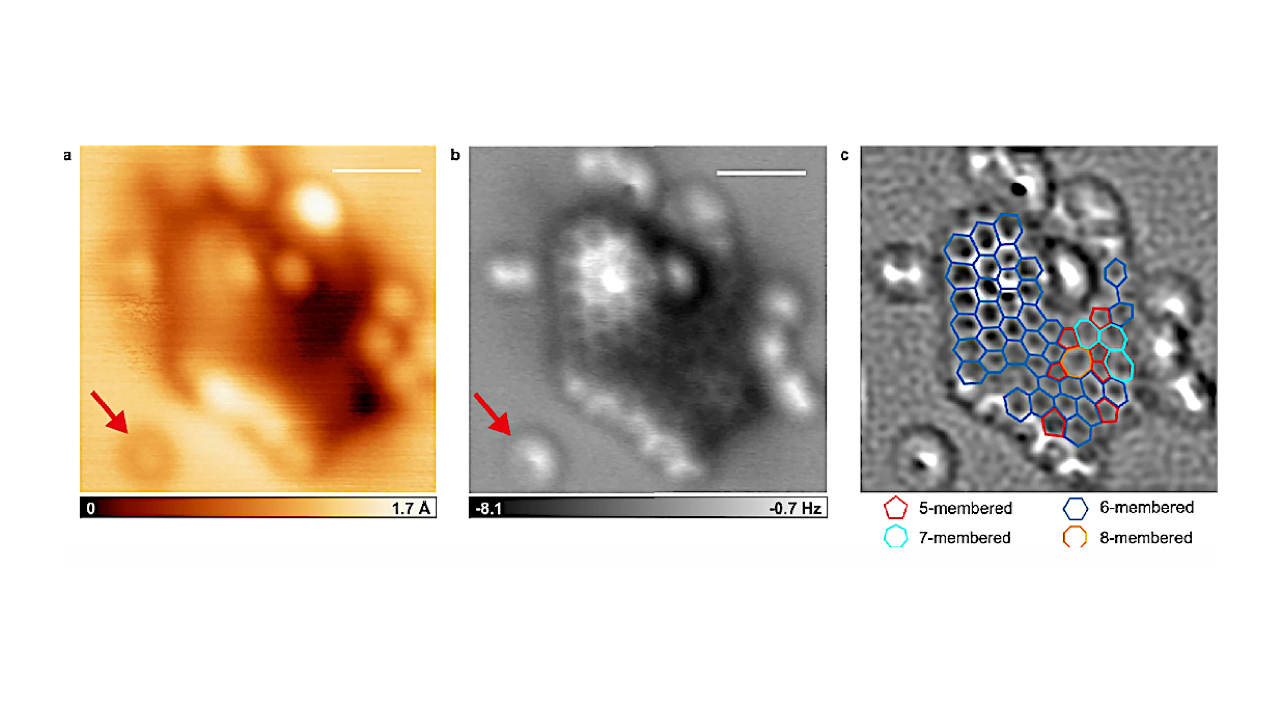

Scanning tunneling microscope image of a molecule from the Ryugu sample. b Atomic force microscope image acquired by the multi-pass method. c Processed image of (b). Ring structure is overlaid. The colors are the same as in Fig. 1, but orange represents an eight-membered ring. Red arrows in (a, b) indicate a single CO molecule. The scale bars are 1 nm. — Nature Communications
Overview
Using a high-resolution atomic force microscope ( AFM ), we directly observed the skeletal structures of individual organic molecules extracted from the Ryugu sample. We discovered numerous gigantic organic molecules with more than 100 rings, which had not been confirmed by conventional analyses. This result provides an extremely important clue to elucidating the evolutionary process of organic molecules inherited from interstellar molecular clouds to asteroids before the formation of the solar system.
A research group led by Project Researcher Kota Iwata (at the time of the research) and Professor Yoshiaki Sugimoto of the Graduate School of Frontier Sciences, the University of Tokyo, in collaboration with research groups led by Associate Professor Yasuhiro Oba of the Institute of Low Temperature Science, Hokkaido University, Professor Hiroshi Naraoka of the Faculty of Science, Kyushu University, Professor Hikaru Yabuta of the Graduate School of Advanced Science and Engineering, Hiroshima University, and Professor Shogo Tachibana of the Graduate School of Science, the University of Tokyo, has succeeded in directly observing organic molecules contained in samples brought back from the asteroid Ryugu (Note 1) by the Hayabusa2 probe at the single-molecule level using a high-resolution atomic force microscope (AFM , Note 2).

Organic molecules contained in samples from the asteroid Ryugu were observed using an atomic force microscope (© JAXA , University of Tokyo, etc.). Nature Communications
This research revealed the existence of large organic molecules with more than 100 rings that had been overlooked by conventional analytical methods. These organic molecules were found to contain diverse ring structures such as 5- membered rings (Note 3 ), 7- membered rings, and even 8- membered rings, and to have a three-dimensional rather than planar structure. This finding provides crucial clues to understanding the evolutionary process of organic molecules inherited from interstellar molecular clouds to asteroids before the formation of the solar system.
Background of the Research
The diverse organic molecules present in outer space hold information about the chemical evolution (Note 4 ) that occurred when the solar system was formed, and it is thought that their arrival on early Earth contributed to the origin of life. Therefore, elucidating the structure of cosmic-origin organic molecules and how they were formed is an important theme in modern cosmochemistry.
In 2020 , the Hayabusa2 probe delivered fresh samples from the asteroid Ryugu to Earth, and analysis has been underway around the world. Previous research, mainly using mass spectrometry, has revealed that Ryugu contains tens of thousands of types of organic molecules. Among these, polycyclic aromatic hydrocarbons, molecules with multiple benzene rings linked together, have attracted particular attention.
Previous studies have reported that relatively small molecules with about four rings (such as pyrene and fluorantene) are mainly present. However, there are limitations to chemical extraction and mass spectrometry. For extremely large molecules and components such as insoluble organic substances that do not dissolve easily in solvents, it has been difficult to identify their detailed structure using conventional “weighing” methods.
Research Content and Results
This research group used AFM, which allows us to directly “see” the shape of individual molecules , to uncover the true nature of organic molecules in Ryugu. In this study, organic molecules extracted from Ryugu samples were deposited onto a copper single-crystal substrate and observed using AFM under extremely low temperatures (5 K (Kelvin) = approximately minus 268.15 °C) and ultra-high vacuum conditions.
This method allows us to visualize even the bonds between atoms within molecules by attaching carbon monoxide (CO) molecules to the tip of the probe . Of the 22 molecules observed , many had enormous structures far exceeding previous expectations (Figure 1 ). The largest had more than 100 rings , and its estimated molecular weight reached over 3,000 .
This means that we have visualized new organic molecules that are different from those mainly detected by conventional mass spectrometry (molecular weights of around 200 to 500 ). These molecules, while corresponding in size to insoluble organic matter according to conventional definitions, have been directly proven to exist as a single, gigantic aromatic skeleton for the first time.
Further detailed analysis of the internal structure revealed that, in addition to the main hexagonal rings ( 6- membered rings), it also contains 5- membered, 7- membered, and rarely, 8- membered rings. The presence of these special cyclic structures indicates that the molecule is not flat, but rather has a complex, three -dimensional structure that is three-dimensionally distorted.

Figure 1: AFM images of diverse organic molecules found on asteroid Ryugu. — Nature Communications
Future Prospects
This result provides an extremely important clue to elucidating the evolutionary process of organic molecules inherited from interstellar molecular clouds (Note 5 ) before the formation of the solar system to asteroids.
Furthermore, this study demonstrates the extremely effective direct observation of molecular structure using high-resolution AFM for extraterrestrial samples. For large and complex organic molecules that are difficult to analyze with conventional methods such as mass spectrometry, AFM provides powerful and complementary information by “directly visualizing the shape of individual molecules.”
In the future, by applying this innovative measurement method to a wider range of extraterrestrial samples, it is expected that research toward elucidating the chemical evolution of organic molecules in the universe, and furthermore, the entire picture of material evolution leading to the formation of the solar system and the origin of life on Earth, will advance dramatically.
For each organic molecule, an AFM image is shown overlaid with a structural model . The red, blue, light blue, and orange colors in the structural model represent 5- membered, 6- membered, 7- membered, and 8- membered rings, respectively. The scale bar in all images represents 1 nm . (The figures used are modified versions of those in the original paper.)
Research grants
This research was supported by the following Grants-in-Aid for Scientific Research: “Academic Transformation Area Research (A) (Grant Number: JP20H05849 )”, “Basic Research B (Grant Number : 22H01950 )” , “Young Scientists (Grant Number: 23K13665 )”, and “Basic Research A (Grant Number: 23H00148 )”.
Direct observation of organic molecules in asteroid ryugu revealed by high-resolution atomic force microscope, Nature Communications (open access)
Astrobiology, Astrochemistry, Astrogeology,










Related Posts

Stay Informed With the Latest & Most Important News
Previous Post
Next Post



Advertisement
-
 01Two Black Holes Observed Circling Each Other for the First Time
 -
 02From Polymerization-Enabled Folding and Assembly to Chemical Evolution: Key Processes for Emergence of Functional Polymers in the Origin of Life
 -
 03Astronomy 101: From the Sun and Moon to Wormholes and Warp Drive, Key Theories, Discoveries, and Facts about the Universe (The Adams 101 Series)
 -
 04True Anomaly hires former York Space executive as chief operating officer
 -
 05Φsat-2 begins science phase for AI Earth images
 -
 06Hurricane forecasters are losing 3 key satellites ahead of peak storm season − a meteorologist explains why it matters
 -
 07Binary star systems are complex astronomical objects − a new AI approach could pin down their properties quickly