
Now Reading: Blue Origin fires up used New Glenn rocket ahead of landmark reflight (photo)
-
01
Blue Origin fires up used New Glenn rocket ahead of landmark reflight (photo)


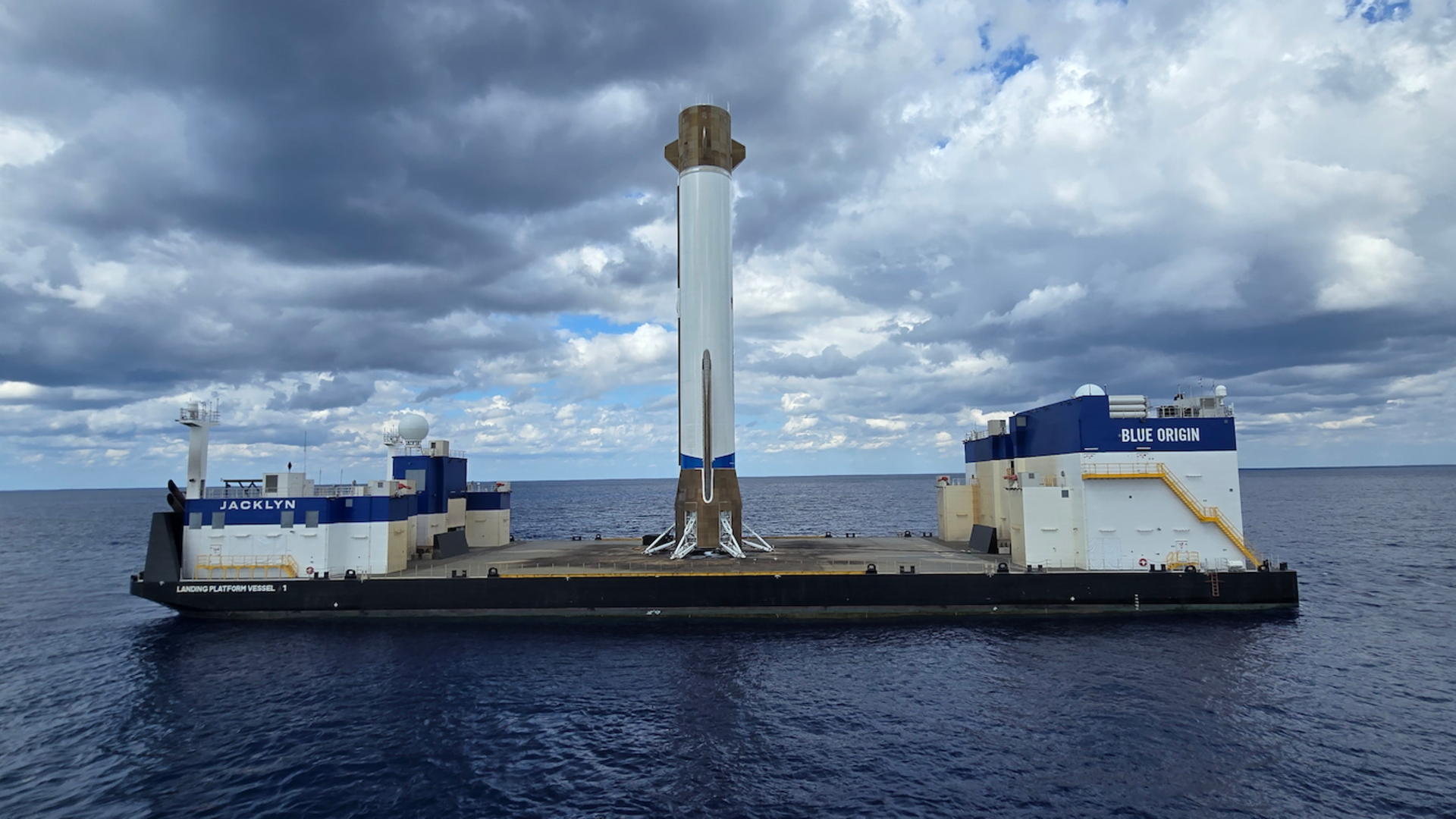
Blue Origin’s New Glenn rocket just took a big step toward its first-ever reflight.
Blue Origin conducted a 19-second static fire test with New Glenn at Florida’s Cape Canaveral Space Force Station this morning (April 16), firing up its seven first-stage engines while the rocket remained anchored to the pad.
The milestone kept New Glenn on track for the planned Sunday (April 19) launch of NG-3, a mission that will reuse a booster from a previous flight — a first for the vehicle.
The two-stage, 322-foot-tall (98 meters) New Glenn has launched twice to date. It debuted on a test flight in January 2025, then successfully sent NASA’s twin ESCAPADE probes toward Mars this past November.
Blue Origin landed New Glenn’s first stage during the ESCAPADE launch, bringing it down softly on the drone ship “Jacklyn” in the Atlantic Ocean. And that booster will fly again on NG-3.
Well, the shell of it will, anyway; some key hardware will be new.
“With our first refurbished booster, we elected to replace all seven engines and test out a few upgrades including a thermal protection system on one of the engine nozzles. We plan to use the engines we flew for NG-2 on future flights,” Blue Origin CEO Dave Limp said via X on Monday (April 13).
Sunday’s mission, which is scheduled to launch at 6:45 a.m. EDT (1045 GMT), could be the first of many reflights for this particular booster. Each New Glenn first stage is designed to fly at least 25 times, Blue Origin has said.

NG-3 will send a Block 2 BlueBird direct-to-cellphone internet satellite to low Earth orbit (LEO) for the Texas company AST SpaceMobile.
One Block 2 BlueBird has reached space to date, getting there in December aboard an Indian rocket. It’s one of the largest satellites in space, with an antenna that covers a whopping 2,400 square feet (223 square meters).
Block 2 BlueBirds are considerably larger than their predecessors, five of which reached LEO. Each of those satellites’ antennas cover 693 square feet (64.4 m).










Related Posts
Stay Informed With the Latest & Most Important News
Previous Post
Next Post



Advertisement
-
 01Two Black Holes Observed Circling Each Other for the First Time
 -
 02From Polymerization-Enabled Folding and Assembly to Chemical Evolution: Key Processes for Emergence of Functional Polymers in the Origin of Life
 -
 03Astronomy 101: From the Sun and Moon to Wormholes and Warp Drive, Key Theories, Discoveries, and Facts about the Universe (The Adams 101 Series)
 -
 04True Anomaly hires former York Space executive as chief operating officer
 -
 05Φsat-2 begins science phase for AI Earth images
 -
 06Hurricane forecasters are losing 3 key satellites ahead of peak storm season − a meteorologist explains why it matters
 -
 07Binary star systems are complex astronomical objects − a new AI approach could pin down their properties quickly