
Now Reading: The Lyrid meteor shower 2026 has begun! Here’s what to expect
-
01
The Lyrid meteor shower 2026 has begun! Here’s what to expect


The Lyrid meteor shower has begun! Here’s what to expect as the shooting star display brightens the spring night sky, when it peaks and how to know if you’ve spotted a Lyrid, or a sporadic meteor!
Lyrid meteors are visible each year as Earth passes through the trail of debris shed by the C/1861 G1 Thatcher, a long-period comet that visits the inner solar system just once every 415 years, according to NASA.
Shooting stars associated with Comet Thatcher are known for producing fast-moving meteors that tend to lack long-lasting trains. The shower can also spawn impressive fireball events that outshine even the brightest planets, as bigger chunks of cometary debris — sometimes the size of a basketball, or larger — forge a flaming path through Earth’s atmosphere
Viewing conditions
The waxing moon will be 40%-lit as the Lyrid meteor shower comes to a peak on the night of April 21-22, when up to 18 shooting stars may be visible brightening the night sky each hour. The lunar disk will set below the western horizon among the stars of the constellation Gemini roughly an hour and a half after midnight, leaving the sky beautifully dark for hunting meteors.
How do I know if the shooting star I saw was a Lyrid?
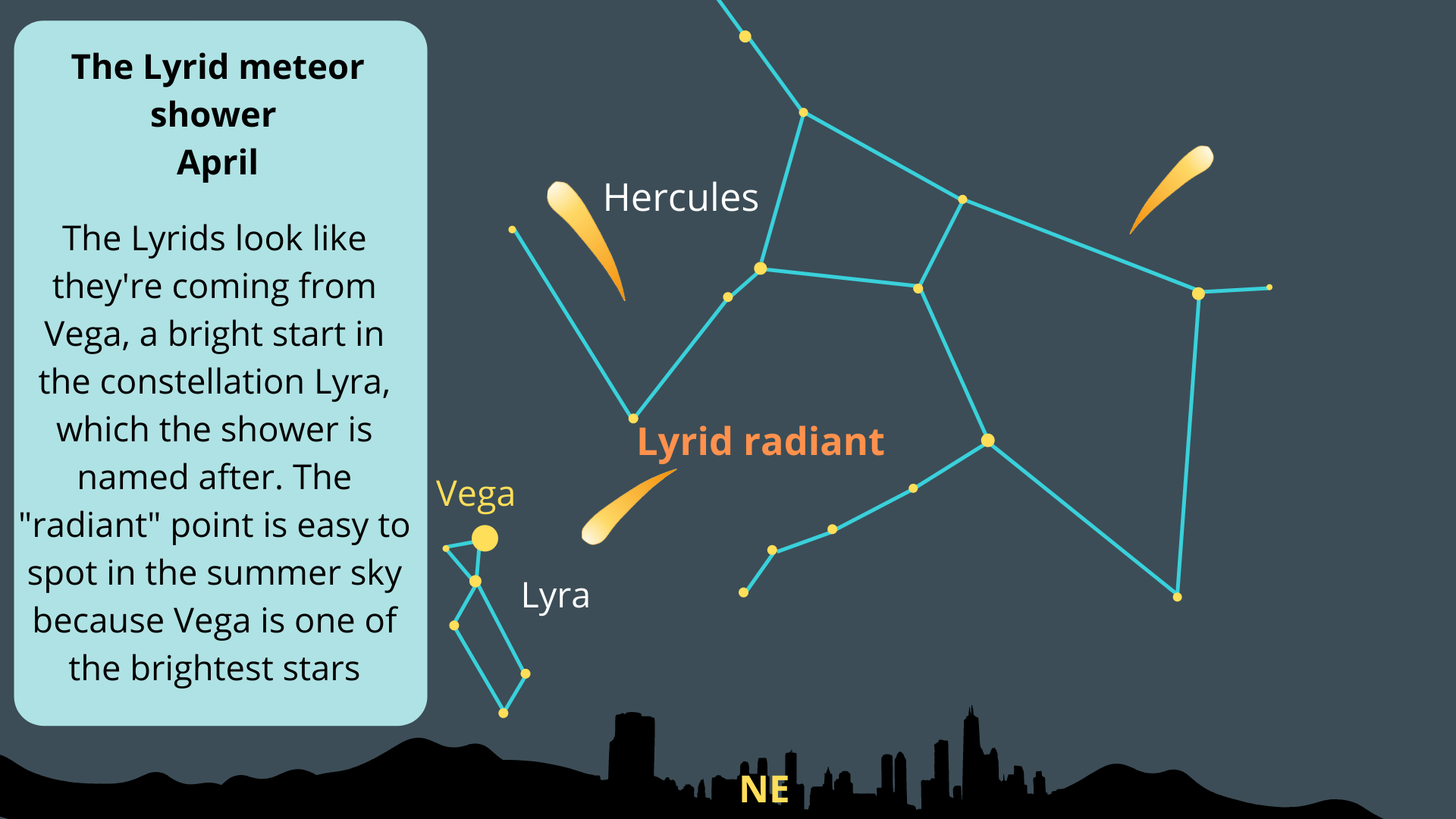
Shooting stars belonging to the Lyrid meteor shower appear to streak away from a patch of sky — known as the shower’s radiant — close to the bright star Vega, whose blue-white light can be spotted shining in the constellation Lyra. This summer constellation rises to its highest point in the eastern sky in the predawn hours in mid-to-late April.
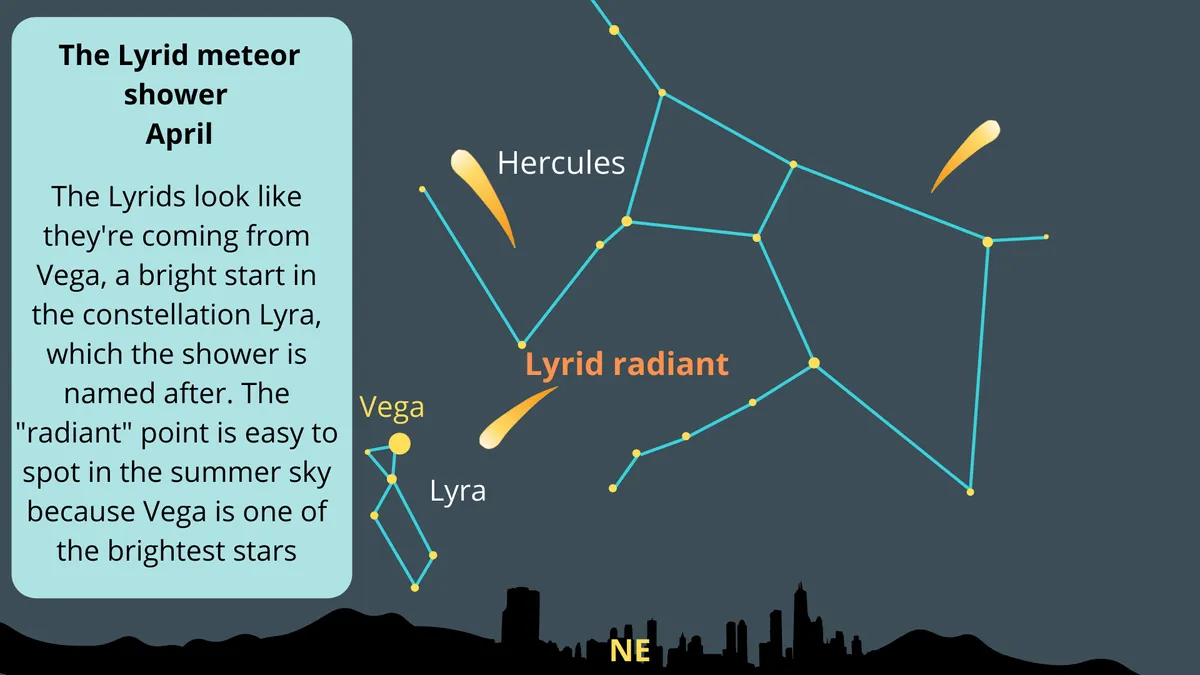
Lyrid meteors may be seen anytime after dark when the radiant is above the horizon. However, your best chance of catching the most shooting stars is in the predawn hours of April 22, as the shower ramps up to peak activity.
Where should I look to see shooting stars?
Canon EOS R7 camera

The Canon EOS R7 is the best camera for beginners hoping to capture shooting stars. Read our full Canon EOS R7 review.
Head outside around three hours before sunrise and locate the bright star Vega in the eastern sky. If you’re unfamiliar with the night sky, you should try navigating using a stargazing smartphone app, many of which use augmented reality to point you in the right direction.
When meteor hunting, it’s never a good idea to stare directly at the radiant. Instead, try to find a patch of sky roughly 40 degrees — roughly the width of four clenched fists held at arm’s length — away from it. Here, the meteor trails will be at their longest!
You may also like: The Lyrids are coming! How I watch meteor showers from the middle of a city
If possible, try to allow 20-30 minutes for your eyes to fully adapt to the dark and to use a red light to avoid spoiling your night vision. Be sure to check out our guide to photographing meteor showers if you’re planning on capturing the event for yourself, along with our roundups of the best cameras and lenses for astrophotography.
Editor’s Note: If you would like to share your Lyrid meteor shower photos with Space.com’s readers, then please send your photo(s), comments, and your name and location to spacephotos@space.com.










Related Posts

Stay Informed With the Latest & Most Important News
Previous Post
Next Post



Advertisement
-
 01Two Black Holes Observed Circling Each Other for the First Time
 -
 02From Polymerization-Enabled Folding and Assembly to Chemical Evolution: Key Processes for Emergence of Functional Polymers in the Origin of Life
 -
 03Astronomy 101: From the Sun and Moon to Wormholes and Warp Drive, Key Theories, Discoveries, and Facts about the Universe (The Adams 101 Series)
 -
 04True Anomaly hires former York Space executive as chief operating officer
 -
 05Φsat-2 begins science phase for AI Earth images
 -
 06Hurricane forecasters are losing 3 key satellites ahead of peak storm season − a meteorologist explains why it matters
 -
 07Binary star systems are complex astronomical objects − a new AI approach could pin down their properties quickly