
Now Reading: Companies make the case for commercial space station markets
-
01
Companies make the case for commercial space station markets


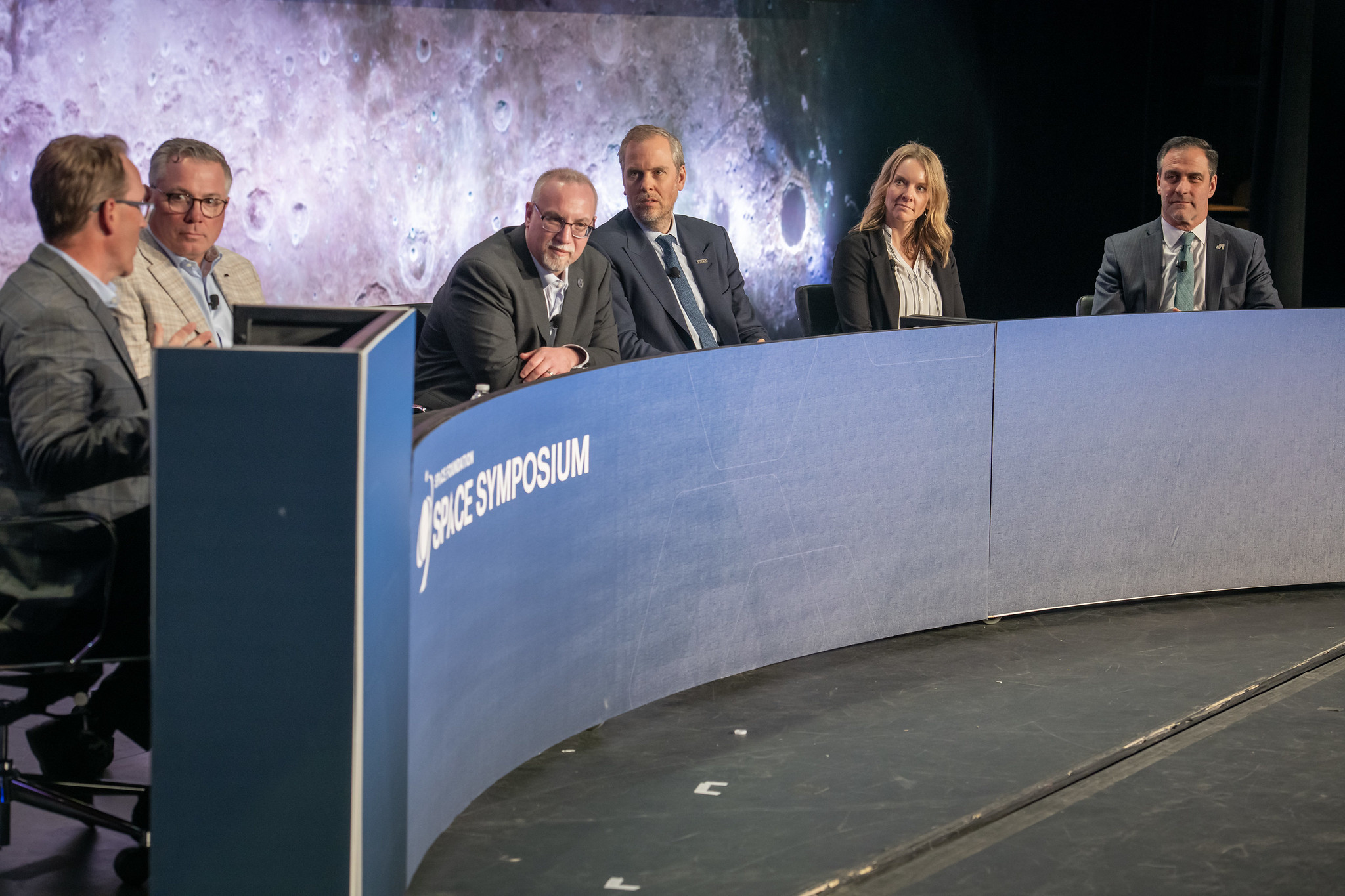

COLORADO SPRINGS — Companies proposing to develop commercial space stations are pushing back against claims by NASA that a market for such stations has yet to develop.
During a panel at the 41st Space Symposium April 15, executives with three companies working on such stations said they’ve described to NASA their estimates of the demand for their stations after NASA proposed a change in strategy for its Commercial Low Earth Orbit Destinations, or CLD, program.
NASA issued a request for information (RFI) March 25 seeking data from companies about the market for commercial space stations and procurement approaches for them. The RFI came a day after NASA’s Ignition event, where agency officials proposed a new approach to the CLD program, claiming that commercial demand for stations had yet to emerge.
Among the companies that responded to the RFI was Starlab Space. “The RFI said, ‘Show us your evidence,’” said Marshall Smith, chief executive of Starlab Space. “We put in 390 pages of independent analysis, research studies, data, contracts, those types of things.”
He did not discuss the company’s market assessment in detail, but noted there has been at least $3 billion in private investment in companies working on commercial stations. “Private capital, private investment is very much on the page that there is a future here,” he said.
Jonathan Cirtain, chief executive of Axiom Space, said his company has data from the series of private astronaut missions it has flown to the International Space Station. “We’ve flown 12 people to space who paid us money to do that,” he said. “We’ve flown 166 payloads to date. All of those are paying payloads that generate revenue for the company.”
He cited strong interest in flying sovereign nation astronauts, or those representing national space agencies. “We’re going to see that evolve as we move forward: sovereign nations wanting to fly their astronauts, get them trained, get them prepared for a role in Artemis,” he said. “That is a market. There is revenue there.”
“There was a challenge that there is potentially no market for commercial space stations. We obviously disagree with that,” said Max Haot, chief executive of Vast. “I think it’s important to reframe the conversation around the market of today and the market of the future.”
The market of the future, he said, includes emerging applications like in-space manufacturing and pharmaceutical development. “We agree with Jared Isaacman and his team that said today it’s not substantially large enough” to support a commercial space station, he said, along with uncertainty about when or if it can become large enough.
However, he said there is a substantial existing market in the form of NASA and other space agencies that currently use the ISS. NASA’s fiscal year 2027 budget proposal, which includes outyear spending projections to 2031, includes more than $1.5 billion in 2031 for the CLD program, reflecting the transfer of $1 billion to it from current ISS operations.
“If CLDs have a low-cost commercial approach, we believe that not only can we be ready by 2030,” he said, “we also believe that we can be profitable on the current market.”
Haot said in a separate interview that he based that profitability on winning between 40% and 60% of overall development money for CLDs from NASA and one six-month mission a year from the agency, along with a shorter 30-day mission from other nations.
“With that alone, and with zero dollars from in-space manufacturing, sponsorship and tourism, Vast can be profitable,” he said. That approach, he added, should enable NASA to support two space station developers rather than just one.
Haot said on the panel that he is working from the assumption that the proposed changes to the CLD program, including the development of a government-procured core module for the ISS that commercial modules would dock to, are just that: a proposal that could be altered or discarded based on feedback from the RFI.
“We believe that logic and reason will prevail. We’ll have a collaborative dialogue and that we’ll end up with something that we have confidence in and our investors have confidence in,” he said.
NASA’s proposal has created confusion in the market. “Investors and our customers are calling us and saying, ‘Hey, what’s going on?’” said Smith.
“Clarity in the demand signal is important,” said Cirtain. “Removing ambiguity and understanding the demand signal are important things.”










Related Posts
Stay Informed With the Latest & Most Important News
Previous Post
Next Post


Advertisement
-
 01Two Black Holes Observed Circling Each Other for the First Time
 -
 02From Polymerization-Enabled Folding and Assembly to Chemical Evolution: Key Processes for Emergence of Functional Polymers in the Origin of Life
 -
 03Astronomy 101: From the Sun and Moon to Wormholes and Warp Drive, Key Theories, Discoveries, and Facts about the Universe (The Adams 101 Series)
 -
 04True Anomaly hires former York Space executive as chief operating officer
 -
 05Φsat-2 begins science phase for AI Earth images
 -
 06Hurricane forecasters are losing 3 key satellites ahead of peak storm season − a meteorologist explains why it matters
 -
 07Binary star systems are complex astronomical objects − a new AI approach could pin down their properties quickly