
Now Reading: Artemis 2’s heat shield seems to have aced its trial by fire
-
01
Artemis 2’s heat shield seems to have aced its trial by fire


Artemis 2’s return to Earth went a lot more smoothly than some folks had feared.
The heat shield on Artemis 2’s Orion capsule, which the crew named “Integrity,” was the topic of considerable discussion in the lead-up to the mission’s April 10 splashdown — for several years before that, in fact.
And it wasn’t just because moon missions come back to Earth at blistering speeds and experience blistering temperatures — in the neighborhood of 5,000 degrees Fahrenheit (2,800 degrees Celsius) — when they hit our planet’s atmosphere. There was also some disconcerting history to consider.
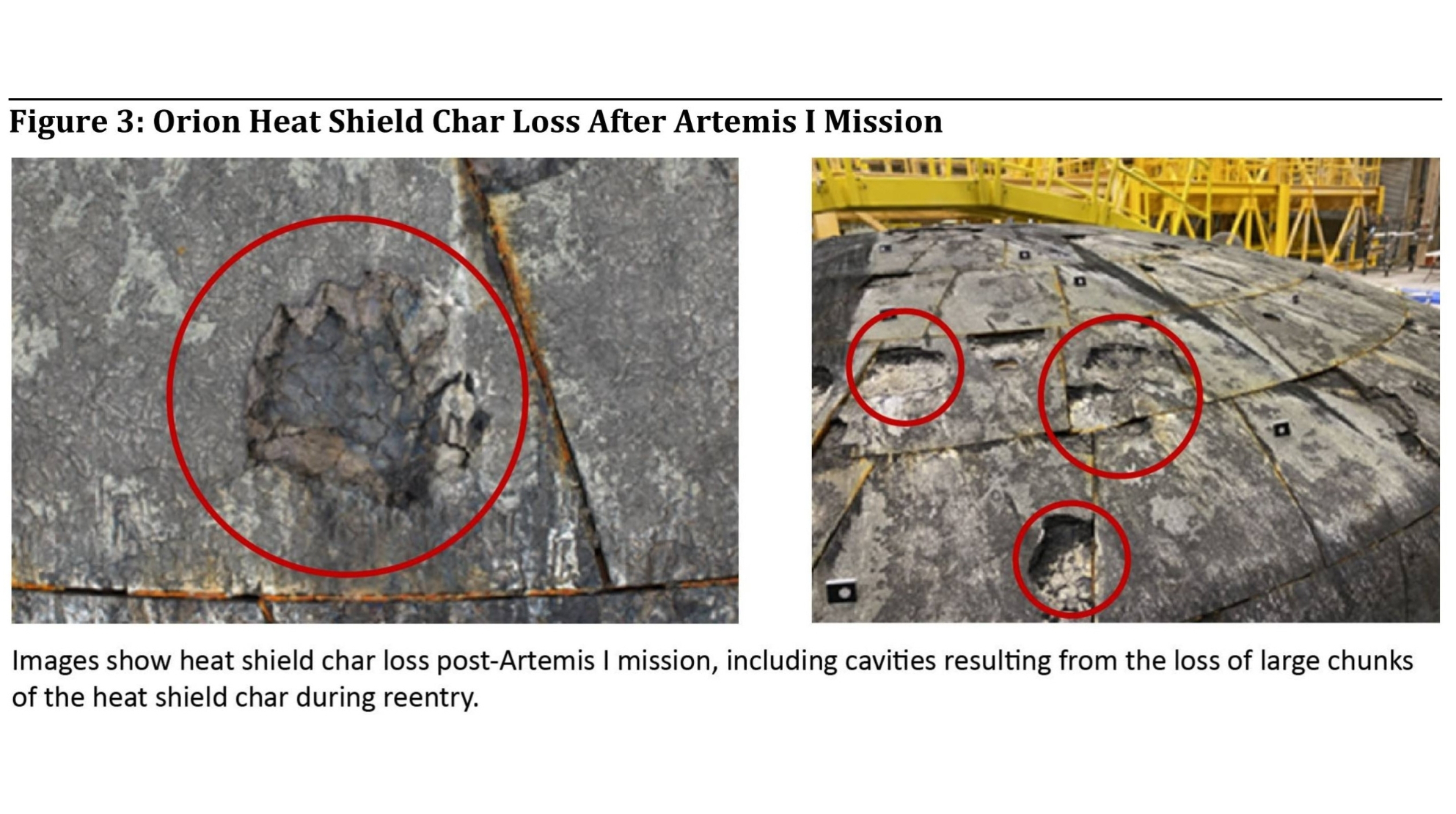
That history concerns Artemis 1, which sent an uncrewed Orion to lunar orbit and back to Earth in late 2022. The mission was a success, but Orion’s 16.5-foot-wide (5 meters) heat shield — the largest of its kind ever flown — suffered more damage than expected during its return trip through Earth’s atmosphere.
After a great deal of analysis and discussion, NASA decided to stick with the same heat shield design for Artemis 2, a decision that drew objections from some in the spaceflight community. The agency did tweak the mission’s reentry trajectory, however, bringing Integrity into the atmosphere at a steeper angle so that it spent less time in the extreme temperature regimes that scarred Artemis 1’s Orion so markedly.
This adjustment apparently did the trick, for Integrity’s heat shield survived its trial by fire in good shape, according to Artemis 2 commander Reid Wiseman.
He and his crewmates — NASA astronauts Victor Glover and Christina Koch and the Canadian Space Agency’s Jeremy Hansen — inspected Integrity shortly after the capsule’s April 10 splashdown. And the vehicle passed that eye test, according to Wiseman.
“Certainly when we went up to the vehicle, there was a little bit of char loss on what’s called the shoulder, which is kind of where the heat shield meets the structure of the cone shape of the spacecraft,” he said.
“But the bottom — we leaned under and looked at the bottom of that thing, and for four humans just looking at the heat shield, it looked wonderful to us,” Wiseman added. “It looked great.”
“The ride back down to Earth was really amazing,” he said. “It was a very smooth ride.”
Wiseman’s observations are quite preliminary, of course; NASA will doubtless have a lot more to say about the heat shield and its performance in the coming weeks and months.
And Artemis 2 was the swan song for this particular heat shield design; NASA has said it will change things up on future Artemis missions.
The next one up likely won’t experience conditions as extreme as those Artemis 1 and Artemis 2 dealt with. Artemis 3 will stay in Earth orbit, testing docking procedures using Orion and one or both of the Artemis program’s privately developed lunar landers (SpaceX’s Starship and Blue Origin’s Blue Moon).
But Artemis 4 will go far afield, and come back hot: It will use one of those landers to put boots down near the lunar south pole, then bring them home from the moon aboard Orion.










Related Posts


Stay Informed With the Latest & Most Important News
Previous Post
Next Post




Advertisement
-
 01Two Black Holes Observed Circling Each Other for the First Time
 -
 02From Polymerization-Enabled Folding and Assembly to Chemical Evolution: Key Processes for Emergence of Functional Polymers in the Origin of Life
 -
 03Astronomy 101: From the Sun and Moon to Wormholes and Warp Drive, Key Theories, Discoveries, and Facts about the Universe (The Adams 101 Series)
 -
 04True Anomaly hires former York Space executive as chief operating officer
 -
 05Φsat-2 begins science phase for AI Earth images
 -
 06Hurricane forecasters are losing 3 key satellites ahead of peak storm season − a meteorologist explains why it matters
 -
 07Binary star systems are complex astronomical objects − a new AI approach could pin down their properties quickly