
Now Reading: Hubble Space Telescope Celebrates 36 Years by Revisiting the Stunning Trifid Nebula
-
01
Hubble Space Telescope Celebrates 36 Years by Revisiting the Stunning Trifid Nebula

Hubble Space Telescope Celebrates 36 Years by Revisiting the Stunning Trifid Nebula

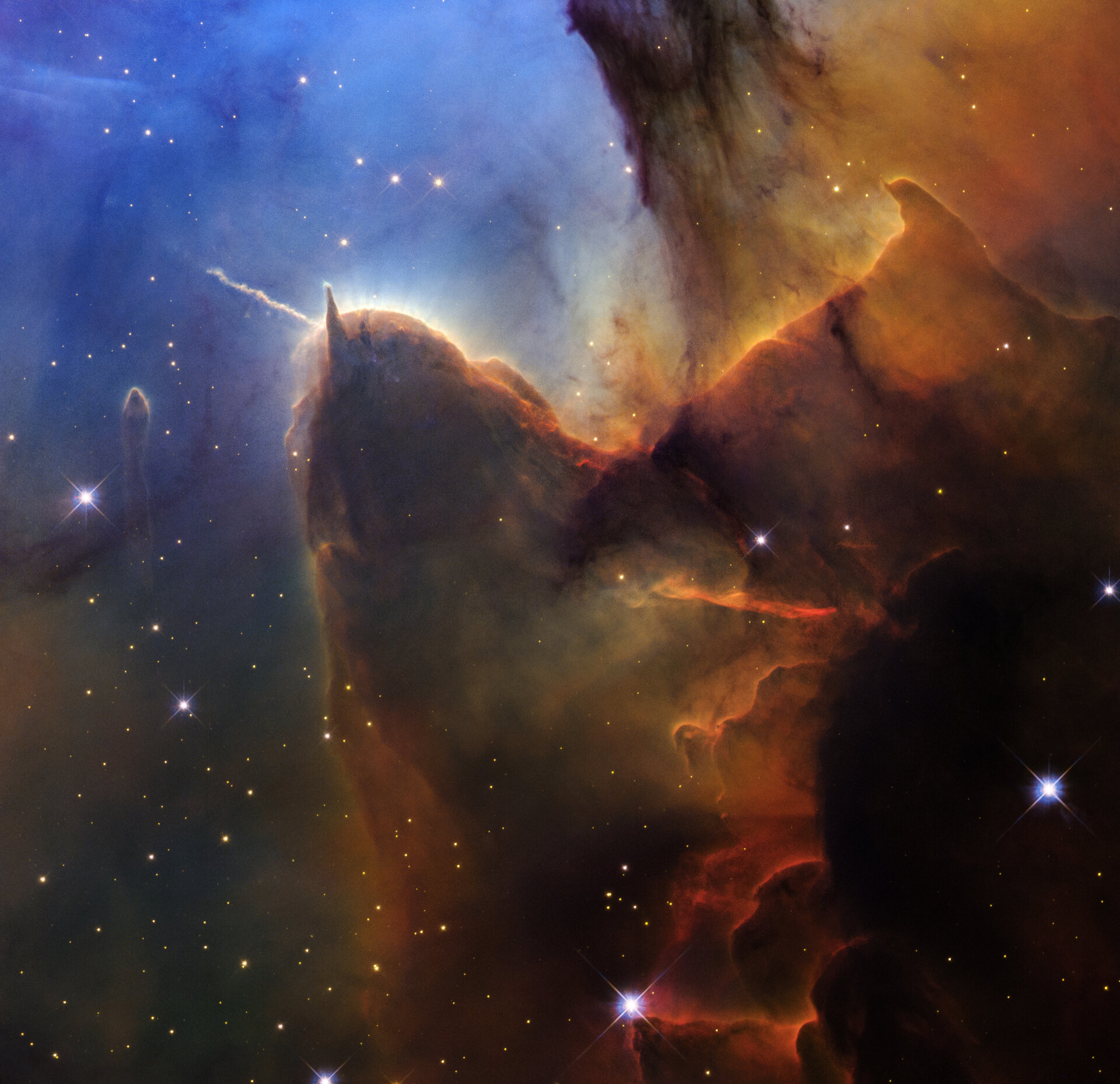

In a remarkable testament to its enduring legacy, the Hubble Space Telescope, a collaborative effort between NASA and the European Space Agency (ESA), has revisited the Trifid Nebula to commemorate its 36th anniversary. Originally photographed in 1997, this iconic star-forming region, located around 5,000 light-years from Earth in the constellation Sagittarius, showcases a breathtaking display of change over relatively brief astronomical timeframes, captivating both scientists and astronomy enthusiasts alike.
The latest images from Hubble reveal vibrant colors that evoke the imagery of a serene underwater scene, complete with shimmering fine particles seemingly drifting through the cosmos. For more than 300,000 years, massive stars located beyond this specific frame have influenced the region, with their fierce ultraviolet winds continuously expanding and shaping a colossal bubble that influences the surrounding gas and dust, igniting new waves of star creation.
This new observation provides a fresh perspective from Hubble’s fourth servicing mission, which upgraded its capabilities with a more advanced camera featuring a broader field of view and enhanced sensitivity. The decision to revisit the Trifid Nebula allows astrophysicists to track dynamic changes and advancements in star formation, decisively linking past and present astronomical contexts.
In the new images, the Trifid Nebula—also known as Messier 20—displays a distinct formation known as the “Cosmic Sea Lemon,” characterized by a curving, rust-hued cloud of gas and dust. Notably, one of its “horns” is associated with Herbig-Haro 399, a recurring jet of plasma released by a young protostar embedded within the nebula. This jet offers unique insights into the energy dynamics of nascent stars and their interaction with the surrounding interstellar medium by allowing researchers to gauge the speeds of these energetic outflows.
Practically speaking, careful observation of this area reveals a myriad of details: a trailing counter jet and remnants of other protostars nestled within the dark tendrils of the nebula. As one examines the image, bright orange dots emerge as stars fully formed, clearing their vicinity of surrounding material, while the darker regions indicate denser dust clouds that could obscure potentially newly created stars.
Hubble’s advanced instruments encompass a broad spectrum of wavelengths from ultraviolet to near-infrared light, enabling researchers to unearth pivotal cosmic discoveries that continue to shape our understanding of the universe. In the past year alone, Hubble has contributed to groundbreaking findings—from tracing the remnants of primordial galaxy formation and documenting faint, nearly invisible galaxies to observing extraterrestrial asteroid collisions and checking the ongoing disintegration of a comet in our own Solar System.
The telescope’s ability to provide stunning imagery of the cosmos shows no signs of waning; it has observed captivating celestial phenomena including the star-forming N11 region and the dramatic Crab Nebula. Since its launch, Hubble has amassed a staggering 1.7 million observations, facilitating nearly 29,000 publications by astronomers, demonstrating its invaluable role in advancing our collective knowledge about the universe.
As Hubble enters the next phase of its operational life, its data continues to serve as an important resource, often in conjunction with the more recent NASA/ESA/CSA James Webb Space Telescope, ensuring that the journey of discovery remains expansive and fruitful.










Related Posts
Stay Informed With the Latest & Most Important News
Previous Post
Next Post


Advertisement
-
 01Two Black Holes Observed Circling Each Other for the First Time
 -
 02From Polymerization-Enabled Folding and Assembly to Chemical Evolution: Key Processes for Emergence of Functional Polymers in the Origin of Life
 -
 03Astronomy 101: From the Sun and Moon to Wormholes and Warp Drive, Key Theories, Discoveries, and Facts about the Universe (The Adams 101 Series)
 -
 04True Anomaly hires former York Space executive as chief operating officer
 -
 05Φsat-2 begins science phase for AI Earth images
 -
 06Hurricane forecasters are losing 3 key satellites ahead of peak storm season − a meteorologist explains why it matters
 -
 07Binary star systems are complex astronomical objects − a new AI approach could pin down their properties quickly