
Now Reading: Atmos Space Cargo raises $30 million for reentry missions
-
01
Atmos Space Cargo raises $30 million for reentry missions


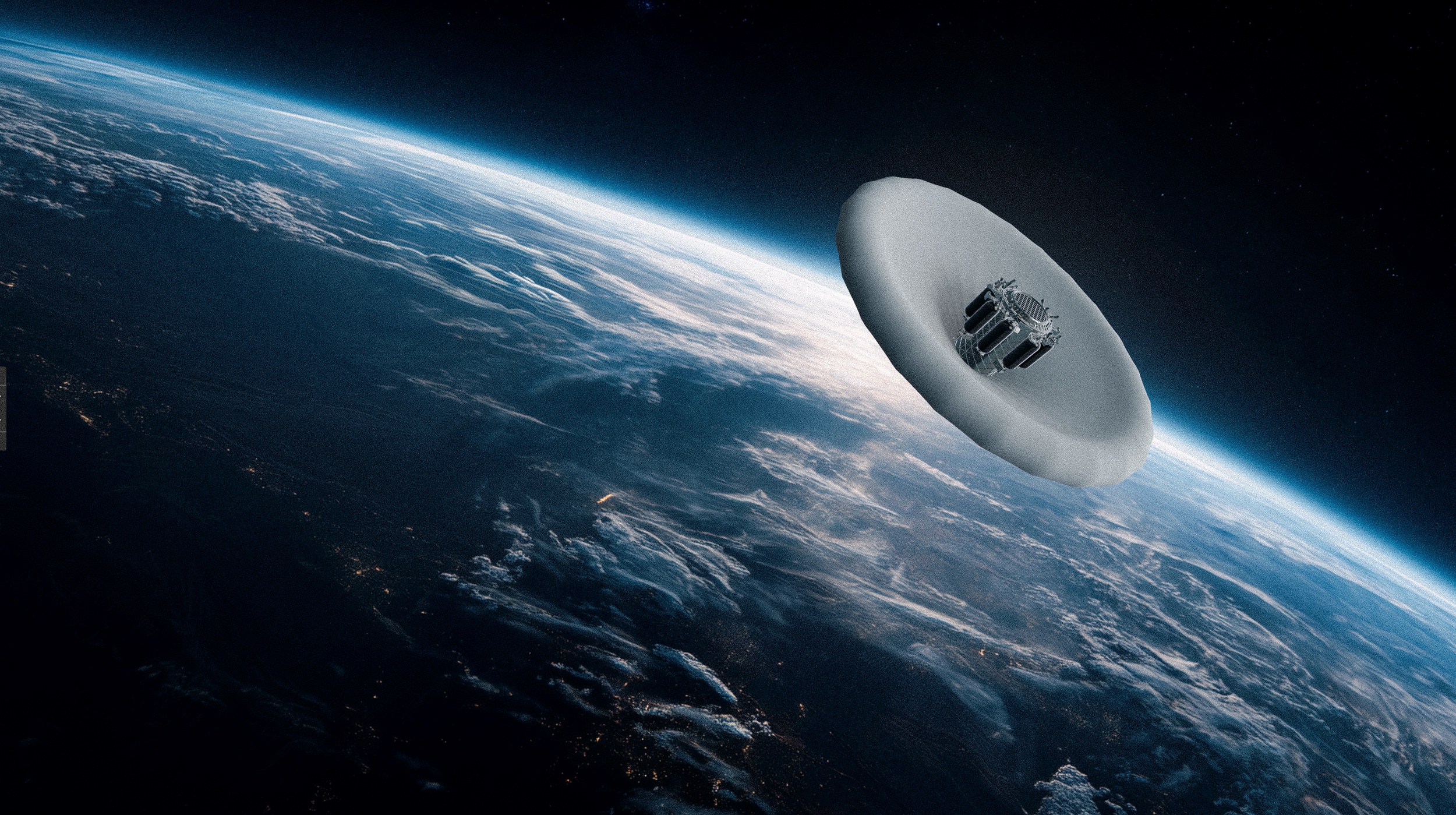

WASHINGTON — Atmos Space Cargo has raised 25.7 million euros ($30.1 million) to fly a series of reentry vehicle missions and work on a larger spacecraft.
The company, with offices in Germany and France, announced April 22 it completed a Series A funding round led by European funds Balnord and Expansion Ventures, with participation from Keen Defence and Security and several other investors. The European Innovation Council also supported the funding round through its Accelerator program, which combined grant and equity financing.
Atmos is developing a line of reentry spacecraft called Phoenix designed to support microgravity research and manufacturing, returning the payloads to Earth with an inflatable heat shield. The company flew its first demonstration mission a year ago, collecting flight data. The company, though, was unable to recover the spacecraft after splashdown because of a change in the flight profile caused by the primary payload on its SpaceX rideshare launch.
The company said it plans to fly three operational missions of its Phoenix 2 spacecraft using the Series A funding. Each Phoenix 2 spacecraft, carrying up to 100 kilograms of payload, is designed to operate in orbit from hours to months. It then reenters, deploying an inflatable heat shield six meters across. The spacecraft will splash down near Santa Maria Island in the Azores.
The company announced March 5 it obtained a reentry license from Portuguese regulators for those reentries. The license is the first from Portugal for the return of a commercial spacecraft to European territory.
The first mission, Phoenix 2.1, is scheduled for the second half of 2026. It will carry Space Cargo Unlimited’s BentoBox microgravity research platform under an agreement between the two companies announced in November 2025.
A company spokesperson said the second mission, Phoenix 2.2, will follow about six months later, with Phoenix 2.3 flying five months after that. Those two missions are partially booked with customers. All three missions will use a mix of SpaceX rideshare launches and European small launchers.
“This financing allows us to move to regular operational service. A structured campaign of three vehicles establishes Europe’s first routine orbital return infrastructure,” Sebastian Klaus, chief executive and co-founder of Atmos Space Cargo, said in a statement. “Phoenix 2 is the first step to build a scalable European return infrastructure that will demonstrate our ability to access, operate and return materials, data and hardware from orbit independently.”
The funding round supports two other initiatives. Atmos plans to start work on a larger reentry vehicle, Phoenix 3. It will be able to carry up to 1,000 kilograms of payload, returning using an inflatable heat shield 15 meters across.
Atmos said it would enable flights of larger payloads and multi-customer missions as well as future institutional and security requirements. A first test flight of the spacecraft is planned for late 2028 or early 2029.
The company also announced Atmos Works, a dedicated business unit focused on European government and defense customers. It will offer Phoenix for missions such as in-orbit demonstration and validation of new technologies as well as secure and sovereign return of sensitive hardware and data.
“With Atmos Works and Phoenix 3, we are building the full architecture — commercial, institutional and defense-capable — in parallel,” Klaus stated.
The government applications of the Phoenix spacecraft were attractive to investors who participated in the Series A round. “Atmos is building exactly the kind of dual-use capability Europe needs more of: sovereign access not only to orbit, but back from orbit,” said Aleksander Dobrzyniecki, general partner at Balnord. “We believe Atmos can become a crucial part of the logistics backbone of a real European space industrial base.”










Related Posts

Stay Informed With the Latest & Most Important News
Previous Post
Next Post




Advertisement
-
 01Two Black Holes Observed Circling Each Other for the First Time
 -
 02From Polymerization-Enabled Folding and Assembly to Chemical Evolution: Key Processes for Emergence of Functional Polymers in the Origin of Life
 -
 03Astronomy 101: From the Sun and Moon to Wormholes and Warp Drive, Key Theories, Discoveries, and Facts about the Universe (The Adams 101 Series)
 -
 04True Anomaly hires former York Space executive as chief operating officer
 -
 05Φsat-2 begins science phase for AI Earth images
 -
 06Hurricane forecasters are losing 3 key satellites ahead of peak storm season − a meteorologist explains why it matters
 -
 07Binary star systems are complex astronomical objects − a new AI approach could pin down their properties quickly