
Now Reading: Interstellar invader comet 3I/ATLAS formed in a world much colder than the solar system
-
01
Interstellar invader comet 3I/ATLAS formed in a world much colder than the solar system

Interstellar invader comet 3I/ATLAS formed in a world much colder than the solar system

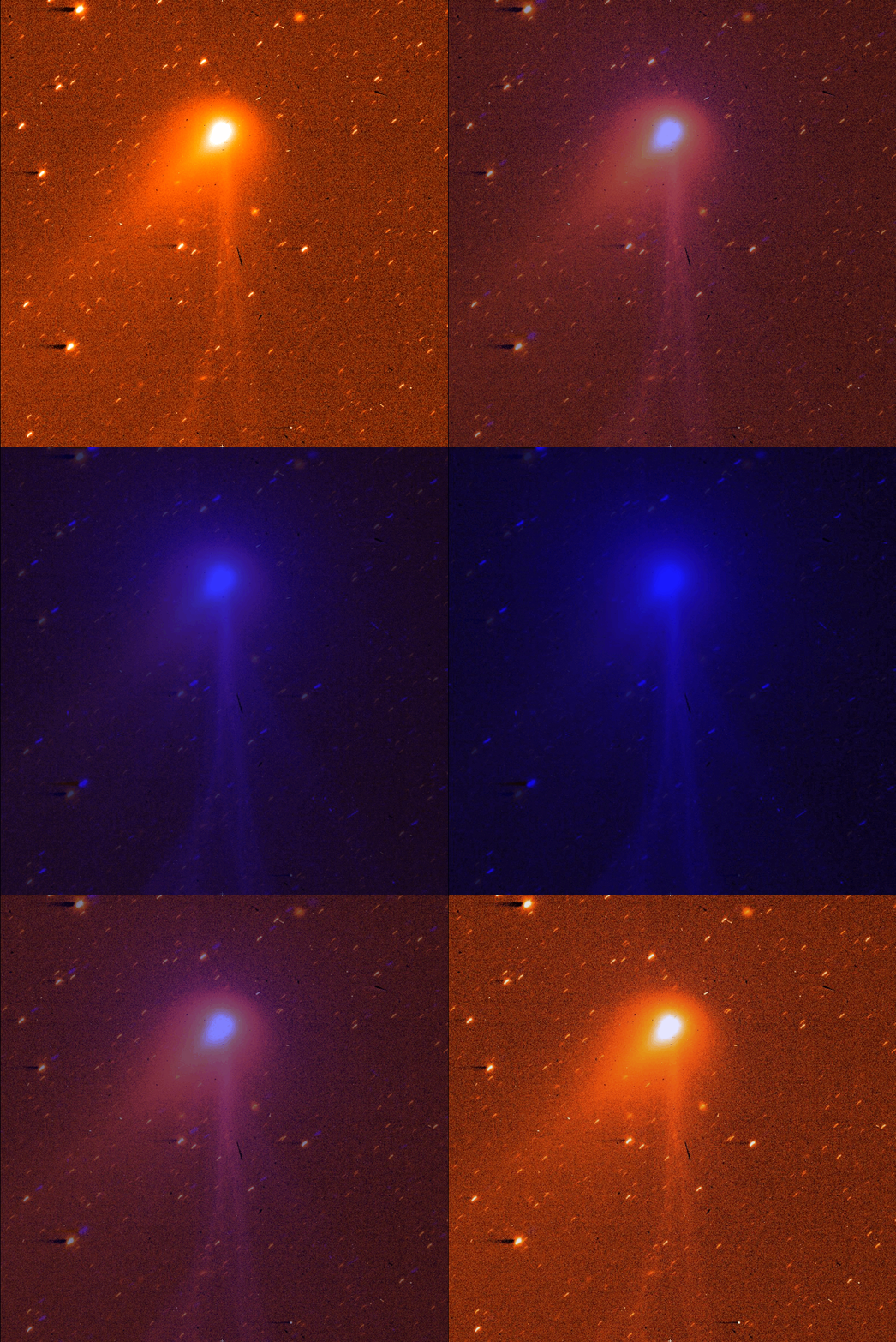
Using the Atacama Large Millimeter/submillimeter Array (ALMA), scientists have discovered that the interstellar invader comet 3I/ATLAS formed in a much colder region of the Milky Way than our solar system.
The discovery came about when scientists made the first-ever measurement of so-called semi-heavy water (or deuterated water) for an object that originated beyond the solar system. Deuterated water refers to water in which one hydrogen atom is replaced with deuterium, a heavy hydrogen isotope that has an atomic nucleus composed of one proton and one neutron. ALMA’s measurements of deuterated water revealed that 3I/ATLAS contains around 30 times as much semi-heavy water as is found in comets that originate in the solar system.
“Our new observations show that the conditions that led to the formation of our solar system are much different from how planetary systems evolved in different parts of our galaxy,” team leader Luis E. Salazar Manzano at the University of Michigan said in a statement.
Manzano and colleagues studied 3I/ATLAS as it reached its closest point to the sun, a feat made possible by the ability of ALMA’s 66 radio antennas to point toward the sun, something optical telescopes can’t do because of the glare of sunlight.
An interstellar snowball
The high water content of comets in the solar system means that they are often referred to as “dirty snowballs.” This water contains a record of the chemistry of the environment in which the comets formed at the time of their birth, which for comets in our solar system was around 4.6 billion years ago, when planets were also forming around the infant sun.
Comets don’t just contain ordinary water composed of two hydrogen atoms with nuclei composed of just one proton bonded to an oxygen atom — they also contain molecules of deuterated water. In the comets of the solar system, one molecule of deuterated water exists for every 10,000 molecules of ordinary water, but the ratio of semi-heavy water to water is 30 times greater for 3I/ATLAS than this. This is, in turn, 40 times greater than the same ratio in the oceans of Earth.
This elevated ratio points to 3I/ATLAS having formed in an exceptionally cold and chemically distinct environment somewhere else in the Milky Way.
“The chemical processes that lead to the enhancement of deuterated water are really sensitive to temperature and usually require environments colder than about 30 Kelvin, or about minus 406 degrees Fahrenheit [207 degrees Celsius],” Manzano said.
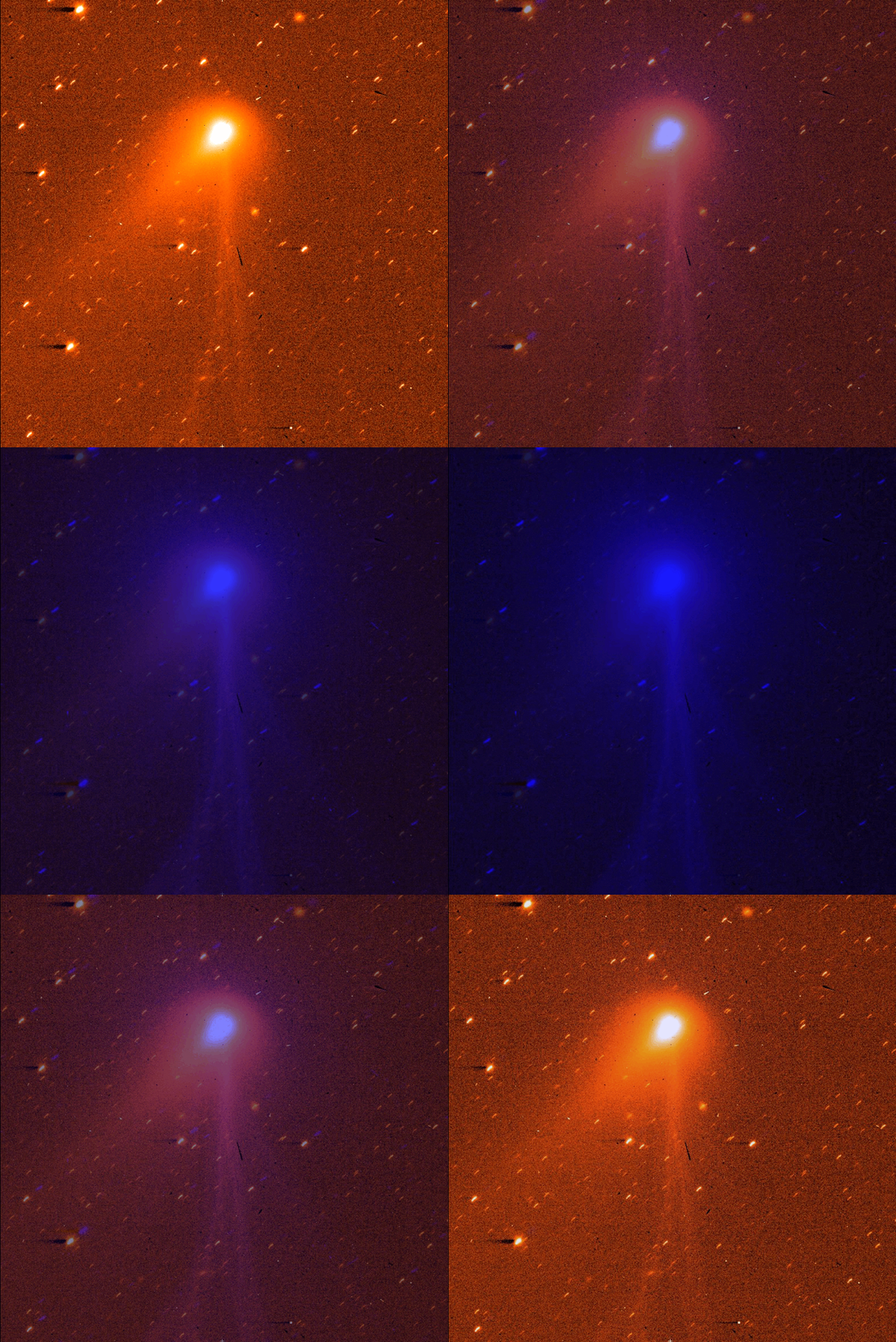
The ratio acts as a record of the chemical environment of 3I/ATLAS’ home system, having remained intact throughout the interstellar invader’s long journey to the solar system. The ratio is also an important one because abundances of deuterium and hydrogen throughout the universe are thought to have been set during the Big Bang itself.
“Each interstellar comet brings a little bit of its history, its fossils, from elsewhere,” team member Teresa Paneque-Carreño of the University of Michigan said. “We don’t know exactly where, but with instruments like ALMA, we can begin to understand the conditions of that place and compare them to our own.”
The team’s research was published on Thursday (April 23) in the journal Nature Astronomy.










Related Posts
Stay Informed With the Latest & Most Important News
Previous Post
Next Post

Advertisement
-
 01Two Black Holes Observed Circling Each Other for the First Time
 -
 02From Polymerization-Enabled Folding and Assembly to Chemical Evolution: Key Processes for Emergence of Functional Polymers in the Origin of Life
 -
 03Astronomy 101: From the Sun and Moon to Wormholes and Warp Drive, Key Theories, Discoveries, and Facts about the Universe (The Adams 101 Series)
 -
 04True Anomaly hires former York Space executive as chief operating officer
 -
 05Φsat-2 begins science phase for AI Earth images
 -
 06Hurricane forecasters are losing 3 key satellites ahead of peak storm season − a meteorologist explains why it matters
 -
 07Binary star systems are complex astronomical objects − a new AI approach could pin down their properties quickly