
Now Reading: Stellar Flare-driven Evolution Of Primordial Early Exo-Earth Atmospheres: Insights From A Young M Dwarf Flare Model
-
01
Stellar Flare-driven Evolution Of Primordial Early Exo-Earth Atmospheres: Insights From A Young M Dwarf Flare Model

Stellar Flare-driven Evolution Of Primordial Early Exo-Earth Atmospheres: Insights From A Young M Dwarf Flare Model

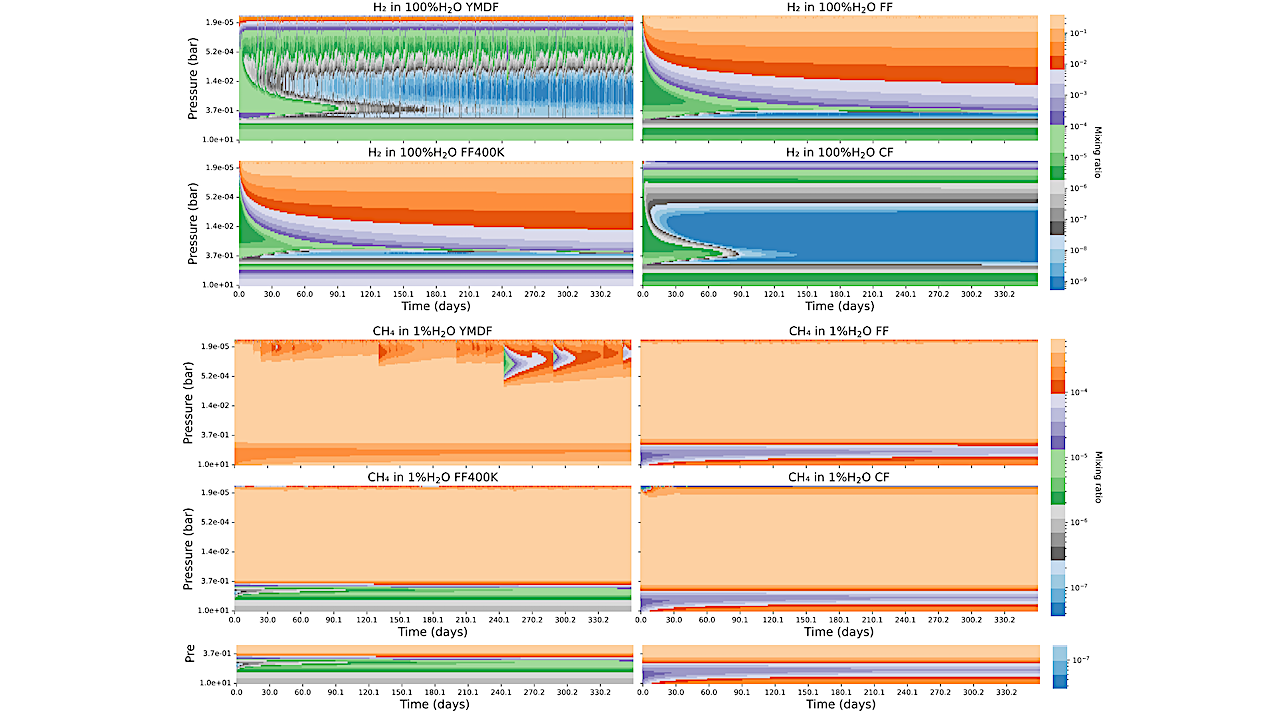
[TOP] Time evolution of H2 mixing ratio for an atmosphere with 100% H2O. The heatmaps display vertical profiles over the 360-day simulation duration, with pressure (in bars) on the y-axis and time (in days) on the x-axis. The upper row shows results from the YMDF and FF models, while the bottom row corresponds to the FF 400 K and the CF model, as indicated on the panels. [BOTTOM] Heatmaps of CH4 mixing ratio in the atmosphere with 1% H2O over the 360-day simulation period for an atmosphere containing 100% water vapour analogous to the previous Fig. 8 — astro-ph.EP
Context. M dwarfs are key targets for terrestrial exoplanet studies, with prospects for atmospheric spectroscopy. However, strong stellar magnetic activity and frequent flaring require modelling efforts to assess their impact on planetary atmospheres.
Aims. We aim to investigate one year of atmospheric chemical evolution of a young exo Earth orbiting an active M dwarf by coupling our Young M Dwarfs Flare (YMDF) model of stellar activity with the VULCAN chemistry kinetic code.
Methods. The YMDF model provides time-resolved spectral energy distributions for high- and low-energy electron beam-driven flares, which are used as external radiative inputs to VULCAN to compute the time-dependent photochemistry and kinetics for different primordial atmospheric scenarios.
Results. We present the impact of stellar flares on atmospheres with varying water vapour content, ranging from a plausible primordial atmosphere with solar abundances, representative of a planet-forming region in a dissipating protoplanetary disk, to an extreme water-steam atmosphere with minimal other species. This was explored across several configurations: variable flux in the YMDF model, the previous model representing an active but older M dwarf with added 10K or 400K bottom boundary heat flux, and a constant stellar flux model.
Conclusions. Our study suggests that, compared to the previous model, the YMDF model produces synthetic flares that exert significantly greater stress on primordial atmospheres, regardless of the water-vapour content. Increased activity and prevalence of mid-size flares have the potential to induce permanent changes in atmospheric mixing ratios, especially in species with low abundances.
E. Mamonova, K. Herbst, V. Kofman, O. Ozgurel, A. F. Kowalski, S. Wedemeyer, S. C. Werner
Subjects: Earth and Planetary Astrophysics (astro-ph.EP); Solar and Stellar Astrophysics (astro-ph.SR)
Cite as: arXiv:2604.20325 [astro-ph.EP] (or arXiv:2604.20325v1 [astro-ph.EP] for this version)
https://doi.org/10.48550/arXiv.2604.20325
Focus to learn more
Submission history
From: Elena Mamonova
[v1] Wed, 22 Apr 2026 08:21:05 UTC (3,944 KB)
https://arxiv.org/abs/2604.20325
Astrobiology,










Related Posts
Stay Informed With the Latest & Most Important News
Previous Post
Next Post




Advertisement
-
 01Two Black Holes Observed Circling Each Other for the First Time
 -
 02From Polymerization-Enabled Folding and Assembly to Chemical Evolution: Key Processes for Emergence of Functional Polymers in the Origin of Life
 -
 03Astronomy 101: From the Sun and Moon to Wormholes and Warp Drive, Key Theories, Discoveries, and Facts about the Universe (The Adams 101 Series)
 -
 04True Anomaly hires former York Space executive as chief operating officer
 -
 05Φsat-2 begins science phase for AI Earth images
 -
 06Hurricane forecasters are losing 3 key satellites ahead of peak storm season − a meteorologist explains why it matters
 -
 07Binary star systems are complex astronomical objects − a new AI approach could pin down their properties quickly