
Now Reading: Beyond The Mass-radius Plane: Integrated Radiative-convective And Interior Structure Simulations Of The Exoplanet Continuum
-
01
Beyond The Mass-radius Plane: Integrated Radiative-convective And Interior Structure Simulations Of The Exoplanet Continuum

Beyond The Mass-radius Plane: Integrated Radiative-convective And Interior Structure Simulations Of The Exoplanet Continuum

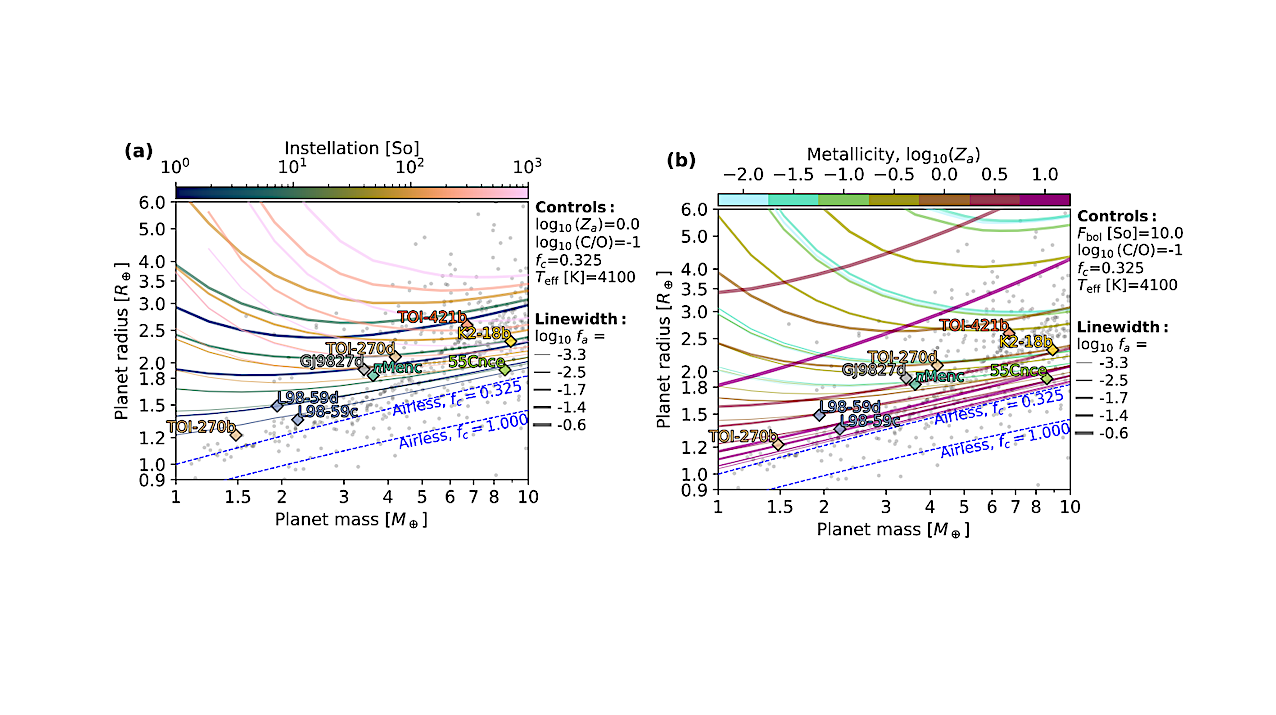
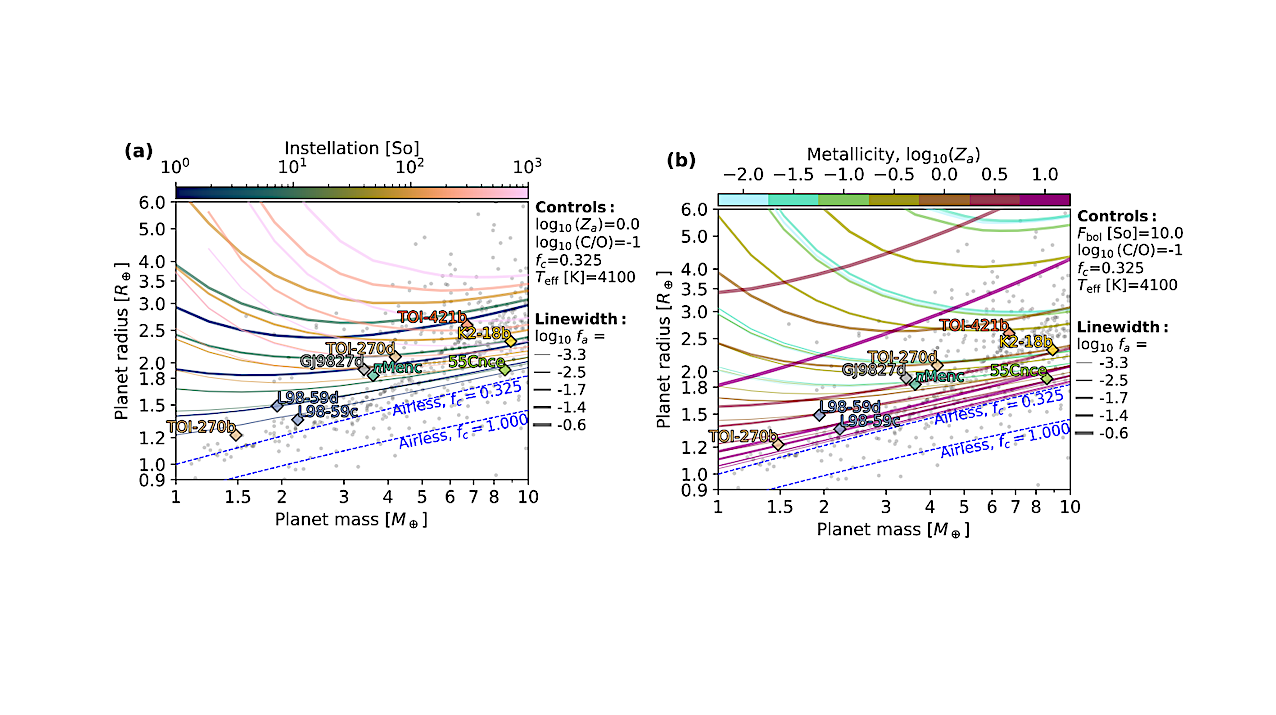
Isolines of planet radius versus mass, extracting cross-sections from our grid of models by holding other variables constant (top-right text box). Top (a): sensitivity to instellation (colour) and atmosphere mass fraction 𝑓𝑎 (line width, five values). Bottom (b): sensitivity to atmospheric metallicity log10 𝑍𝑎 (colour) and 𝑓𝑎 (line width, five values). For visualisation, only five sets of secondary variables (line widths) are shown. Dashed blue lines show airless cases with different core sizes (Zeng et al. 2019). — astro-ph.EP)
Static structure models, which map mass-radius constraints to bulk planet composition, are frequently used to categorise exoplanets due to their computational efficiency and the high-level insight they offer into planetary properties.
However, static structure models typically have simplified atmospheric treatments, which may introduce systematic biases when interpreting the structures — and therefore the climates — of sub-Neptunes and this http URL present a framework for recovering exoplanet properties using static structure models that accounts for necessary physical-chemical complexity in their atmospheres.
We produce a comprehensive library of 504,000 exoplanet simulations that unify deep planetary interior structure with radiative-convective-chemical climate calculations. From these models we demonstrate that a planet’s envelope mass fraction — a critical parameter to infer — is frequently degenerate with its instellation flux and atmospheric metallicity, and sensitive to the treatment of gravitational acceleration at the mbar level.
Such uncertainties have significant implications for inferring planetary processes, as our modelling shows that habitable-zone sub-Neptunes readily host supercritical surfaces or deep magma oceans, despite their temperate irradiation regime. To marginalise over these uncertainties, we introduce a Bayesian retrieval tool that uses our library of self-consistent models.
By applying this Bayesian approach to case-studies of Pi Men c and TOI-421 b, we show that robust physical interpretations are achievable through whole-planet mass-radius retrievals.
While new data from JWST, Ariel, and PLATO will expand our observational horizon, physically-consistent modelling provides the means to transition from categorical interpretations toward a comprehensive picture of the exoplanet continuum.
Harrison Nicholls, Oliver Shorttle, Tim Lichtenberg, Flavia Pascal
Comments: 20 pages and 11 figures. In review at MNRAS. Comments welcome
Subjects: Earth and Planetary Astrophysics (astro-ph.EP)
Cite as: arXiv:2604.15891 [astro-ph.EP](or arXiv:2604.15891v1 [astro-ph.EP] for this version)
https://doi.org/10.48550/arXiv.2604.15891
Focus to learn more
Submission history
From: Harrison Nicholls
[v1] Fri, 17 Apr 2026 09:41:13 UTC (2,589 KB)
https://arxiv.org/abs/2604.15891
Astrobiology, Exoplanet,










Related Posts

Stay Informed With the Latest & Most Important News





Advertisement
-
 01Two Black Holes Observed Circling Each Other for the First Time
 -
 02From Polymerization-Enabled Folding and Assembly to Chemical Evolution: Key Processes for Emergence of Functional Polymers in the Origin of Life
 -
 03Astronomy 101: From the Sun and Moon to Wormholes and Warp Drive, Key Theories, Discoveries, and Facts about the Universe (The Adams 101 Series)
 -
 04True Anomaly hires former York Space executive as chief operating officer
 -
 05Φsat-2 begins science phase for AI Earth images
 -
 06Hurricane forecasters are losing 3 key satellites ahead of peak storm season − a meteorologist explains why it matters
 -
 07Binary star systems are complex astronomical objects − a new AI approach could pin down their properties quickly