
Now Reading: Inversion of Hydrogen-rich Atmosphere and Water Content for GJ 486b
-
01
Inversion of Hydrogen-rich Atmosphere and Water Content for GJ 486b


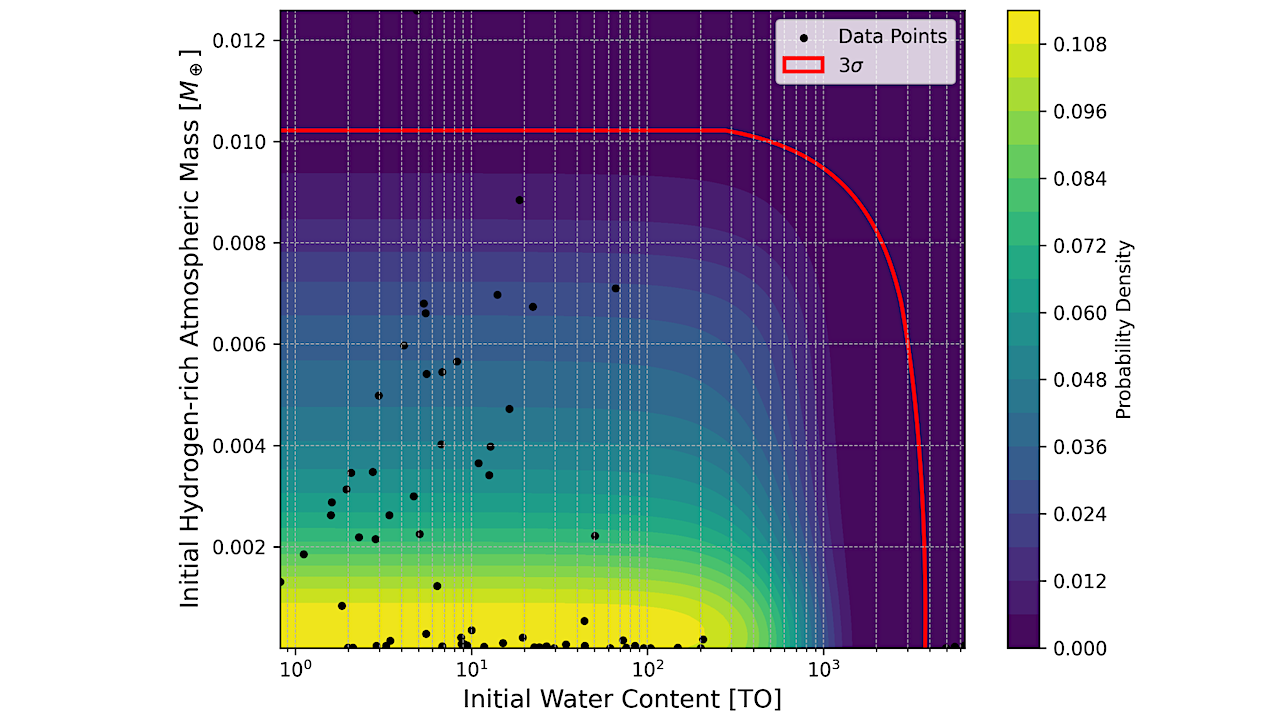
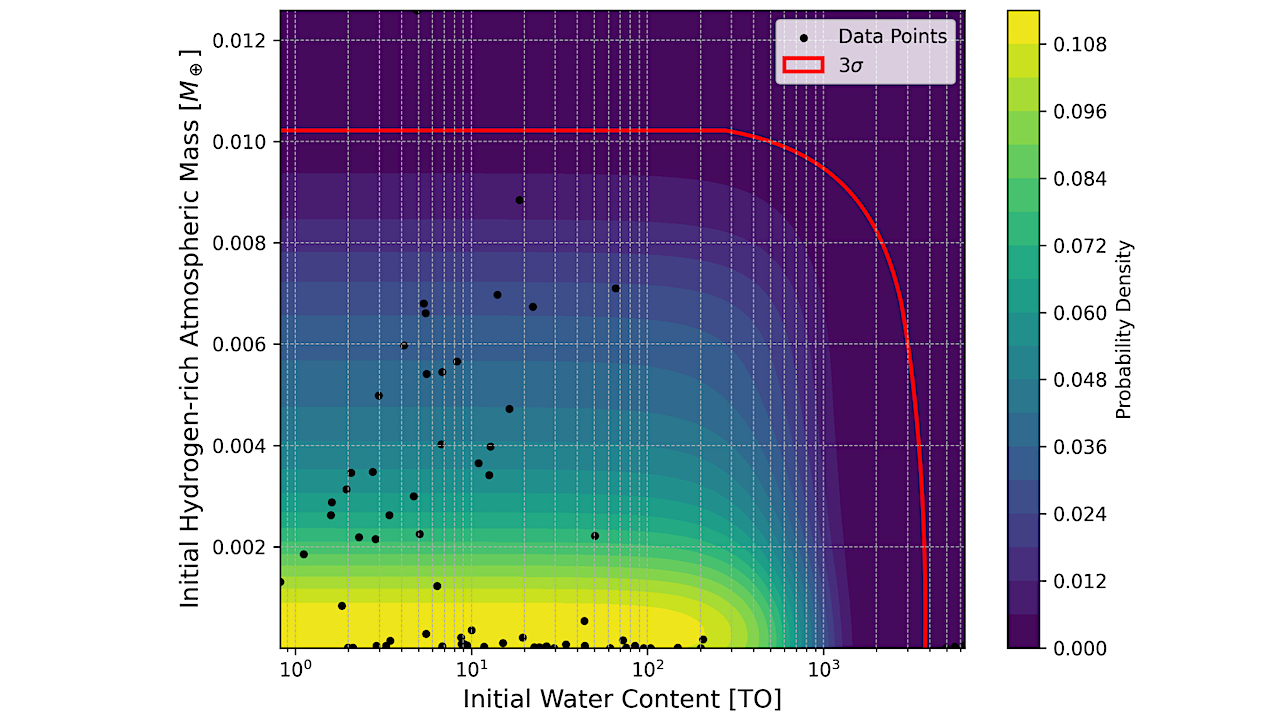
Black points are the sample of the planetary formation dataset provided by Kimura & Ikoma (2022) in the phase space of ∆a = 0.005AU, ∆Mp = 0.5M⊕. Two-dimensional probability density distribution of the initial water content and hydrogen-rich atmospheric mass for GJ 486b analogs, constructed using Gaussian kernel density estimation (KDE). The water content axis is sampled logarithmically and the atmospheric mass axis is sampled linearly to properly account for the dynamic range of the variables. The red overlaid ellipse represents the 3σ confidence region derived from the covariance matrix, indicating the principal dispersion of the sample distribution. — astro-ph.EP
GJ-486b is a close-in planet orbiting an M dwarf and is therefore expected to have undergone strong atmospheric escape. Motivated by theoretical and observational studies on the constraints of its water and atmosphere, we investigate which combinations of an primordial hydrogen-rich atmosphere and water inventory could fit the current water content implied by bulk density measurements.
We model the atmosphere escape using VPLanet, following the loss of an initial hydrogen-rich atmosphere and the subsequent escape of a water-dominated atmosphere. By scanning a broad parameter space across different stellar ages, we invert for the initial hydrogen-rich atmospheric mass and water inventory consistent with the current constraints.
Our results reveal a strong degeneracy between the water reservoir and the initial hydrogen-rich atmosphere. Even a modest hydrogen-rich atmosphere can significantly delay early escape of the water and reduce the water inventory required to reproduce the current water content. We also find that the inferred initial conditions are also strongly age dependent.
Incorporating a planet formation dataset as a prior, we derive a probabilistic constraint on the host star age, yielding an expected age of 2.90+2.47−2.27~Gyr, which is consistent with the results obtained from other methods to determine M dwarf ages.
Junda Zhou, Zhenyang Huang, Di-Chang Chen, Jianheng Guo
Comments: 21 pages, 15 figures; accepted for publication in The Astrophysical Journal
Subjects: Earth and Planetary Astrophysics (astro-ph.EP)
Cite as: arXiv:2604.11079 [astro-ph.EP] (or arXiv:2604.11079v1 [astro-ph.EP] for this version)
https://doi.org/10.48550/arXiv.2604.11079
Focus to learn more
Submission history
From: Zhenyang Huang
[v1] Mon, 13 Apr 2026 06:59:09 UTC (3,537 KB)
https://arxiv.org/abs/2604.11079
Astrobiology, exoplanet,










Related Posts
Stay Informed With the Latest & Most Important News




Advertisement
-
 01Two Black Holes Observed Circling Each Other for the First Time
 -
 02From Polymerization-Enabled Folding and Assembly to Chemical Evolution: Key Processes for Emergence of Functional Polymers in the Origin of Life
 -
 03Astronomy 101: From the Sun and Moon to Wormholes and Warp Drive, Key Theories, Discoveries, and Facts about the Universe (The Adams 101 Series)
 -
 04True Anomaly hires former York Space executive as chief operating officer
 -
 05Φsat-2 begins science phase for AI Earth images
 -
 06Hurricane forecasters are losing 3 key satellites ahead of peak storm season − a meteorologist explains why it matters
 -
 07Binary star systems are complex astronomical objects − a new AI approach could pin down their properties quickly