
Now Reading: Coupled Orbital And Interior Structure Evolution Of Lava Planets
-
01
Coupled Orbital And Interior Structure Evolution Of Lava Planets


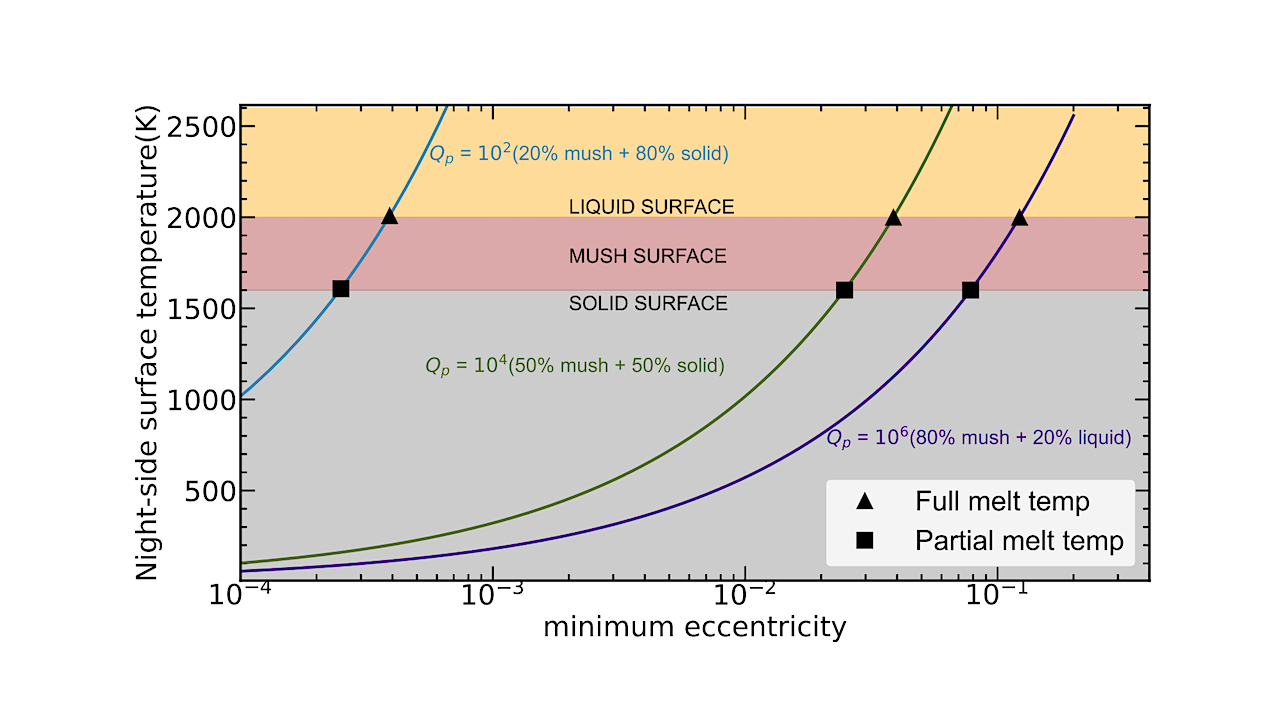
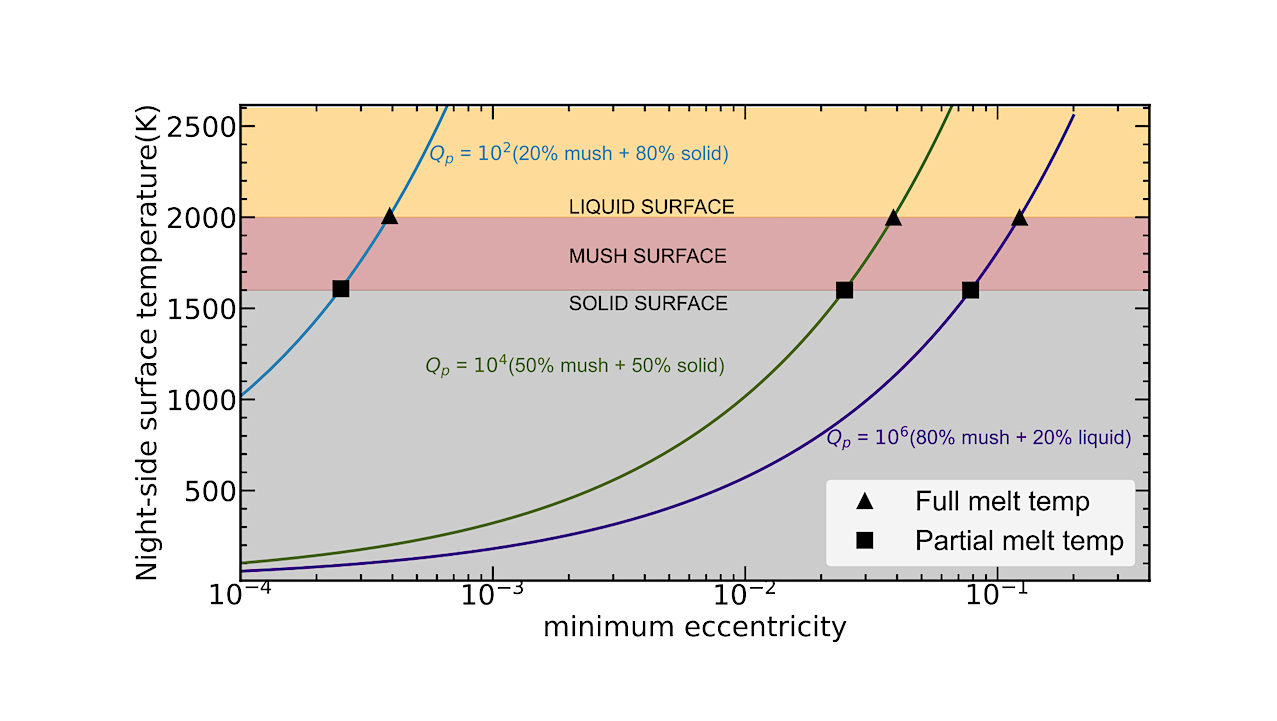
The night-side surface temperatures for different minimum eccentricities for K2-141b, at its present day orbit. The three lines in blue, green and indigo represent three types of mantle mixtures where the global quality factor Qp for each was calculated following the method outlined in Section 2.1. The x-axis gives a spread of possible minimum eccentricities at the current orbit. The y-axis gives the resulting night-side surface temperatures if tidal dissipation is the only source of heat. The compositions are the same mixtures as those used in Figure 2. The grey, brown and orange horizontal layers show the different states of the mantle at the night-side surface (respectively, solid, mush and liquid) as a function of its temperature. — astro-ph.EP
Lava planets likely did not form in their current orbits, instead migrating inward via orbital decay, which influenced the evolution of their magma oceans.
We introduce a coupled thermal-orbital evolution model to explore how rocky planets migrate from the inner edge of the protoplanetary disk, with periods of 1-10 days, to orbital periods of less than a day.
In our model, mantle melting is controlled by tidal heating and stellar flux, while orbits evolve via tidal migration. The mantle’s tidal quality factor varies with its temperature and structure, creating a feedback loop between thermal evolution and orbital decay.
We use our numerical model to simulate the migration of seven known lava planets: K2-141b, K2-360b, TOI-141b, TOI-431b, TOI-2431b, HD 3167b and GJ 367b. Migration occurs in two stages: an initial high-eccentricity stage reducing the semi-major axis by a factor of ∼2, followed by a low-eccentricity stage reducing it by a factor of ∼5. A successful migration from ∼0.1 AU to a present-day orbit requires starting eccentricities ≥0.9 and sustained eccentricity forcing with emin≥10−2.
The rate of migration depends on the state of the mantle: slow when mostly molten, fast when mostly solid. This pathway works for most lava planets, but not for TOI-431b or GJ-367b, suggesting that multiple migration pathways are possible for lava planets.
Mahesh Herath, Nicolas B. Cowan, Charles-Édouard Boukaré, Mathieu Dumberry
Subjects: Earth and Planetary Astrophysics (astro-ph.EP)
Cite as: arXiv:2604.18682 [astro-ph.EP] (or arXiv:2604.18682v1 [astro-ph.EP] for this version)
https://doi.org/10.48550/arXiv.2604.18682
Focus to learn more
Submission history
From: Mahesh Herath
[v1] Mon, 20 Apr 2026 18:00:02 UTC (5,509 KB)
https://arxiv.org/abs/2604.18682
Astrobiology,










Related Posts
Stay Informed With the Latest & Most Important News
Previous Post
Next Post



Advertisement
-
 01Two Black Holes Observed Circling Each Other for the First Time
 -
 02From Polymerization-Enabled Folding and Assembly to Chemical Evolution: Key Processes for Emergence of Functional Polymers in the Origin of Life
 -
 03Astronomy 101: From the Sun and Moon to Wormholes and Warp Drive, Key Theories, Discoveries, and Facts about the Universe (The Adams 101 Series)
 -
 04True Anomaly hires former York Space executive as chief operating officer
 -
 05Φsat-2 begins science phase for AI Earth images
 -
 06Hurricane forecasters are losing 3 key satellites ahead of peak storm season − a meteorologist explains why it matters
 -
 07Binary star systems are complex astronomical objects − a new AI approach could pin down their properties quickly