
Now Reading: Toward Inferring the Surface Fluxes of Biosignature Gases on Rocky Exoplanets from Telescope Spectra
-
01
Toward Inferring the Surface Fluxes of Biosignature Gases on Rocky Exoplanets from Telescope Spectra

Toward Inferring the Surface Fluxes of Biosignature Gases on Rocky Exoplanets from Telescope Spectra

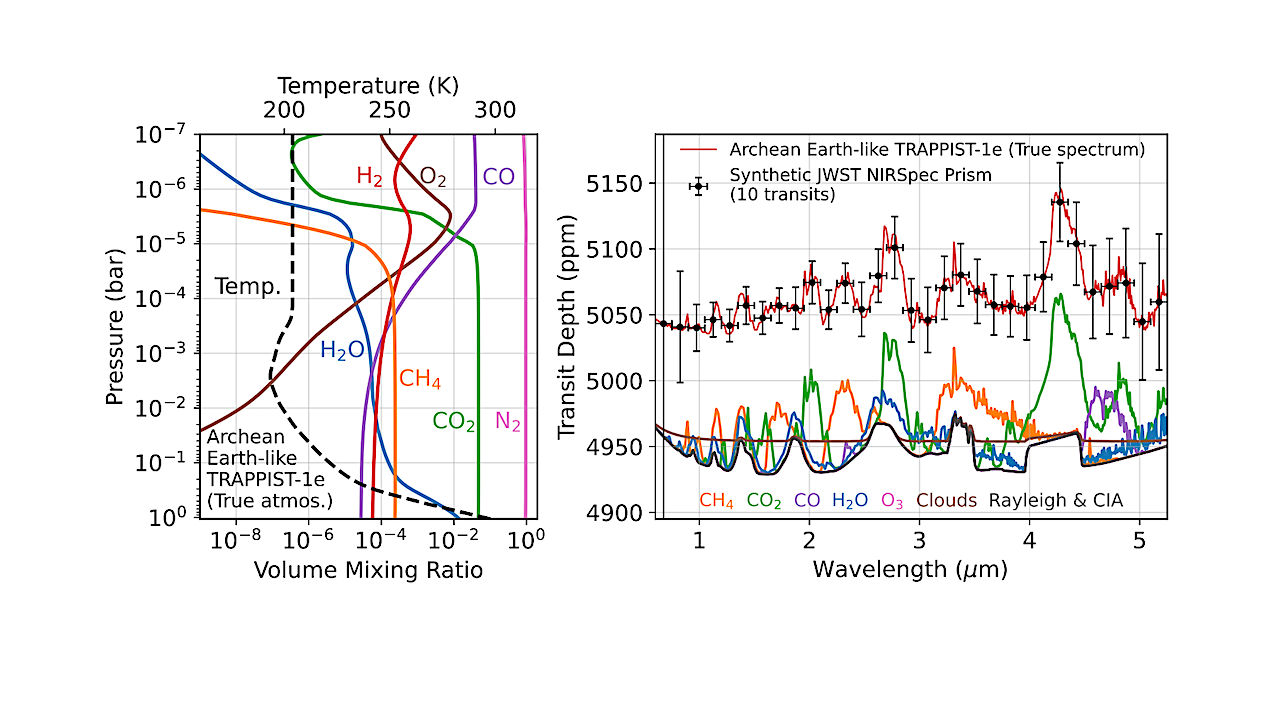
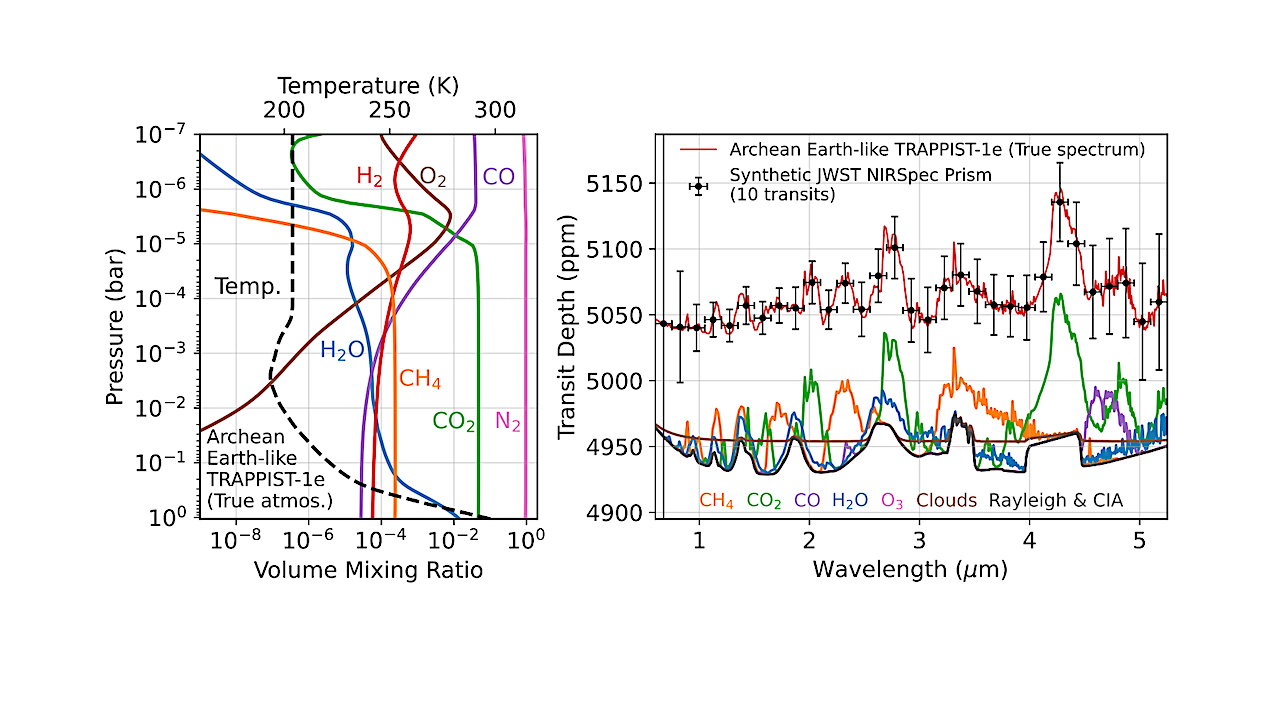
A simulated Archean Earth-like TRAPPIST-1 e, to which we apply our novel retrieval algorithm. Left: The modeled temperature profile (black dashed line) and mixing ratio profiles (solid color lines) of main atmospheric species for an Archean Earth-like TRAPPIST-1 e. The simulation has a biological CH4 flux equal to the modern Earth’s resulting in a 234 ppmv surface abundance. Right: The transmission spectrum of the Archean Earth-like atmosphere (red line). The data points are a synthetic NIRSpec Prism spectrum for 10 transits computed with PandExo assuming no stellar contamination. The colored lines below the data indicate the spectral contribution of various molecules, clouds, Rayleigh scattering, and CIA, all shifted downward for visual clarity. — astro-ph.EP
The James Webb Space Telescope and the future Habitable Worlds Observatory aim to discover exoplanet atmospheric spectra that detect life. Currently, most existing spectral “retrieval” algorithms focus on inferring the abundances of biogenic gases from these spectra.
However, abundances are hard to interpret as signatures of life because they are modified by photochemistry, climate, and atmospheric escape. To address this problem, we develop a method for inferring the fluxes of gases at a planetary surface by inverting a coupled photochemical-climate model.
As a proof-of-concept, we apply the approach to a synthetic 10-transit JWST NIRSpec Prism spectrum of TRAPPIST-1 e assuming it hosts a biosphere similar to the Archean Earth’s. The retrieval confidently detects CO2 and CH4 and can constrain the flux of CH4 into the atmosphere to within approximately 1.5 orders of magnitude (68% credible interval) provided that TRAPPIST-1’s near-UV spectrum is accurately known.
We demonstrate how inferred surface gas fluxes naturally fold into a probabilistic assessment of life, finding that ~ 80% of the surface gas flux posterior is consistent with a CH4-producing metabolism for our nominal test case. As with any inverse problem, these results are conditional on a number of assumptions in our forward model.
Overall, we argue that increasing the robustness of life detection on exoplanets requires moving beyond atmospheric abundances toward inference of the surface fluxes that sustain them.
Nicholas F. Wogan, Natasha E. Batalha, Joshua Krissansen-Totton, Kevin Zahnle, Victoria S. Meadows, Amber V. Young, Evan L. Sneed, Edward W. Schwieterman
Comments: resubmitted to ApJ with minor revisions
Subjects: Earth and Planetary Astrophysics (astro-ph.EP)
Cite as: arXiv:2604.21848 [astro-ph.EP] (or arXiv:2604.21848v1 [astro-ph.EP] for this version)
https://doi.org/10.48550/arXiv.2604.21848
Focus to learn more
Submission history
From: Nicholas Wogan
[v1] Thu, 23 Apr 2026 16:39:40 UTC (1,254 KB)
https://arxiv.org/abs/2604.21848
Astrobiology,










Related Posts
Stay Informed With the Latest & Most Important News
Previous Post
Next Post




Advertisement
-
 01Two Black Holes Observed Circling Each Other for the First Time
 -
 02From Polymerization-Enabled Folding and Assembly to Chemical Evolution: Key Processes for Emergence of Functional Polymers in the Origin of Life
 -
 03Astronomy 101: From the Sun and Moon to Wormholes and Warp Drive, Key Theories, Discoveries, and Facts about the Universe (The Adams 101 Series)
 -
 04True Anomaly hires former York Space executive as chief operating officer
 -
 05Φsat-2 begins science phase for AI Earth images
 -
 06Hurricane forecasters are losing 3 key satellites ahead of peak storm season − a meteorologist explains why it matters
 -
 07Binary star systems are complex astronomical objects − a new AI approach could pin down their properties quickly