
Now Reading: MINDS: Intertwined Evolution Of Dust And Gas In Large Planet-forming Disks. A Diversity Driven By Halted Pebble Drift?
-
01
MINDS: Intertwined Evolution Of Dust And Gas In Large Planet-forming Disks. A Diversity Driven By Halted Pebble Drift?

MINDS: Intertwined Evolution Of Dust And Gas In Large Planet-forming Disks. A Diversity Driven By Halted Pebble Drift?

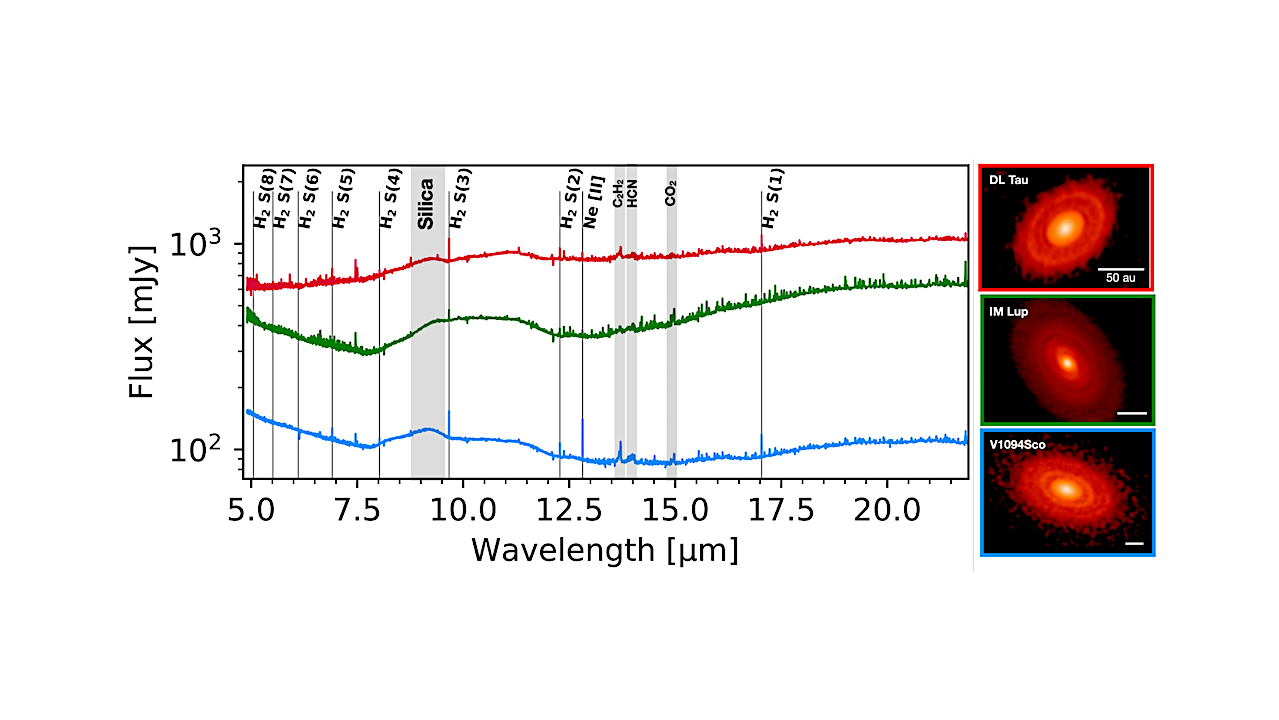
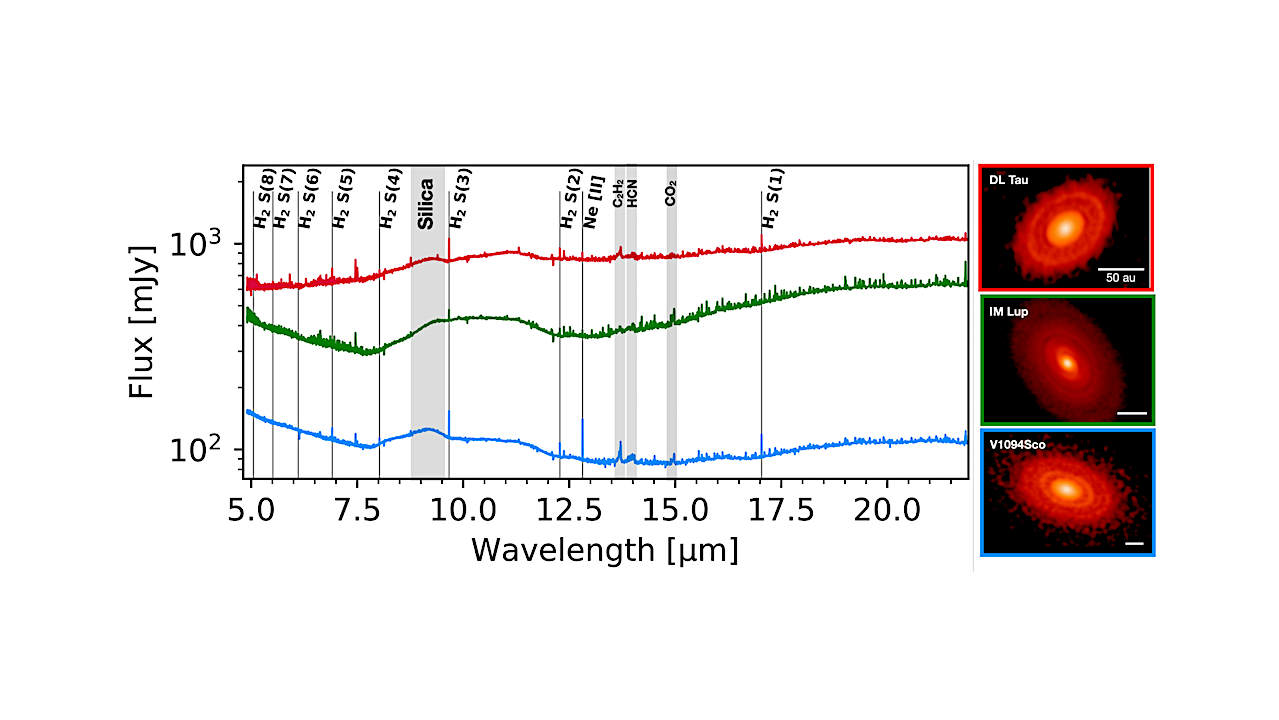
Overview of the MIRI-MRS spectra of the three T Tauri disks along with ALMA views of their dust emission for illustrative purposes. The mid-IR emission is dominated by a dust continuum with particularly flat silicate features in DL Tau and V1094 Sco, revealing large micron-sized grains with a prominent silica feature. The 13-16 µm region shows a wealth of molecular features with a prominent C2H2, HCN, and CO2 features outlined in Fig. 2. In addition the pure rotational lines of H2 and the Ne [II] line are seen in all three disks. — astro-ph.EP
(Abridged) We aim to investigate the inner regions of large and massive disks orbiting T Tauri stars, thought to be progenitors of systems with wide-orbit planets and possible cases of halted pebble drift.
We analyze the MIRI spectra of three disks from the MINDS program: V1094 Sco, DL Tau, and IM Lup. The spectra reveal a striking diversity. V1094 Sco and DL Tau exhibit the highest C2H2/H2O flux ratio in the MINDS sample of T Tauri disks. In V1094 Sco, even cold C4H2 is seen. In contrast, the IM Lup spectrum is dominated by O-bearing species. No one-to-one correspondence is found between the gas in the outer disk, as traced by the C2H/C18O flux ratio, and that of the inner disk as traced by the C2H2/H2O flux ratio.
To explain these results, we propose a scenario based on a toy model of halted pebble drift. We show that a volatile C/O ratio close to unity and low C and O abundances in inner disks arise only if: (1) ~95% of the icy grains are blocked in the outer disk, (2) the outer disk is chemically evolved, and (3) the gas in the outer disk has had time to reach the inner disk. DL Tau and perhaps V1094 Sco would be the rare examples for which all these conditions are met.
Therefore, a high C2H2/H2O flux ratio in pebble-rich disks would have a different origin than proposed for very-low mass stars, for which fast drift of O-rich pebbles would eventually leave a C-rich inner disk. We also show for the first time that the disks with high C2H2/H2O flux ratio exhibit a prominent silica dust component, a result found in four disks published so far (V1094 Sco, DL Tau, CY Tau, DoAr 33).
We propose that the reformation of dust at the sublimation front of silicates in a gas with super-solar (but below unity) C/O ratio leads to a silica stoichiometry (SiO2). In turn, silica is a promising diagnostic of the C/O ratio in the inner disks.
Benoît Tabone, Milou Temmink, Laurens B. F. M. Waters, Ewine F. van Dishoeck, Andrew Sellek, Pacôme Estève, Nicolas T. Kurtovic, Inga Kamp, Thomas Henning, Danny Gasman, Sierra L. Grant, József Varga, Alice Guerras, Dmitry Semenov, Aditya M. Arabhavi, Alessio Caratti o Garatti, Anne Dutrey, Edwige Chapillon, Stéphane Guilloteau, Manuel Güdel, Hyerin Jang, Till Kaeufer, Jayatee Kanwar, Göran Olofsson, Giulia Perotti, Vincent Piétu, Thomas P. Ray, Marissa Vlasblom
Comments: Accepted for publication in Astronomy & Astrophysics
Subjects: Earth and Planetary Astrophysics (astro-ph.EP); Astrophysics of Galaxies (astro-ph.GA); Solar and Stellar Astrophysics (astro-ph.SR)
Cite as: arXiv:2604.21803 [astro-ph.EP] (or arXiv:2604.21803v1 [astro-ph.EP] for this version)
https://doi.org/10.48550/arXiv.2604.21803
Focus to learn more
Submission history
From: Benoît Tabone
[v1] Thu, 23 Apr 2026 16:00:18 UTC (5,758 KB)
https://arxiv.org/abs/2604.21803
Astrobiology,










Related Posts
Stay Informed With the Latest & Most Important News


Advertisement
-
 01Two Black Holes Observed Circling Each Other for the First Time
 -
 02From Polymerization-Enabled Folding and Assembly to Chemical Evolution: Key Processes for Emergence of Functional Polymers in the Origin of Life
 -
 03Astronomy 101: From the Sun and Moon to Wormholes and Warp Drive, Key Theories, Discoveries, and Facts about the Universe (The Adams 101 Series)
 -
 04True Anomaly hires former York Space executive as chief operating officer
 -
 05Φsat-2 begins science phase for AI Earth images
 -
 06Hurricane forecasters are losing 3 key satellites ahead of peak storm season − a meteorologist explains why it matters
 -
 07Binary star systems are complex astronomical objects − a new AI approach could pin down their properties quickly