
Now Reading: Experimental and Numerical Modeling of Liposome Congregation in Meteorite Craters of Early Earth
-
01
Experimental and Numerical Modeling of Liposome Congregation in Meteorite Craters of Early Earth

Experimental and Numerical Modeling of Liposome Congregation in Meteorite Craters of Early Earth

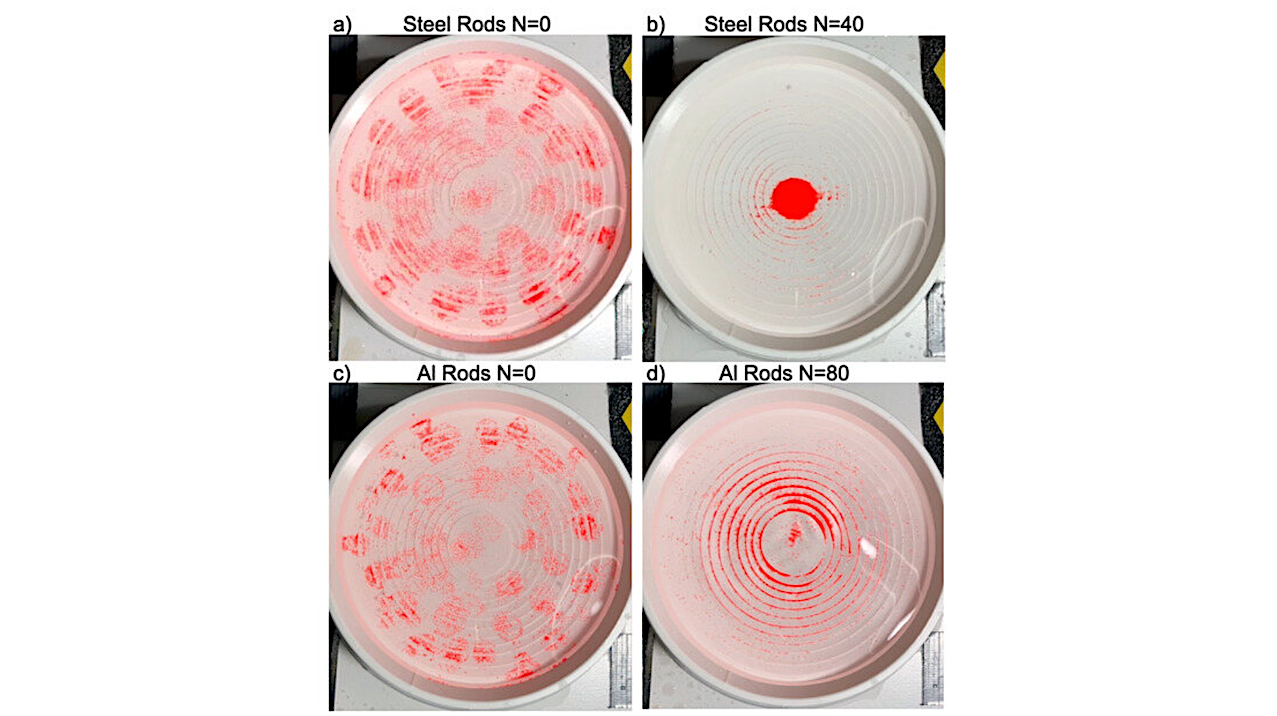
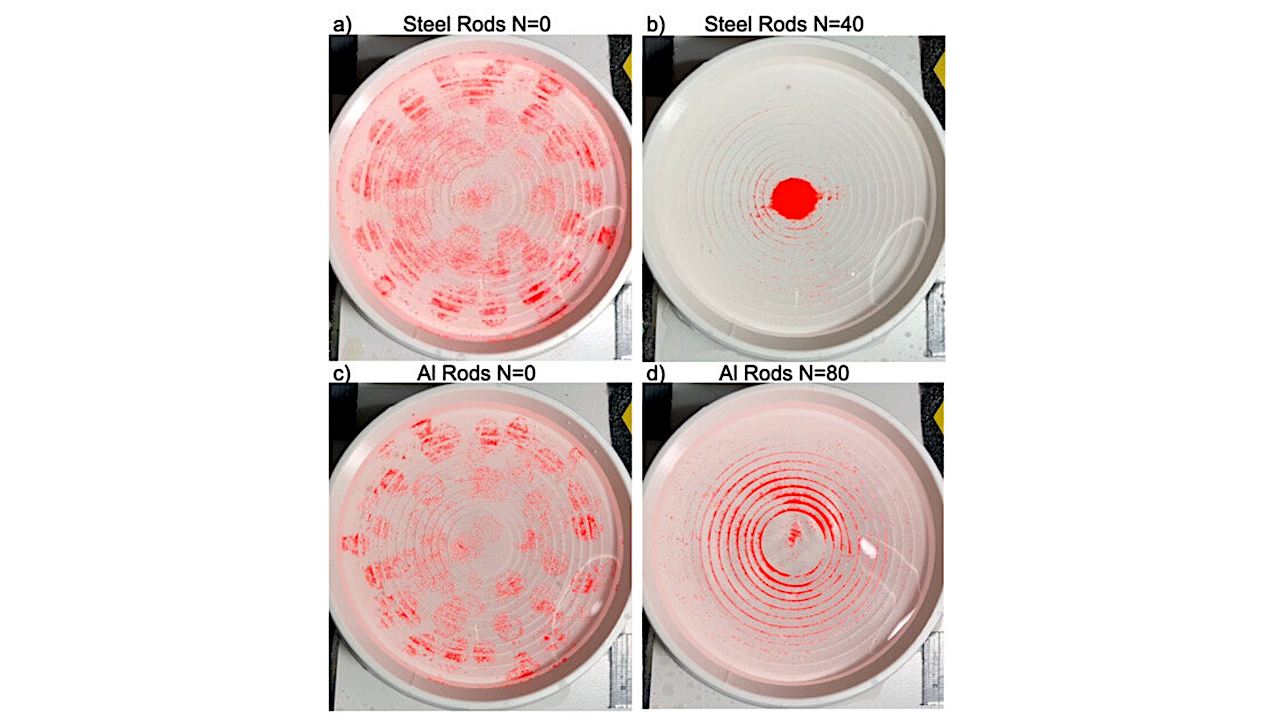
Summary of particle dynamics. The top and bottom rows compare results for steel and aluminum rods, respectively, while the left and right columns show the initial and final stages. (b) Dropping steel bars led to nearly complete particle collection at the center after N = 40 drops. (d) Dropping aluminum bars resulted in a profile that, although somewhat peaked, remained noticeably wide even after 80 drops. — Life
This paper provides experimental and numerical evidence supporting the occurrence of liposome congregation at the floors of meteor craters on Early Earth.
This work builds on our earlier research, which demonstrated that liposomes submerged in a shallow Archean pond are protected from harmful UV radiation.
This protection enables them to survive sufficiently long for autocatalytic amphiphile replication and for the mutation and selection of assemblies that enhance membrane stability.
For liposomes to fuse, grow, exchange contents and membrane components, and divide, they must establish a population, i.e., form a dense conglomerate that enables close physical contact.
The study demonstrates that such a congregation is feasible in bowl-shaped meteor craters on Early Earth, especially under periodic seismic disturbances.
Experimental and Numerical Modeling of Liposome Congregation in Meteorite Craters of Early Earth, Life (open access)
Astrobiology










Related Posts
Stay Informed With the Latest & Most Important News

Advertisement
-
 01Two Black Holes Observed Circling Each Other for the First Time
 -
 02From Polymerization-Enabled Folding and Assembly to Chemical Evolution: Key Processes for Emergence of Functional Polymers in the Origin of Life
 -
 03Astronomy 101: From the Sun and Moon to Wormholes and Warp Drive, Key Theories, Discoveries, and Facts about the Universe (The Adams 101 Series)
 -
 04True Anomaly hires former York Space executive as chief operating officer
 -
 05Φsat-2 begins science phase for AI Earth images
 -
 06Hurricane forecasters are losing 3 key satellites ahead of peak storm season − a meteorologist explains why it matters
 -
 07Binary star systems are complex astronomical objects − a new AI approach could pin down their properties quickly