
Now Reading: Is Constitutive Red-shift An Advantage For Oxygenic Photosynthesis Under M-dwarf Starlight? Insights From Acaryochloris marina sp. str. Moss Beach
-
01
Is Constitutive Red-shift An Advantage For Oxygenic Photosynthesis Under M-dwarf Starlight? Insights From Acaryochloris marina sp. str. Moss Beach

Is Constitutive Red-shift An Advantage For Oxygenic Photosynthesis Under M-dwarf Starlight? Insights From Acaryochloris marina sp. str. Moss Beach

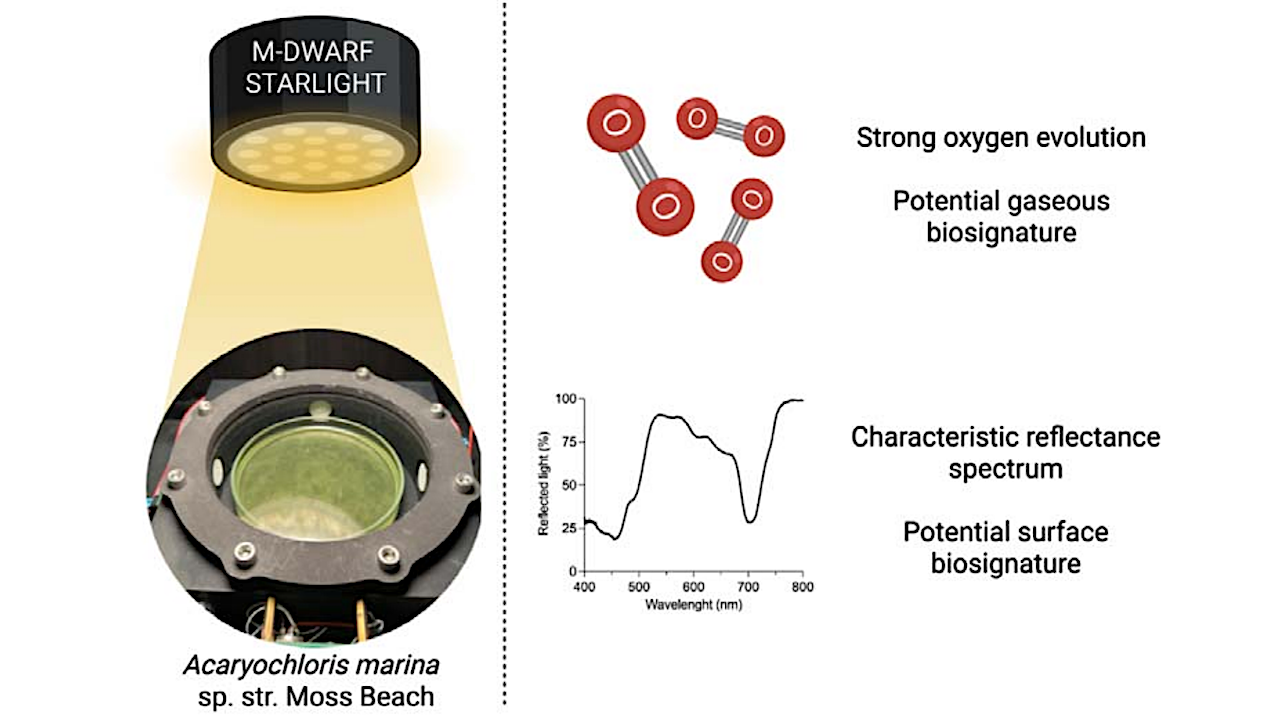
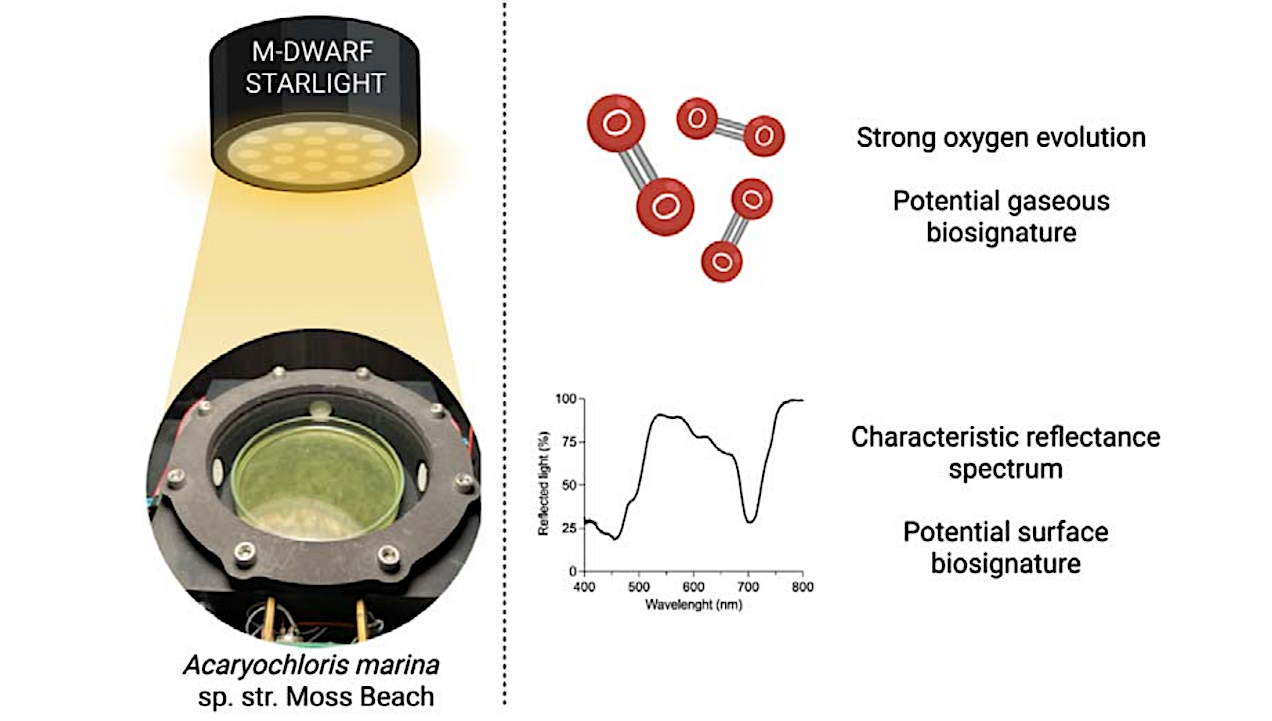
Graphical Abstract. Created in BioRender. Liistro, E. (2026) https://BioRender.com/j2de4ay
In the next years, several space missions will search for evidence of life on exoplanets, focusing on robust biosignatures associated with oxygenic photosynthesis, including atmospheric oxygen accumulation and the Vegetation Red-Edge in surface reflectance spectra.
Many potentially habitable rocky exoplanets orbit M-dwarf stars, whose spectral energy distribution may challenge oxygenic photosynthesis. Differently from the Sun, M-dwarf stars emit predominantly far-red (700-750 nm) and infrared (750-1000 nm) light, and relatively little visible (400-700 nm) radiation, which constitutes photosynthetically active radiation.
Some organisms have been found to photosynthesize under such spectrum but less efficiently than under solar light, as their photosynthetic apparatus evolved to harvest visible light emitted by the Sun. Around M-dwarfs, such different irradiation might have selected adaptations optimized for harvesting far-red / infra-red light.
On Earth, similar selection can be found in Acaryochloris marina strains, constitutively presenting high chlorophyll d content in photosystem II & I, with in vivo absorption peaks beyond 700 nm. Here we tested the Moss Beach strain under a simulated M-dwarf spectrum and a simulated primeval atmosphere – anoxic and enriched in carbon dioxide.
Results underline how this permanently red-shifted photosynthetic apparatus does not require acclimation to the stellar spectrum and enables for a strong growth and oxygen production, higher than under simulated solar light.
Moreover, cells reflectance spectrum highlights a shift of the canonical red-edge toward longer wavelengths, resulting in a Chl d-near-infrared edge, suggesting a similar metabolism on exoplanets orbiting M-dwarfs could successfully produce both a gaseous biosignature and a characteristic surface biosignature.
Astrobiology,










Related Posts

Stay Informed With the Latest & Most Important News
Previous Post
Next Post




Advertisement
-
 01Two Black Holes Observed Circling Each Other for the First Time
 -
 02From Polymerization-Enabled Folding and Assembly to Chemical Evolution: Key Processes for Emergence of Functional Polymers in the Origin of Life
 -
 03Astronomy 101: From the Sun and Moon to Wormholes and Warp Drive, Key Theories, Discoveries, and Facts about the Universe (The Adams 101 Series)
 -
 04True Anomaly hires former York Space executive as chief operating officer
 -
 05Φsat-2 begins science phase for AI Earth images
 -
 06Hurricane forecasters are losing 3 key satellites ahead of peak storm season − a meteorologist explains why it matters
 -
 07Binary star systems are complex astronomical objects − a new AI approach could pin down their properties quickly