
Now Reading: JOYS+ Analyses Of OCN−, N2O, NO, And Complex Cyanides In Ices — Thermal Processing Results In Modest Enhancement Of OCN− Ice
-
01
JOYS+ Analyses Of OCN−, N2O, NO, And Complex Cyanides In Ices — Thermal Processing Results In Modest Enhancement Of OCN− Ice

JOYS+ Analyses Of OCN−, N2O, NO, And Complex Cyanides In Ices — Thermal Processing Results In Modest Enhancement Of OCN− Ice

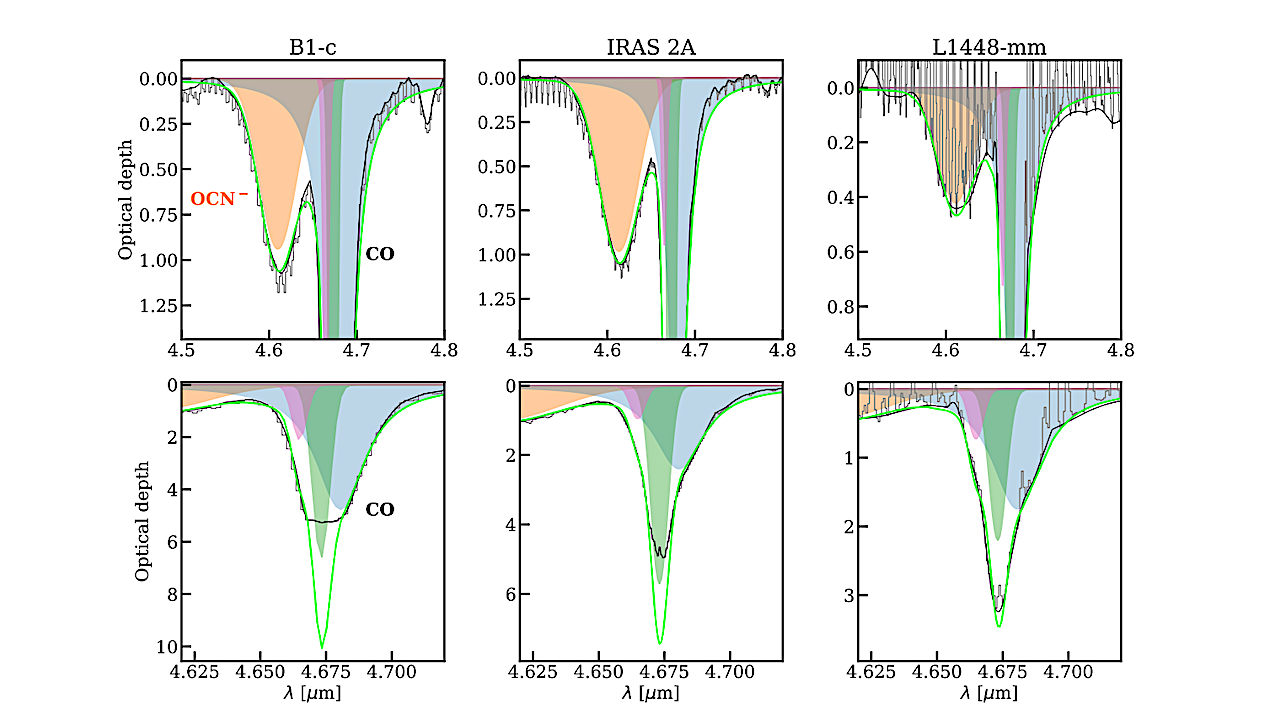
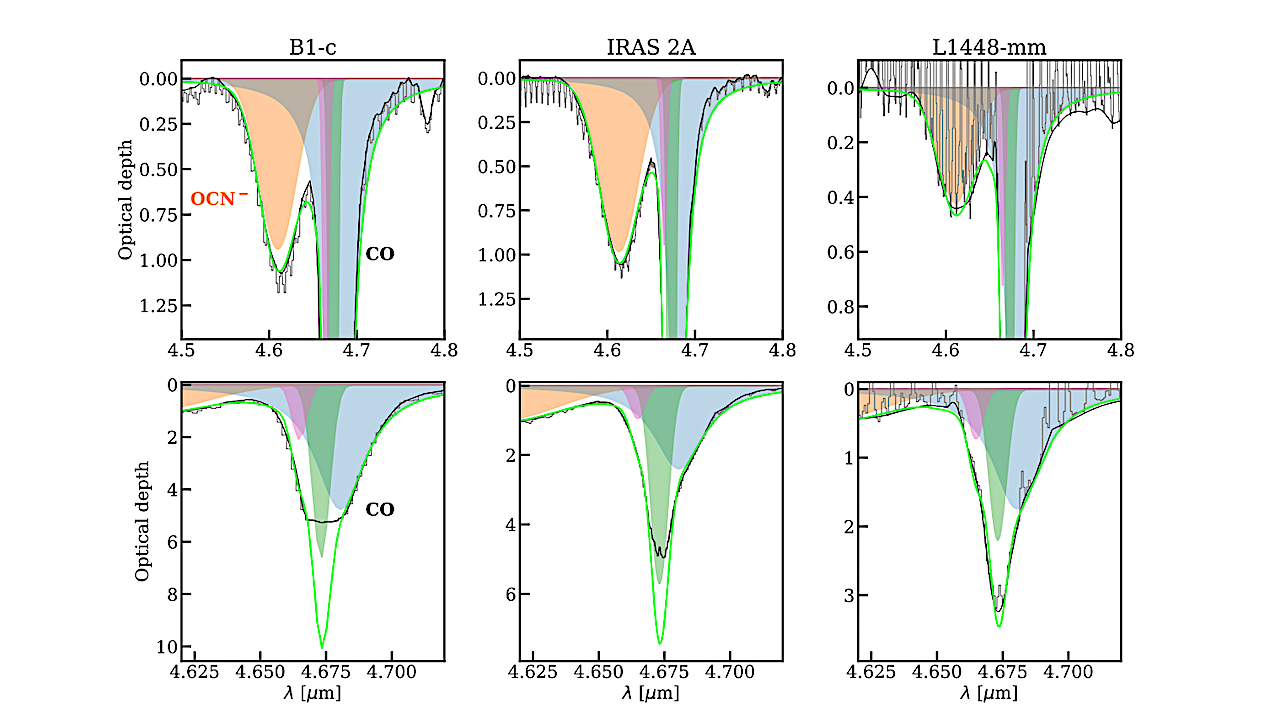
Our fits to the OCN− and CO absorption features toward three of the studied objects. As explained in the text, OCN− is fitted simultaneously with CO ice. The orange shaded area shows the fit to the OCN− feature. Shaded blue, green, and pink areas show the Lorentzian and Gaussian components fitted to the CO feature. The total fit is presented with solid lime green line. The black solid line shows the spline that is fitted to the bottom of the gas-phase emission or top of the gas-phase absorption lines where the data are overplotted in gray. Note that the top and bottom rows have different scales; the top row highlights the OCN− fits and the bottom row shows the CO fits. For some objects such as B1-c and IRAS 2A, where the CO feature gets saturated close to the noise level, the bottom of the CO feature is ignored when fitting the data and only the wings of the CO band, which are well above the noise level, are fitted. The fits for the other objects considered in this work are given in Figs. B.2 and B.3. — astro-ph.GA
Nitrogen-bearing molecules are more difficult to observe than oxygen-bearing ones, mainly due to the lower abundance of nitrogen in the interstellar medium.
Therefore, the formation pathways of many of these species is still under debate. Studies prior to the launch of the JWST did not have the sensitivity to observe ices toward the youngest and most deeply embedded Class 0 objects.
Here we will focus on OCN−, CH3CN, C2H5CN, NO, and N2O in ices to better understand their formation. We use the data from the JOYS+ program to study 8 Class 0 and 11 Class I objects with JWST. We firmly detect OCN− in ices for all these objects, tentatively detect CH3CN, C2H5CN, and N2O toward three sources, and find upper limits on the NO abundance in ices.
The OCN−−/CO2 ratios are found to be larger by a factor of ~2-3 for the objects that have a visible CO2 double peak (a sign of ice thermal processing) pointing to the moderate effect of temperature on OCN− production. Relation of H2O, CO2, and OCN− with AV indicates that OCN− may tentatively form at a later stage than H2O and CO2.
We find that the ratios of CH3CN, C2H5CN, and N2O with respect to OCN− are relatively constant within one order of magnitude across our objects, likely suggesting that they have similar ice environments. The upper limit abundances of NO are ~1 order of magnitude lower than what was previously predicted in ices of a mature protoplanetary disk. This indicates that the detected gas-phase NO in that disk may be a product of another molecule (e.g. N2O) in the ices.
We conclude that OCN− can get enhanced at higher temperatures by only a factor of ~2-3 and thus OCN− detection alone does not imply ice heating. Large-sample studies of OCN−− toward pre-stellar cores will be useful to further confirm the formation timeline of this molecule.
P. Nazari, N. Brunken, Y. Chen, K. Slavicinska, E. F. van Dishoeck, W. R. M. Rocha, A. C. A. Boogert, M. G. Navarro, V. J. M. Le Gouellec, L. Francis, Ł. Tychoniec, A. Caratti o Garatti, C. Gieser, T. P. Greene, P. J. Kavanagh
Comments: Accepted for publication in A&A, 19 pages, 14 figures
Subjects: Astrophysics of Galaxies (astro-ph.GA)
Cite as: arXiv:2604.25915 [astro-ph.GA] (or arXiv:2604.25915v1 [astro-ph.GA] for this version)
https://doi.org/10.48550/arXiv.2604.25915
Focus to learn more
Submission history
From: Pooneh Nazari
[v1] Tue, 28 Apr 2026 17:59:07 UTC (2,865 KB)
https://arxiv.org/abs/2604.25915
Astrobiology, Astrochemistry, Astronomy,










Related Posts

Stay Informed With the Latest & Most Important News
Previous Post
Next Post




Advertisement
-
 01Two Black Holes Observed Circling Each Other for the First Time
 -
 02From Polymerization-Enabled Folding and Assembly to Chemical Evolution: Key Processes for Emergence of Functional Polymers in the Origin of Life
 -
 03Astronomy 101: From the Sun and Moon to Wormholes and Warp Drive, Key Theories, Discoveries, and Facts about the Universe (The Adams 101 Series)
 -
 04True Anomaly hires former York Space executive as chief operating officer
 -
 05Φsat-2 begins science phase for AI Earth images
 -
 06Hurricane forecasters are losing 3 key satellites ahead of peak storm season − a meteorologist explains why it matters
 -
 07Binary star systems are complex astronomical objects − a new AI approach could pin down their properties quickly