
Now Reading: CORINOS V: Radiative Transfer Effects In Protostellar Ice Observations
-
01
CORINOS V: Radiative Transfer Effects In Protostellar Ice Observations


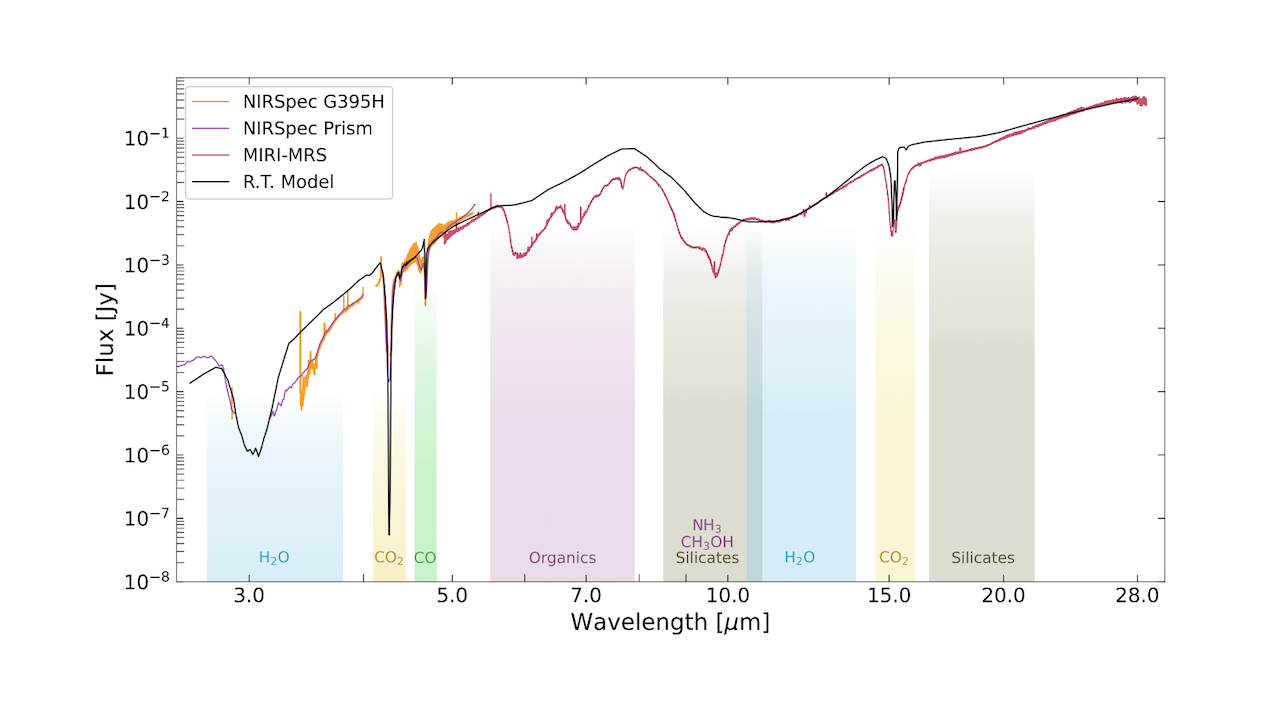

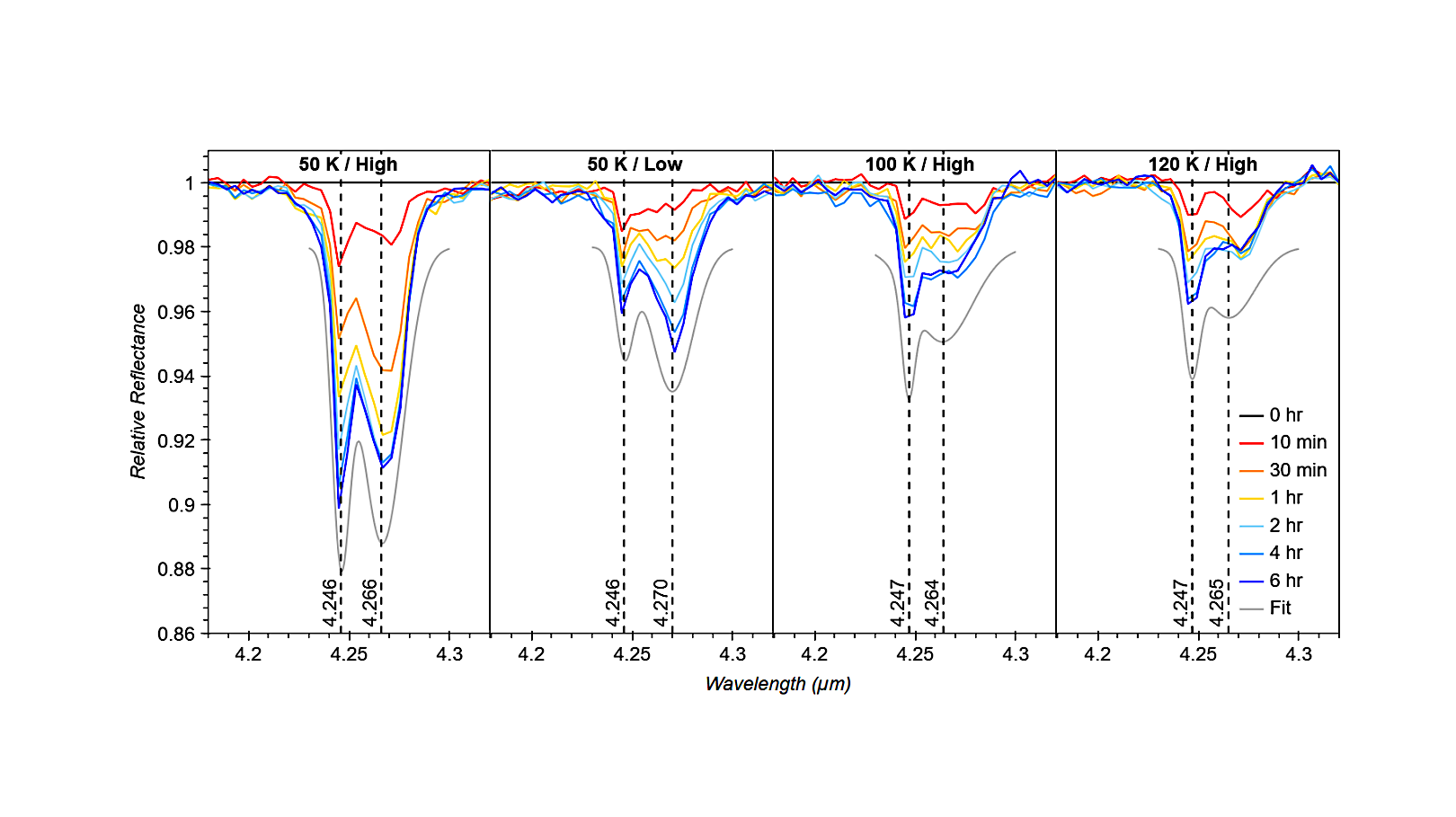
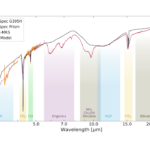
IRAS 15398 JWST NIRSpec spectrum (Program ID 1854, PI: M. McClure), NIRSpec Prism spectrum (Program ID 6161, PI: K. Slavicinska), and MIRI-MRS spectrum (Program ID 2151, PI: Y.-L. Yang) with the radiative transfer model spectrum extracted in a 1” diameter overlaid in black. Data points which hit the noise floor from the G395H and Prism data were removed. A spectrum zoomed in to the NIR CO2 and CO absorption is shown in Appendix E. — astro-ph.SR
Recent observations of protostars with the James Webb Space Telescope have revealed unprecedented chemical complexity from their ice absorption features.
However, these spectra are likely influenced by radiative transfer effects, and there is little understanding of how this impacts our ability to identify, quantify, and interpret the observed ice features.
We have developed a new modeling framework to investigate the radiative transfer through icy protostellar envelopes, and apply this to the IRAS 15398-3359 protostar observed by the JWST CORINOS program. The modeled H2O and CO column densities are similar to previous empirical studies, but we require a high CO2/H2O ratio of 76% to match the optical depth of the 15 μm band.
We use our modeled continuum to calculate a 6-10 μm optical depth spectrum, and see considerable differences compared to a simple polynomial continuum model, underscoring the challenges with quantifying trace ice species in this range.
For this source, we find that the observed absorption predominantly originates along the viewing line of sight between 1000 – 2000 au, peaking at the transition from the outflow cavity to the envelope; the spectra are largely insensitive to absorption from ices in the outer envelope, which extends out to 20,000 au.
Lastly, we show that depending on how the line of sight intersects the cavity, the apparent CO2/H2O and CO/H2O column density ratios can be underestimated compared to the underlying ice abundance ratios. Together this provides important context for interpreting the ice constraints derived from JWST observations of protostars.
Will E. Thompson, Jennifer B. Bergner, Neal J. Evans II, Yao-Lun Yang, Vincent Kreft, Lenore Anderson, Klaus M. Pontoppidan, L. Ilsedore Cleeves, Ewine F. van Dishoeck, Rachel E. Gross, Jeong-Eun Lee, Melissa K. McClure, Nami Sakai, Katerina Slavicinska
Subjects: Solar and Stellar Astrophysics (astro-ph.SR); Astrophysics of Galaxies (astro-ph.GA)
Cite as: arXiv:2604.27133 [astro-ph.SR] (or arXiv:2604.27133v1 [astro-ph.SR] for this version)
https://doi.org/10.48550/arXiv.2604.27133
Focus to learn more
Submission history
From: Will Thompson
[v1] Wed, 29 Apr 2026 19:33:17 UTC (6,623 KB)
https://arxiv.org/abs/2604.27133
Astrobiology, astrochemistry,










Related Posts
Stay Informed With the Latest & Most Important News
Previous Post
Next Post
Advertisement
-
 01Two Black Holes Observed Circling Each Other for the First Time
 -
 02From Polymerization-Enabled Folding and Assembly to Chemical Evolution: Key Processes for Emergence of Functional Polymers in the Origin of Life
 -
 03Astronomy 101: From the Sun and Moon to Wormholes and Warp Drive, Key Theories, Discoveries, and Facts about the Universe (The Adams 101 Series)
 -
 04True Anomaly hires former York Space executive as chief operating officer
 -
 05Φsat-2 begins science phase for AI Earth images
 -
 06Hurricane forecasters are losing 3 key satellites ahead of peak storm season − a meteorologist explains why it matters
 -
 07Binary star systems are complex astronomical objects − a new AI approach could pin down their properties quickly