
Now Reading: The T16 Planet Hunt: 10,000 New Planet Candidates from TESS Cycle 1 and the Confirmation of a Hot Jupiter Around TIC 183374187
-
01
The T16 Planet Hunt: 10,000 New Planet Candidates from TESS Cycle 1 and the Confirmation of a Hot Jupiter Around TIC 183374187

The T16 Planet Hunt: 10,000 New Planet Candidates from TESS Cycle 1 and the Confirmation of a Hot Jupiter Around TIC 183374187

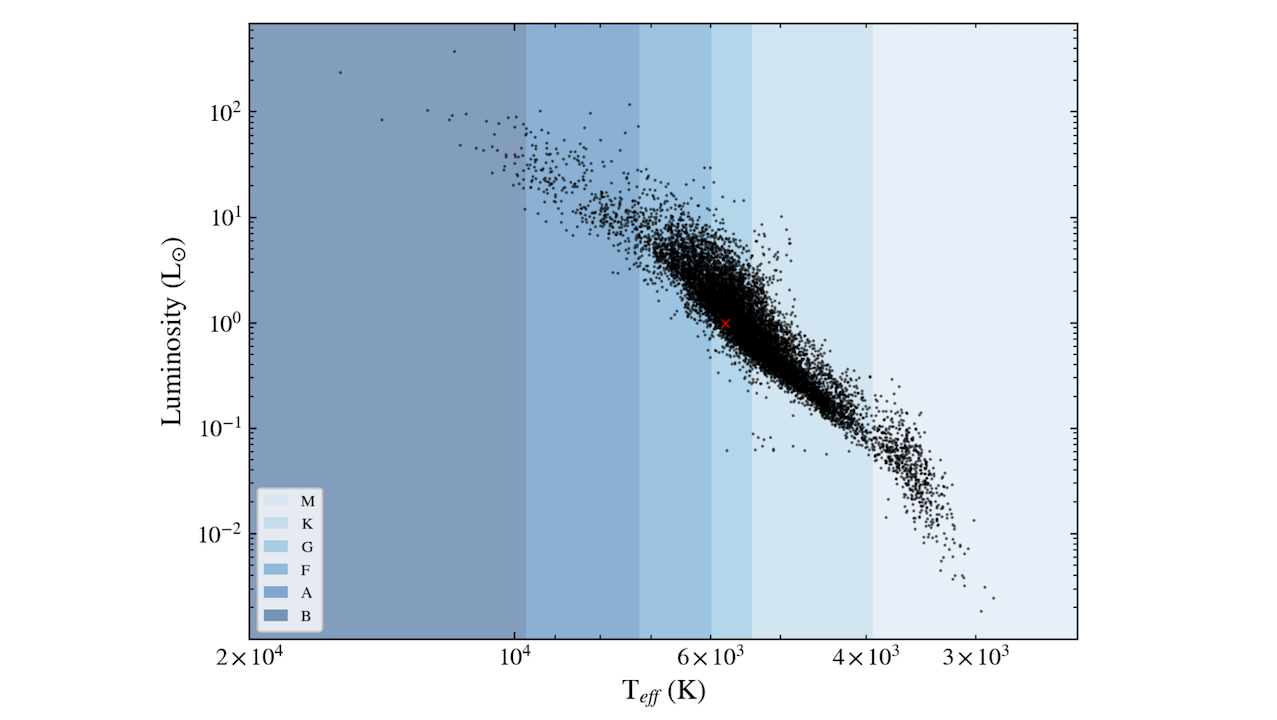
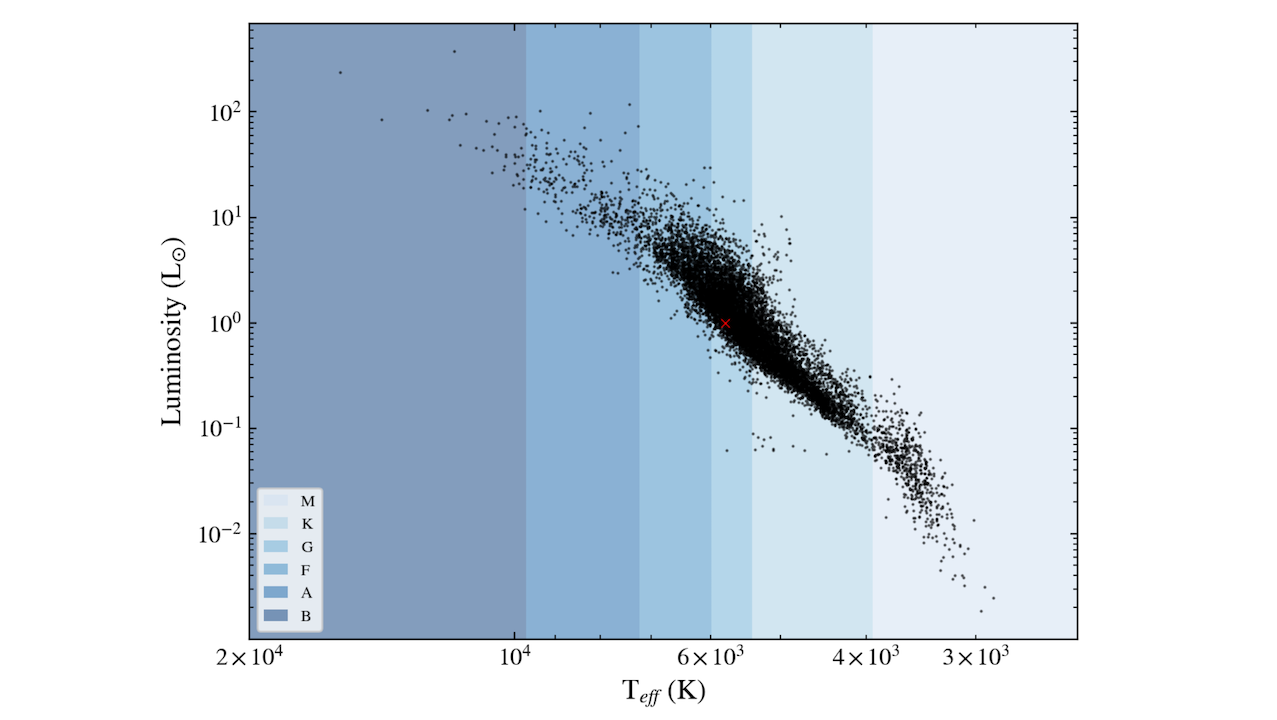
Distribution of our candidates on an HR diagram. The red cross marks the Sun’s position, the background colors provide approximate stellar types via the classifications in Pecaut & Mamajek (2013). Stellar parameters are drawn from the TESS Input Catalog (Stassun et al.
2018), supplemented by Gaia DR3 where necessary (Gaia Collaboration et al. 2023)
The T16 project has produced a uniformly detrended and systematics-corrected set of 83,717,159 TESS Cycle 1 full-frame image light curves for stars observed by TESS in its primary mission down to T=16 mag, enabling sensitive transit searches beyond the official TESS pipelines.
While most existing TESS planet searches focus on relatively bright targets, planet occurrence rates suggest that a substantial number of planets should exist around fainter stars. We therefore use the T16 light curves to conduct a semi-automated search for transiting exoplanets across the full Cycle 1 FFI sample, resulting in 11,554 planet candidates orbiting stars down to 16th magnitude in the TESS band with orbital periods between 0.5 and 27 days.
Of these, 10,091 are new planet candidates, and 411 are single-transit events, for which we do not attempt to determine orbital parameters. The remaining 1,052 candidates are previously known TESS candidates. We validate our pipeline through Magellan/PFS radial-velocity follow-up measurements on one of our candidate hosts, TIC 183374187, a metal poor thick-disk star, confirming the signal as newly identified hot Jupiter. This detection demonstrates our pipeline’s ability to identify real, previously undiscovered, transiting planets.
Overall, this work shows that large-scale, machine learning-assisted transit searches of TESS full-frame images can significantly expand the census of transiting planet candidates, particularly around faint stars, providing a rich target set for future validation and follow-up efforts. Our findings more than double the number of known TESS exoplanet candidates.
Joshua T. Roth, Joel D. Hartman, Gáspár Á. Bakos, Samuel W. Yee, Luke G. Bouma, Jhon Yana Galarza, Johanna K. Teske, R.P. Butler, Jeffrey D. Crane, Steve Shectman, David Osip, Shreyas Vissapragada, Yuri Beletsky, Shubham Kanodia, Yadira Gaibor
Comments: 28 pages, 12 figures, 7 tables, accepted for publication in ApJS
Subjects: Earth and Planetary Astrophysics (astro-ph.EP)
Cite as: arXiv:2604.18579 [astro-ph.EP] (or arXiv:2604.18579v1 [astro-ph.EP] for this version)
https://doi.org/10.48550/arXiv.2604.18579
Focus to learn more
Related DOI:
https://doi.org/10.3847/1538-4365/ae5b6c
Focus to learn more
Submission history
From: Joshua Roth
[v1] Mon, 20 Apr 2026 17:59:06 UTC (10,134 KB)
https://arxiv.org/abs/2604.18579
Astrobiology, exoplanet,










Related Posts


Stay Informed With the Latest & Most Important News
Previous Post
Next Post




Advertisement
-
 01Two Black Holes Observed Circling Each Other for the First Time
 -
 02From Polymerization-Enabled Folding and Assembly to Chemical Evolution: Key Processes for Emergence of Functional Polymers in the Origin of Life
 -
 03Astronomy 101: From the Sun and Moon to Wormholes and Warp Drive, Key Theories, Discoveries, and Facts about the Universe (The Adams 101 Series)
 -
 04True Anomaly hires former York Space executive as chief operating officer
 -
 05Φsat-2 begins science phase for AI Earth images
 -
 06Hurricane forecasters are losing 3 key satellites ahead of peak storm season − a meteorologist explains why it matters
 -
 07Binary star systems are complex astronomical objects − a new AI approach could pin down their properties quickly