
Now Reading: Smaller Than Earth Habitability Model (STEHM): The Lower Size Limit for Atmosphere Retention in the Habitable Zone
-
01
Smaller Than Earth Habitability Model (STEHM): The Lower Size Limit for Atmosphere Retention in the Habitable Zone

Smaller Than Earth Habitability Model (STEHM): The Lower Size Limit for Atmosphere Retention in the Habitable Zone

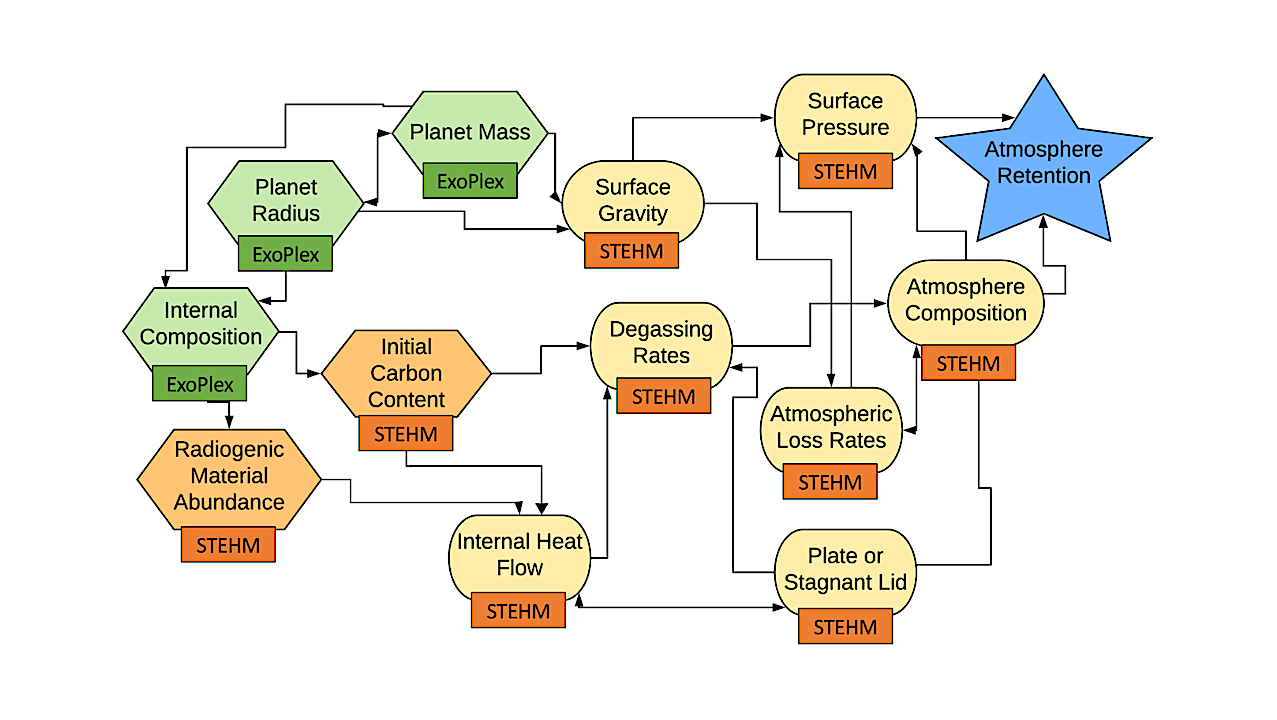

STEHM flow chart. Green hexagons are input parameters that are calculated by ExoPlex. Orange hexagons are input parameters set within STEHM. Yellow stadiums are components that are explored by STEHM. Arrows indicate how each section of the code interacts with the others. On the bottom right there is a yellow stadium indicating a choice of tectonic regime. This paper is based on a planet with stagnant lid tectonics, however future versions of the STEHM code will also include plate tectonics. — astro-ph.EP
With recent advances in exoplanet observational techniques enabling the discovery of increasingly smaller planets, a crucial question emerges in the search for habitable planets: how small can a planet be and still maintain an atmosphere?
We present results from the Smaller Than Earth Habitability Model (STEHM) which examines how small a planet can be and still maintain a long-term (multi-gigayear) atmosphere for planets from 1.0R⊕ down to 0.5R⊕. The model is based on a stagnant lid planet orbiting within the habitable zone of a sun-like star.
Our model demonstrates that planets ≥0.8R⊕ can maintain their atmospheres under our Earth-like default conditions for a solar analog star, while smaller planets lose their atmospheres. Variations from the default Earth-like values cause mostly minor variations to the planet size boundary results, with some changes allowing ≥0.7R⊕ planets to maintain their atmosphere.
Initial carbon inventory emerges as the most influential parameter for atmospheric retention, though orders of magnitude difference to Earth values are required to make a significant difference to longevity of atmospheric retention. Planets with substantial initial carbon content, large amounts of heat producing elements, cool initial mantle temperatures and low core radius fractions show the best atmospheric retention capabilities.
Our results indicate that atmospheric retention on small planets depends strongly on their formation conditions and early evolution, providing important constraints for future observations of rocky exoplanets and their potential habitability.
Michelle L. Hill, Stephen R. Kane, Bradford J. Foley, Laura K. Schaefer
Comments: 18 Pages, 11 Figures, Accepted for Publication in PSJ
Subjects: Earth and Planetary Astrophysics (astro-ph.EP)
Cite as: arXiv:2605.00170 [astro-ph.EP] (or arXiv:2605.00170v1 [astro-ph.EP] for this version)
https://doi.org/10.48550/arXiv.2605.00170
Focus to learn more
Submission history
From: Michelle Hill
[v1] Thu, 30 Apr 2026 19:43:18 UTC (2,985 KB)
https://arxiv.org/abs/2605.00170
Astrobiology, exoplanet, AI,










Related Posts

Stay Informed With the Latest & Most Important News
Previous Post
Next Post



Advertisement
-
 01Two Black Holes Observed Circling Each Other for the First Time
 -
 02From Polymerization-Enabled Folding and Assembly to Chemical Evolution: Key Processes for Emergence of Functional Polymers in the Origin of Life
 -
 03Astronomy 101: From the Sun and Moon to Wormholes and Warp Drive, Key Theories, Discoveries, and Facts about the Universe (The Adams 101 Series)
 -
 04True Anomaly hires former York Space executive as chief operating officer
 -
 05Φsat-2 begins science phase for AI Earth images
 -
 06Hurricane forecasters are losing 3 key satellites ahead of peak storm season − a meteorologist explains why it matters
 -
 07Binary star systems are complex astronomical objects − a new AI approach could pin down their properties quickly