
Now Reading: The Hydrogen, Methane And Ammonia Biosphere On Early Earth
-
01
The Hydrogen, Methane And Ammonia Biosphere On Early Earth


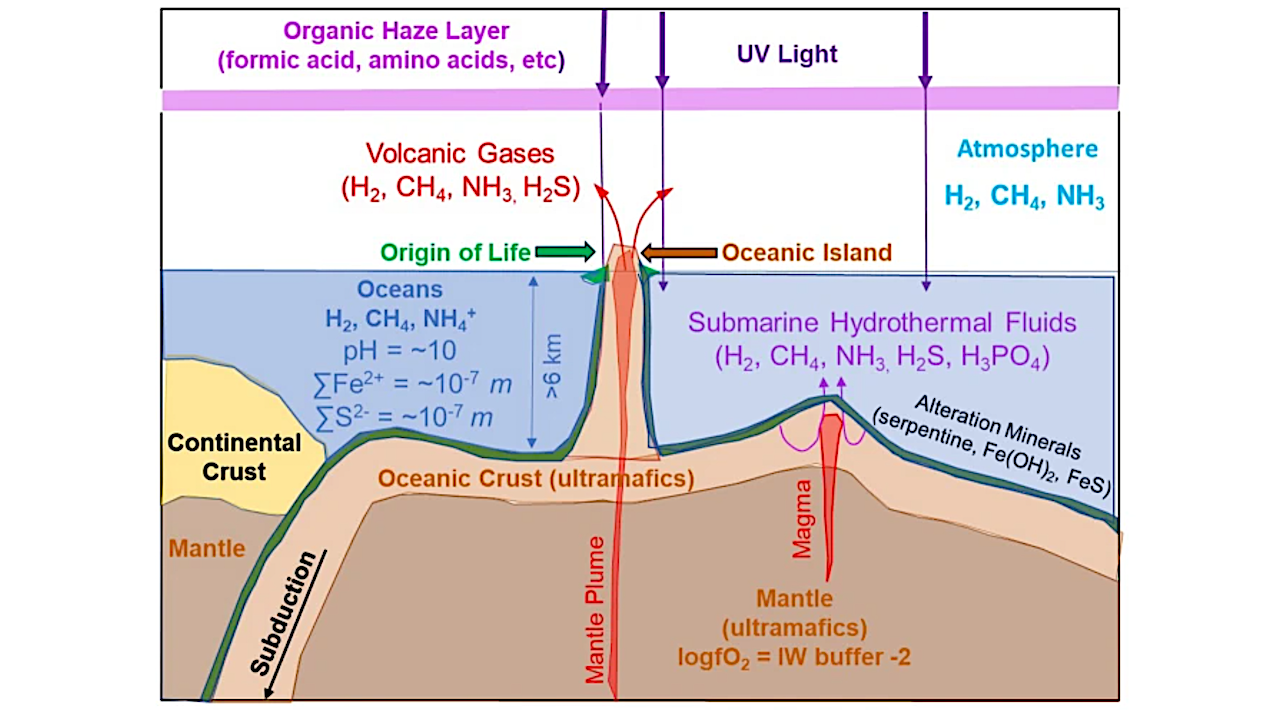
A schematic illustration of the geological and geochemical characteristics of the pre-biotic Earth. The important characteristics include: the nearly-completely ocean-covered Earth; the continental crust mostly submerged in the oceans; the degassing of gases/fluids to the oceans mostly by reducing submarine hydrothermal fluids; the H2–CH4–NH3-rich atmosphere; the Fe–S–H+-poor oceans; the origin and evolution of life on ocean islands; and an organic haze layer for the protection of life from UV radiation from the sun. — Scientific Reports
Current paradigms for the origin and evolutions of life and the environment on early Earth have been based on the premises that carbon dioxide (CO2) and nitrogen gas (N2) were the principal constituents of the atmosphere and the sources of carbon and nitrogen for organisms today.
Based on thermodynamic analyses of the redox state of the Hadean (4.56-4.0 Ga) mantle, the atmospheric compositions during the magma-ocean stage, and the effects of submarine hydrothermal fluids on the atmosphere of the ocean-covered Late-Hadean Earth, we suggest that life evolved sometime during 4.50–3.9 Ga under a reducing atmosphere, rich in hydrogen (H2), methane (CH4), and ammonia (NH3), but very poor in CO2, which was similar to today’s atmosphere on Jupiter.
The ocean water was alkaline (pH = 10 ± 1) and poor in Fe2− and S2−. CH4 and NH3 were the principal sources for carbon nitrogen and energy of the first organisms, greenhouse gases, and the UV shield on early Earth.
The first organisms on Earth were possibly aerobic phototrophic methanotrophs, either oxygenic and/or anoxygenic. They evolved in micro-aerobic environments, which were created by the photodissociation of H2O on the surfaces of photocatalytic minerals (e.g., rutile (TiO2), pyrrhotite (FeS)) that accumulated in shallow water bodies on tropical islands.
The enzymes for oxygenic Photosystem II (PSII) and PSI may also have evolved in the Late-Hadean microaerobic environments, facilitating the appearance of cyanobacteria. The symbiotic relationships between CO2-generating methanotrophs and the CH4-generating, H2-oxidizing methanogens and cyanobacteria characterized the first biosphere.
Plate tectonics has played a key role in the transformation of the H2-CH4–NH3-rich to CO2-N2-rich atmosphere and biosphere by ~ 3.9 Ga because of the increased oxidation of the mantle, caused by the continuous subduction of the oxidized and hydrated oceanic crust into the mantle.
Our study suggests that the search for life in the universe should be directed toward planets with a H2-CH4–NH3-rich atmosphere, as well as to those with a CO2–N2-rich atmosphere.
Astrobiology,










Related Posts
Stay Informed With the Latest & Most Important News

Advertisement
-
 01Two Black Holes Observed Circling Each Other for the First Time
 -
 02From Polymerization-Enabled Folding and Assembly to Chemical Evolution: Key Processes for Emergence of Functional Polymers in the Origin of Life
 -
 03Astronomy 101: From the Sun and Moon to Wormholes and Warp Drive, Key Theories, Discoveries, and Facts about the Universe (The Adams 101 Series)
 -
 04True Anomaly hires former York Space executive as chief operating officer
 -
 05Φsat-2 begins science phase for AI Earth images
 -
 06Hurricane forecasters are losing 3 key satellites ahead of peak storm season − a meteorologist explains why it matters
 -
 07Binary star systems are complex astronomical objects − a new AI approach could pin down their properties quickly