
Now Reading: Europe Launches Thirteen New Satellites to improve Earth Observation and Communication for Italy and Greece
-
01
Europe Launches Thirteen New Satellites to improve Earth Observation and Communication for Italy and Greece

Europe Launches Thirteen New Satellites to improve Earth Observation and Communication for Italy and Greece



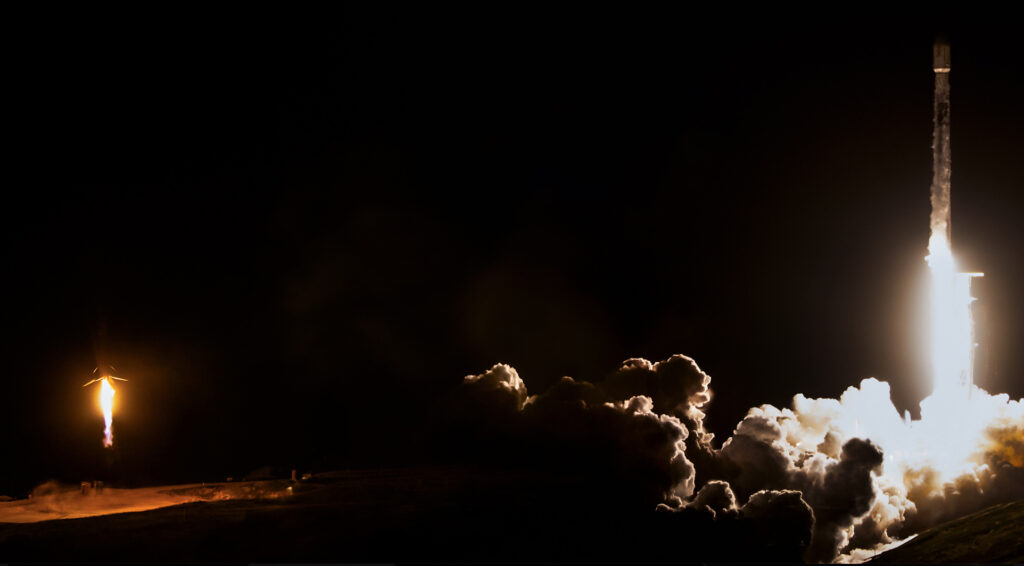
In a remarkable display of international collaboration and technological advancement, thirteen new satellites from Europe have successfully achieved orbit, enhancing monitoring capabilities for both Italy and Greece while also pushing forward innovations in satellite communications. The satellites were launched aboard a SpaceX Falcon-9 rocket from Vandenberg Space Force Base in California on May 3, 2026, at 09:00 CEST.
Among the notable additions are seven satellites for Italy’s IRIDE Earth observation initiative. This expansion boosts the Hawk for Earth Observation (HEO) constellation, bringing Italy’s total number of IRIDE satellites in orbit to 31. Developed by Argotec, these new satellites are equipped with multispectral, high-resolution optical instruments designed to capture diverse data across the electromagnetic spectrum. The data will assist Italian authorities in monitoring coastal and maritime areas, evaluating land use, and enhancing emergency response capabilities.
Greece also marked a milestone with the launch of four satellites for its Hellenic Fire System, dedicated to wildfire detection and monitoring—making it a pioneering effort in terms of national satellite capabilities aimed at combating such natural disasters. This initiative is the result of a collaborative effort that includes support from the European Space Agency (ESA) and emphasizes the role of union between the Greek government and the private sector in addressing important national needs through advanced space technologies.
Additionally, the launch saw the deployment of two CubeSats for the Hellenic Space Dawn project, which will test optical data transmission and satellite communication links in space. Managed by EMTech Space and equipped with advanced CubeCAT laser terminals, these CubeSats will not only evaluate connectivity potentials but also carry high-resolution cameras, serving applications such as cartography and land monitoring.
Simonetta Cheli, the Director of ESA’s Earth Observation Programmes, expressed enthusiasm for the advancements represented by this launch, noting the expansion of the IRIDE system and the collaborative nature of the Hellenic Fire System project. “These efforts exemplify how European cooperation can translate innovation into operational capabilities,” she stated. Meanwhile, Laurent Jaffart, Director of ESA’s Resilience, Navigation and Connectivity, highlighted the significance of this launch in realizing Europe’s vision for next-generation connectivity and fostering sovereign solutions in space.
The IRIDE programme, part of Italy’s broader economic revitalization efforts following the COVID-19 pandemic, aims to enhance national satellite technologies and contribute to economic growth, disaster response, and environmental monitoring for Greece as well. As each of these satellites embarks on its mission, they collectively underscore the growing importance of satellite technology in addressing contemporary challenges faced by nations.










Related Posts


Stay Informed With the Latest & Most Important News
Previous Post
Next Post






Advertisement
-
 01Two Black Holes Observed Circling Each Other for the First Time
 -
 02From Polymerization-Enabled Folding and Assembly to Chemical Evolution: Key Processes for Emergence of Functional Polymers in the Origin of Life
 -
 03Astronomy 101: From the Sun and Moon to Wormholes and Warp Drive, Key Theories, Discoveries, and Facts about the Universe (The Adams 101 Series)
 -
 04True Anomaly hires former York Space executive as chief operating officer
 -
 05Φsat-2 begins science phase for AI Earth images
 -
 06Hurricane forecasters are losing 3 key satellites ahead of peak storm season − a meteorologist explains why it matters
 -
 07Binary star systems are complex astronomical objects − a new AI approach could pin down their properties quickly