
Now Reading: The Atmosphere Of The Warm Neptune GJ 436 b Probed With ESPRESSO
-
01
The Atmosphere Of The Warm Neptune GJ 436 b Probed With ESPRESSO


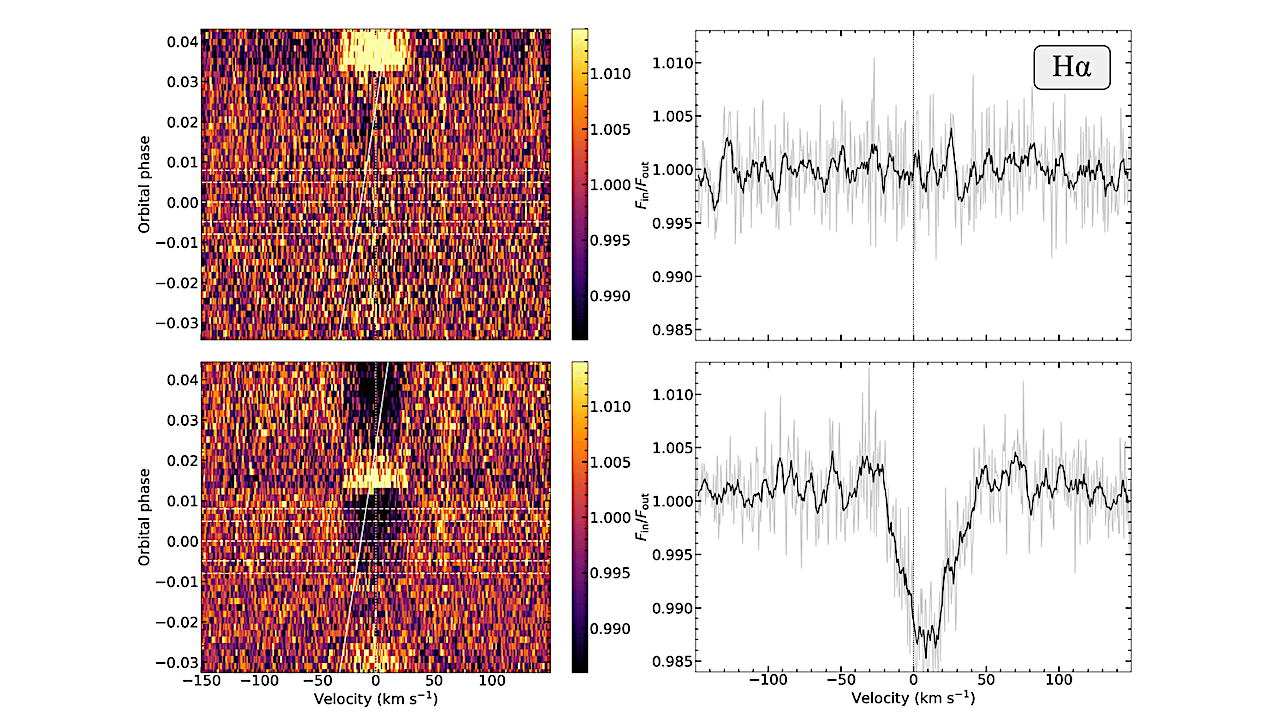

Left: T1 (top) and T2 (bottom) tomography maps in the stellar rest frame around the Hα line. A 3-pixel moving average was applied along the velocity axis to smooth the maps. The horizontal dashed lines indicate the orbital phases at the four contacts of the transit and at midtransit, and the slanted solid line marks the planetary velocities during the observation. The dotted vertical line indicates the stellar rest frame velocity. Right: In-transit combined planetary spectrum around Hα in the planetary rest frame. The grey line represents the original spectrum, while the black line represents the spectrum after applying a 9-point moving average for increasing the S/N. The central wavelength of Hα is marked by the vertical line at 0 km s−1 . The observed Hα absorption seen in the planetary spectrum of T2 is a product of stellar contamination. — astro-ph.EP
Aims. We aim to identify the presence of atomic and molecular species in the upper atmosphere of the warm Neptune-sized transiting planet GJ 436 b, which has a radiative equilibrium temperature of 690 K and a mass of 25.4 Earth masses.
Methods. Using transmission spectroscopy, we observed two full transits of GJ 436 b with the ESPRESSO spectrograph, covering the wavelength range from 3800 to 7880 Angstrom. We searched for traces of atomic (H I, Li I, Na I, Mg I, V I, Cr I, Fe I, and Fe II) and molecular (TiO, VO) species by directly detecting planetary absorption features and by cross-correlating the planetary spectrum with theoretical spectra computed for each investigated species.
Results. Our analysis reveals no strong planetary detection for any of the species, consistent with a featureless optical spectrum. We derived upper limits by combining all ESPRESSO observations. Post-transit stellar flares were detected on both nights, primarily affecting chromospheric lines.
A tentative Fe I signal appears in the first transit (S/N = 3.4 +/- 0.2) at a wind velocity of about -18.6 km/s, which is unexpectedly large for a cool planet. This weak signal is not present in the second transit and, combined with its low significance, suggests an origin in noise.
In the less probable scenario where the feature is suppressed during the second transit by the higher stellar activity state, the T1 tentative signal peaks at 1300 K, which is above the equilibrium temperature of GJ 436 b. Ultimately, this result would imply a neutral iron abundance comparable to or exceeding that of the host star.
E. Herrero-Cisneros, M. R. Zapatero Osorio, J. Sanz-Forcada, R. Allart, T. Azevedo Silva, S. Cristiani, A. R. Costa Silva, Y. C. Damasceno, P. Di Marcantonio, P. Figueira, J. I. González Hernández, B. Lavie, M. Lendl, G. Lo Curto, C. J. A. P. Martins, E. Pallé, F. Pepe, A. Psaridi, R. Rebolo, J. Rodrigues, N. C. Santos, J. V. Seidel, A. Sozzetti, A. Suárez Mascareño
Comments: Accepted in A&A. 17 pages, 11 figures, 5 tables in the main body (24 pages, 24 figures, 5 tables including appendices)
Subjects: Earth and Planetary Astrophysics (astro-ph.EP)
Cite as: arXiv:2605.01390 [astro-ph.EP] (or arXiv:2605.01390v1 [astro-ph.EP] for this version)
https://doi.org/10.48550/arXiv.2605.01390
Focus to learn more
Related DOI:
https://doi.org/10.1051/0004-6361/202554029
Focus to learn more
Submission history
From: Eva Herrero-Cisneros
[v1] Sat, 2 May 2026 11:27:34 UTC (12,542 KB)
https://arxiv.org/abs/2605.01390
Astrobiology, exoplanet,










Related Posts
Stay Informed With the Latest & Most Important News
Previous Post
Next Post




Advertisement
-
 01Two Black Holes Observed Circling Each Other for the First Time
 -
 02From Polymerization-Enabled Folding and Assembly to Chemical Evolution: Key Processes for Emergence of Functional Polymers in the Origin of Life
 -
 03Astronomy 101: From the Sun and Moon to Wormholes and Warp Drive, Key Theories, Discoveries, and Facts about the Universe (The Adams 101 Series)
 -
 04True Anomaly hires former York Space executive as chief operating officer
 -
 05Φsat-2 begins science phase for AI Earth images
 -
 06Hurricane forecasters are losing 3 key satellites ahead of peak storm season − a meteorologist explains why it matters
 -
 07Binary star systems are complex astronomical objects − a new AI approach could pin down their properties quickly