
Now Reading: JWST Unveils A High Mean Molecular Weight Atmosphere For Mini-Neptune TOI-1130b: Evidence For Formation Beyond The Water Ice Line
-
01
JWST Unveils A High Mean Molecular Weight Atmosphere For Mini-Neptune TOI-1130b: Evidence For Formation Beyond The Water Ice Line

JWST Unveils A High Mean Molecular Weight Atmosphere For Mini-Neptune TOI-1130b: Evidence For Formation Beyond The Water Ice Line

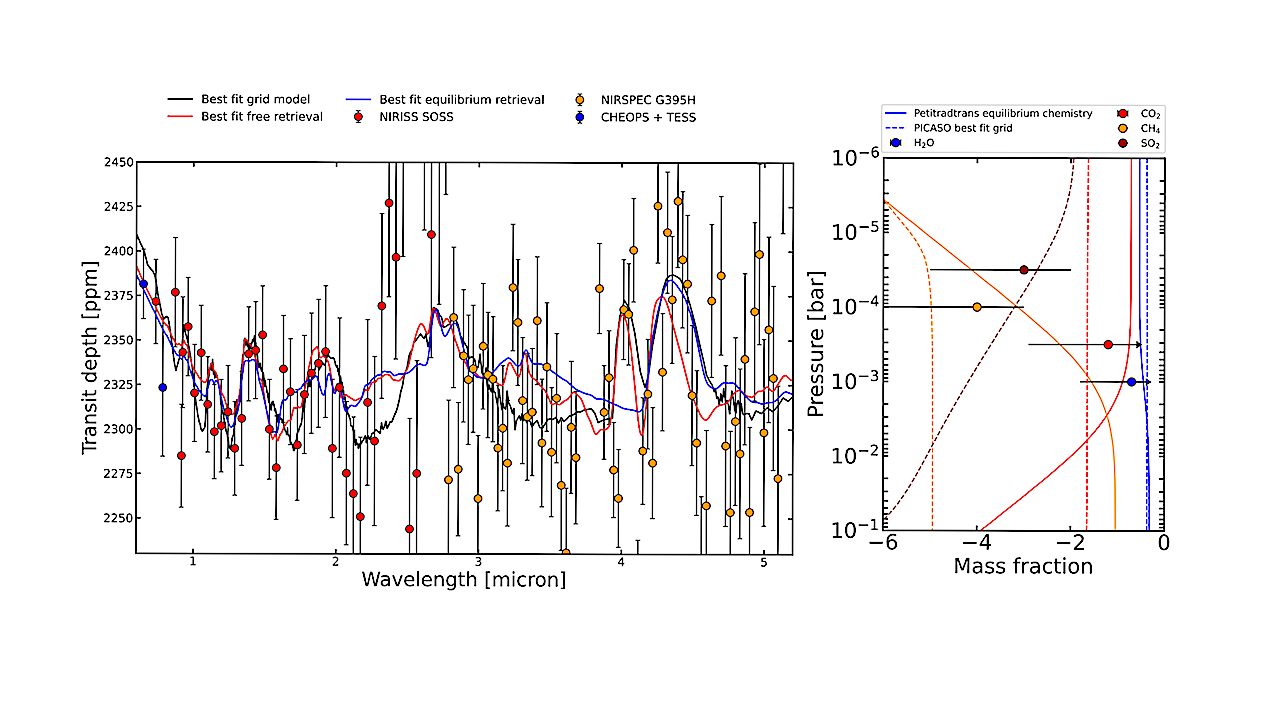

Transmission spectrum of TOI-1130b with the best-fit free chemistry, equilibrium chemistry and grid model overplotted (left) and comparison between retrieved abundances from the three model fits for TOI-1130b (right). The points shown on the right panel are the best fit mass fractions from the free retrieval. The H2O and CO2 posterior distributions shows a lower limit, where as the other molecules show gaussian distributions. Therefore H2O and CO2 data points are shown with upper arrows. The solid lines show chemical abundance profiles from equilibrium chemistry and the dashed lines show the chemical profiles from the self-consistent forward model grid. — astro-ph.EP
We present the combined JWST/NIRSpec G395H and NIRISS SOSS transmission spectrum of a warm mini-Neptune, TOI-1130b (3.66 R⊕, 19.8 M⊕, Teq∼825 K). It is part of a rare and unique multi-planet system TOI-1130, which hosts an inner mini-Neptune and an outer hot Jupiter locked in a 2:1 mean motion resonance.
From the transmission spectrum of TOI-1130b we detect multiple molecules — H2O (7.5σ), CO2 (3.3σ), and SO2 (3.6σ), as well as a tentative detection of CH4 (∼2σ). We find a strong optical slope in the NIRISS/SOSS spectrum, which is consistent with TESS and CHEOPS transit depth measurements.
From equilibrium chemistry retrievals we measure the atmospheric metallicity (logZ/Z⊙=1.8+0.4−0.3) and C/O ratio (<0.75 at 3σ level confidence) and constrain the atmospheric mean molecular weight, μ = 5.5+1.3−0.8 amu. These constraints are consistent with self-consistent forward model grids.
We detect no significant He I 1.083μm absorption signal and put a mass-loss rate upper limit of 1011gs−1. The volatile-rich high mean molecular weight atmosphere of TOI-1130b along with the `pebble-filtering’ effect of the outer hot Jupiter supports the ex-situ formation scenario beyond the water ice line and subsequent migration, coherent with its present orbital architecture.
A volatile-rich formation scenario could also potentially explain the location of TOI-1130b at the edge of the `radius cliff’. This result hints that the mini-Neptune population may not a homogeneous formation history; rather, volatile-rich ex-situ formation also contributes to its population.
Saugata Barat, Tyler Fairnington, Shelby Courreges, Chelsea Huang, Andrew Vanderburg, Caroline V. Morley, Judith Korth, Hannu Parviainen, Alexis Brandeker, George Zhou, Thomas M. Evans-Soma, Lizhou Sha, Douglas N. C. Lin, Duncan Wright, Ava Morrissey, Emma Nabbie, Karen A. Collins Phil Evans, Tristan Guillot, Keith Horne, Don J. Radford, Richard P. Schwarz, Avi Shporer, Gregorg Srdoc, Olga Suarez
Comments: Accepted ApJ Letters
Subjects: Earth and Planetary Astrophysics (astro-ph.EP)
Cite as: arXiv:2605.02036 [astro-ph.EP] (or arXiv:2605.02036v1 [astro-ph.EP] for this version)
https://doi.org/10.48550/arXiv.2605.02036
Focus to learn more
Related DOI:
https://doi.org/10.3847/2041-8213/ae5f8b
Focus to learn more
Submission history
From: Saugata Barat
[v1] Sun, 3 May 2026 20:04:12 UTC (11,441 KB)
https://arxiv.org/abs/2605.02036
Astrobiology,










Related Posts

Stay Informed With the Latest & Most Important News





Advertisement
-
 01Two Black Holes Observed Circling Each Other for the First Time
 -
 02From Polymerization-Enabled Folding and Assembly to Chemical Evolution: Key Processes for Emergence of Functional Polymers in the Origin of Life
 -
 03Astronomy 101: From the Sun and Moon to Wormholes and Warp Drive, Key Theories, Discoveries, and Facts about the Universe (The Adams 101 Series)
 -
 04True Anomaly hires former York Space executive as chief operating officer
 -
 05Φsat-2 begins science phase for AI Earth images
 -
 06Hurricane forecasters are losing 3 key satellites ahead of peak storm season − a meteorologist explains why it matters
 -
 07Binary star systems are complex astronomical objects − a new AI approach could pin down their properties quickly