
Now Reading: Water World Genomics: Unlocking Ocean Secrets With eDNA
-
01
Water World Genomics: Unlocking Ocean Secrets With eDNA


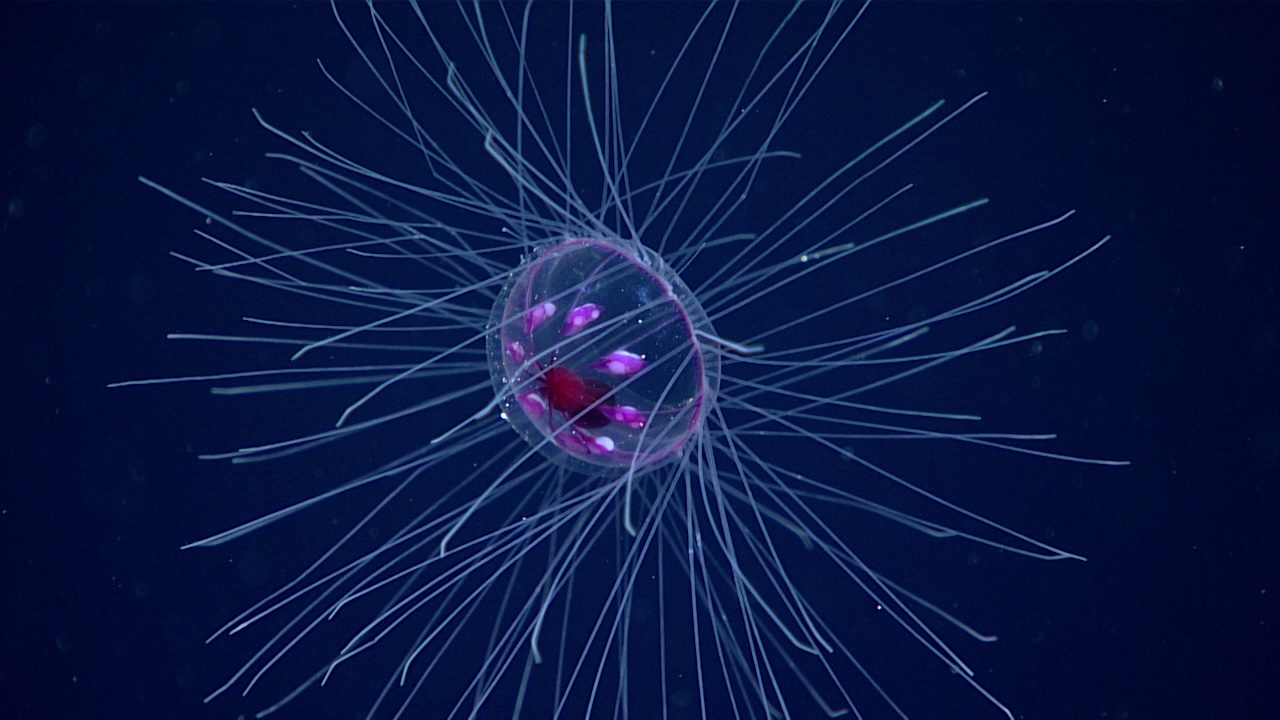

Editor’s note: with recent speculation about the potential habitability of other worlds and understanding the processes whereby other biospheres arise and evolve, thought needs to be given to developing sensor technology to do in situ analysis of samples collected by robotic systems and human crews. With size and power and energy constraints in mind, having the most compact way to quickly analyze a sample or monitor alien life forms will be of great utility to future astrobiology expeditions. Systems such as the one described below are good step in this direction. Such reverse translation/sequencing platforms also allow for proteins to be traced back to their original DNA sequencing. One more thing for your tricorder to do.
Can we learn about life in the deep ocean even if we don’t see it? Yes we can. Thanks to environmental DNA (eDNA), we no longer need a visual sighting to know what’s been in the neighborhood.
NOAA Ocean Exploration, in partnership with the National Systematics Laboratory of NOAA Fisheries, the Smithsonian National Museum of Natural History’s Ocean DNA Program, the Northern Gulf Institute, and NOAA’s Atlantic Oceanographic and Meteorological Laboratory (AOML), has released the first eDNA data from expeditions on NOAA Ship Okeanos Explorer. These biological data yield a wealth of information about the organisms that inhabit the hard to reach underwater world, and can provide critical insights for scientists, resource managers, and policymakers.

NOAA Ocean Exploration incorporated environmental DNA (eDNA) into regular operations on NOAA Ship Okeanos Explorer in 2021 after identifying it as a high-priority exploration variable. This added capability greatly expanded the scope of each expedition’s data haul. Here, members of the science team retrieve water samples containing eDNA that were collected using remotely operated vehicle Deep Discoverer. Image courtesy of NOAA Ocean Exploration, 2025 Beyond the Blue. Download largest version (jpg 1 MB).
Beyond the ROV: Where eDNA Fits In
Large and remote, the deep ocean is difficult to explore. To learn about life in the deep, researchers have relied largely on physical samples captured in nets or by remotely operated vehicles (ROVs) and ROV video footage. While invaluable, these physical and visual sampling methods may miss small and “shy” organisms. Nets can damage sensitive habitats, and video footage may not provide sufficient detail to distinguish between closely related organisms. As a result, much of the life in the deep ocean is unaccounted for or is only minimally understood.
With eDNA, we can overcome some of these challenges: it’s more comprehensive and cost-effective, less invasive, and safer. It’s an increasingly popular tool for finding, mapping, monitoring, and managing life in the deep ocean. However, interpreting these data and making them accessible, reproducible, and transparent has proven challenging given the sheer volume of data now being collected.

NOAA Ocean Exploration’s environmental DNA (eDNA) collection and processing methods on NOAA Ship Okeanos Explorer continue to evolve. In this image, members of the science team are filtering eDNA from water samples collected at depth in Okeanos Explorer’s wet lab. Image courtesy of NOAA Ocean Exploration, 2025 Beyond the Blue. Download largest version (jpg 1 MB).
From Seawater to Sequences: An eDNA Pipeline
To handle the deluge of eDNA data, AOML researchers developed a streamlined workflow to process and share it. This workflow was used with eDNA collected during expeditions on Okeanos Explorer between 2021 and 2023 at depths exceeding 200 meters (656 feet) in the Atlantic and Pacific oceans.

From the sea to the cloud, NOAA Ocean Exploration’s environmental DNA (eDNA) goes on quite a journey before the data are made publicly available. By providing access to these foundational data, NOAA Ocean Exploration is helping address national priorities associated with assessing, monitoring, and managing marine ecosystems. Image courtesy of NOAA Ocean Exploration. Download largest version (jpg 1 MB).
The journey of an eDNA sample:
- Sample collection: The shipboard science team collects water samples using ROV Deep Discoverer and a conductivity, temperature, and depth (CTD) rosette.
- Sample filtration and preservation: The shipboard science team filters eDNA from the water samples and preserves it in the ship’s wet lab.
- Data generation: The National Systematics Laboratory catalogs the sample extracts, amplifies, and sequences the DNA.
- Identification: AOML analyzes and assigns taxonomic names to the sequence data, which are standardized for public release.
Open Access for Global Discovery
The final step, data sharing. In a win for open science, these data — and their metadata — are now freely available to the public:
- Raw sequences: Available from the National Center for Biotechnology Information (NCBI) (BioProject: 1284389), a national repository for biomedical and genomic data.
- Organism identifications: Available from the Ocean Biodiversity Information System (OBIS), the world’s largest marine biodiversity database. By sharing this information through globally accessible repositories, the partners are enabling further deep-ocean discoveries and understanding.
For More Information
NOAA Omics and the NOAA Library are hosting a webinar about these data as part of the NOAA Omics Seminar Series.
What: From Seawater to Sequences: Exploring NOAA’s New Deep-Sea Environmental DNA Dataset
When: Thursday, May 28, 2026, noon EDT
Related Links
Share Your Story
NOAA Omics and NOAA Ocean Exploration would like to know how these data are being used. Share your use case with us by emailing [email protected].
Astrobiology, genomics,










Related Posts
Stay Informed With the Latest & Most Important News
Previous Post
Next Post




Advertisement
-
 01Two Black Holes Observed Circling Each Other for the First Time
 -
 02From Polymerization-Enabled Folding and Assembly to Chemical Evolution: Key Processes for Emergence of Functional Polymers in the Origin of Life
 -
 03Astronomy 101: From the Sun and Moon to Wormholes and Warp Drive, Key Theories, Discoveries, and Facts about the Universe (The Adams 101 Series)
 -
 04True Anomaly hires former York Space executive as chief operating officer
 -
 05Φsat-2 begins science phase for AI Earth images
 -
 06Hurricane forecasters are losing 3 key satellites ahead of peak storm season − a meteorologist explains why it matters
 -
 07Binary star systems are complex astronomical objects − a new AI approach could pin down their properties quickly