
Now Reading: A Public Dataset Of Ariel Simulated Observations For Developing Exoplanetary Atmosphere Data Reduction Pipelines
-
01
A Public Dataset Of Ariel Simulated Observations For Developing Exoplanetary Atmosphere Data Reduction Pipelines

A Public Dataset Of Ariel Simulated Observations For Developing Exoplanetary Atmosphere Data Reduction Pipelines

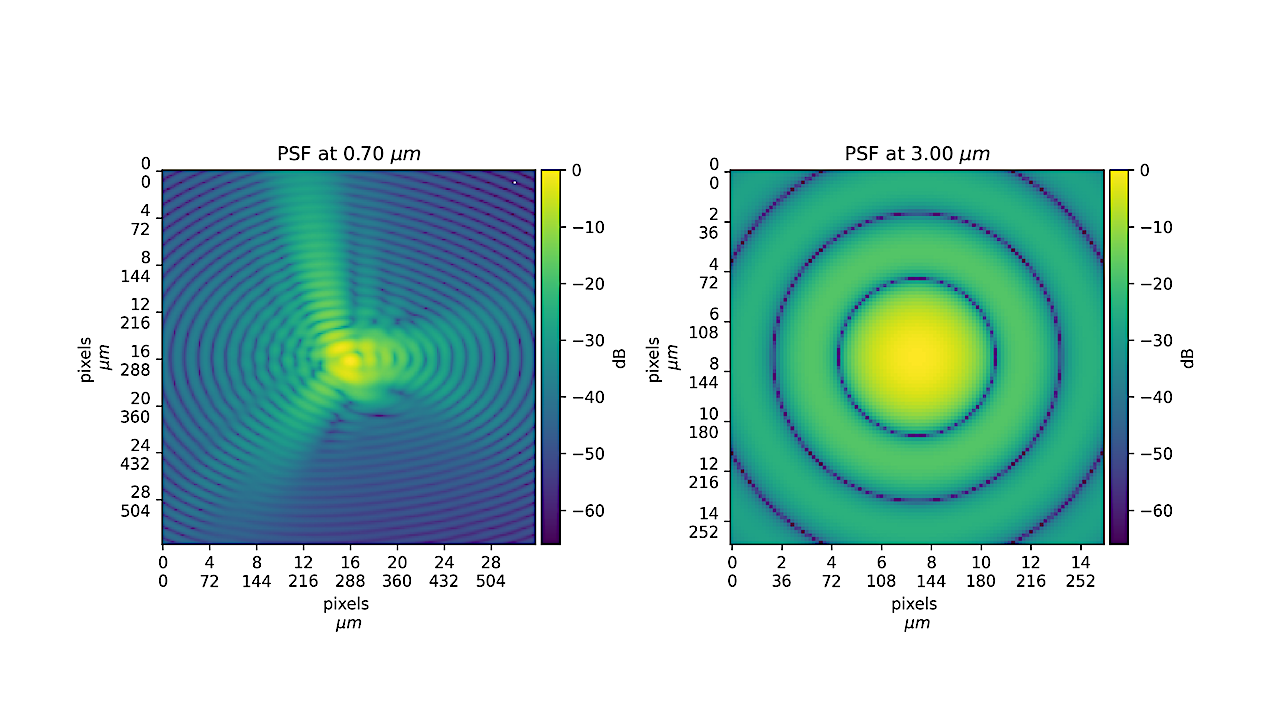
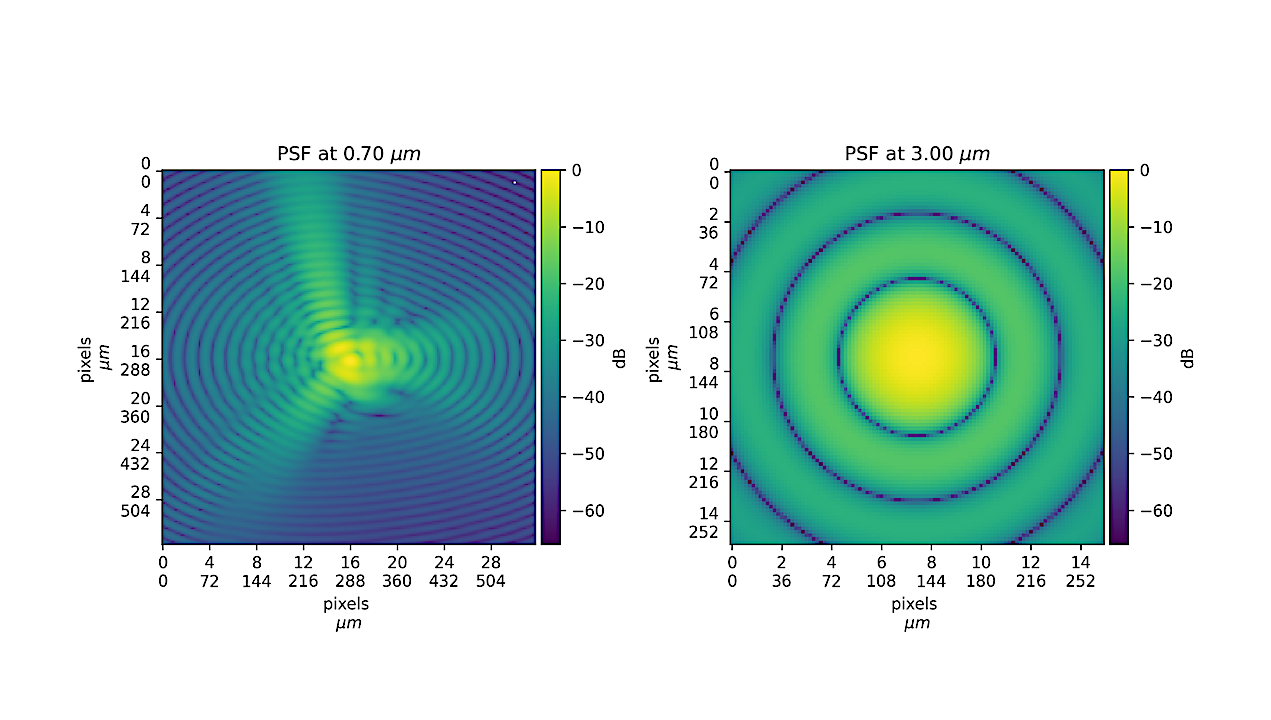
The figure reports two of the PSFs used to simulate FGS1 (left) and AIRS-CH0 (right). The PSFs are sampled at the sub-pixel level and reported in decibels normalised to the maximum value in the field. The axes report the grid into pixel and micron units. The reader may note that the FGS1 PSF is highly aberrated and complex, so it is sampled on a grid of the same size as the detector (32 × 32), while the AIRS-CH0 PSF is an Airy function and here is reported on a smaller grid. For details, please refer to the software documentation. — astro-ph.EP
Detecting and characterising exoplanet atmospheres remains challenging because atmospheric signals can be comparable to residual noise and instrumental/astrophysical systematics. Spectral features span from a few ppm for small planets up to ∼103 ppm for warm/hot giants, while high-quality JWST time-series spectroscopy typically reaches ∼10–50 ppm (occasionally ∼100–200 ppm in the presence of stellar variability or stronger systematics), making correlated noise across temporal and spectral dimensions a key limitation.
With JWST delivering an increasing volume of high-precision transmission spectra, and Ariel set to extend this to a homogeneous survey of ∼103 exoplanet atmospheres, robust benchmarking resources with known ground truth are essential to develop and validate data-driven (including ML-based) detrending approaches.
As a major step towards this goal, we use ExoSim2 and TauREx to generate one of the most comprehensive public datasets based on the current payload design of the ESA Ariel mission, specifically intended to benchmark detrending algorithms.
We also provide a deep neural network baseline for time-series reduction, and use it to highlight the limitations of ML based detrendng methods, i.e. the risks posed by dataset shift when observed distributions diverge from those of the training set, a scenario likely to arise in real observations.
This dataset is featured in the Ariel Data Challenge 2024 on Kaggle and has been field-tested for robustness and simulation fidelity. By making these resources publicly available, we aim to support the community in developing, comparing, and stress-testing scalable and reliable methods for exoplanet transmission spectroscopy.
Lorenzo V. Mugnai, Kai Hou Yip, Andrea Bocchieri, Andreas Papageorgiou, Virginie Batista, Orphée Faucoz, Angèle Syty, Tara Tahseen, Enzo Pascale, Ingo Waldmann
Comments: 22 pages, 26 figures. Accepted for publication in RASTI
Subjects: Earth and Planetary Astrophysics (astro-ph.EP); Instrumentation and Methods for Astrophysics (astro-ph.IM)
Cite as: arXiv:2605.03719 [astro-ph.EP] (or arXiv:2605.03719v1 [astro-ph.EP] for this version)
https://doi.org/10.48550/arXiv.2605.03719
Focus to learn more
Submission history
From: Lorenzo Mugnai
[v1] Tue, 5 May 2026 13:06:37 UTC (21,611 KB)
https://arxiv.org/abs/2605.03719
Astrobiology, exoplanet,










Related Posts
Stay Informed With the Latest & Most Important News
Previous Post
Next Post




Advertisement
-
 01Two Black Holes Observed Circling Each Other for the First Time
 -
 02From Polymerization-Enabled Folding and Assembly to Chemical Evolution: Key Processes for Emergence of Functional Polymers in the Origin of Life
 -
 03Astronomy 101: From the Sun and Moon to Wormholes and Warp Drive, Key Theories, Discoveries, and Facts about the Universe (The Adams 101 Series)
 -
 04True Anomaly hires former York Space executive as chief operating officer
 -
 05Φsat-2 begins science phase for AI Earth images
 -
 06Hurricane forecasters are losing 3 key satellites ahead of peak storm season − a meteorologist explains why it matters
 -
 07Binary star systems are complex astronomical objects − a new AI approach could pin down their properties quickly