
Now Reading: Phase-Space Crystallization in Galactic Globular Clusters: A Gaia-Based Metric and Implications for Technosignature Searches
-
01
Phase-Space Crystallization in Galactic Globular Clusters: A Gaia-Based Metric and Implications for Technosignature Searches

Phase-Space Crystallization in Galactic Globular Clusters: A Gaia-Based Metric and Implications for Technosignature Searches

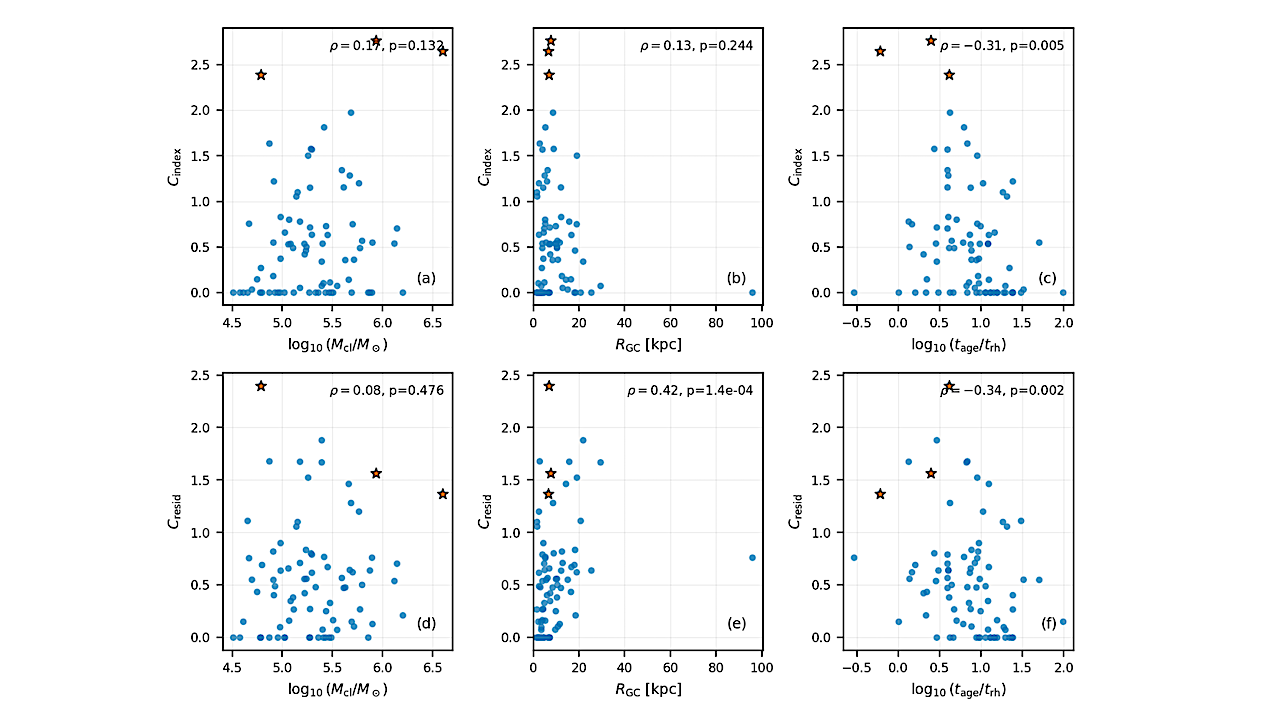
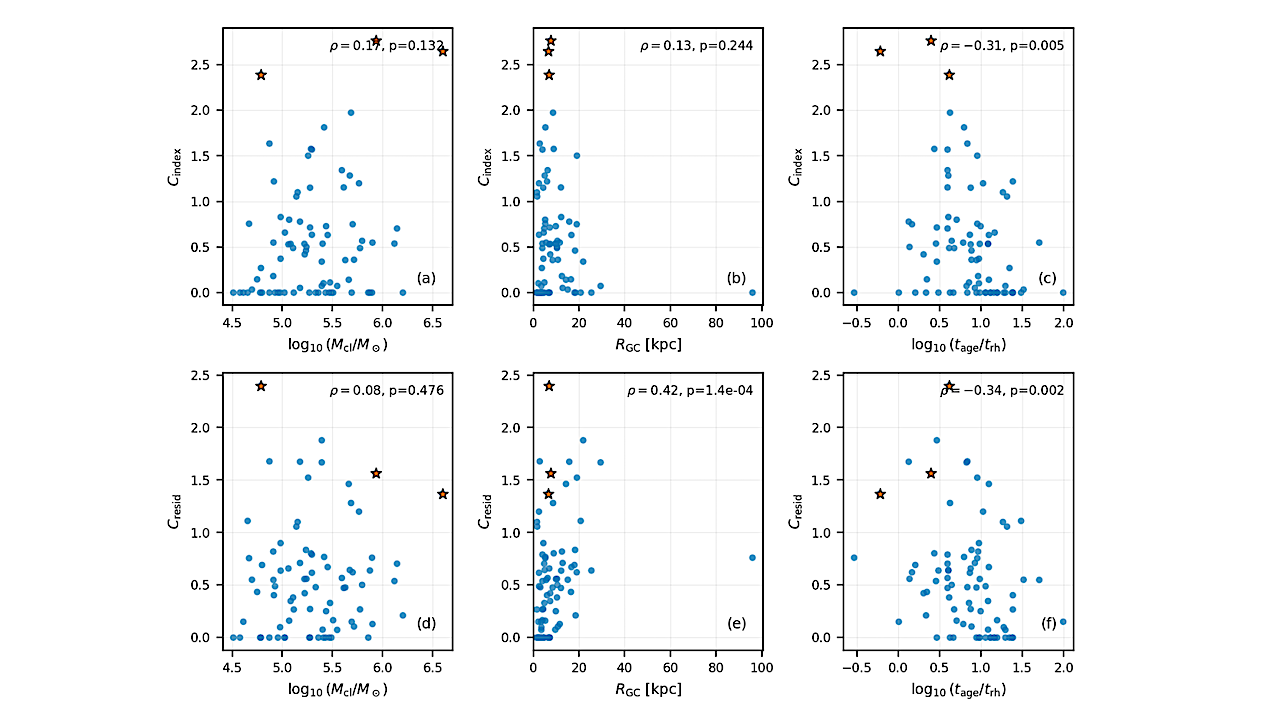
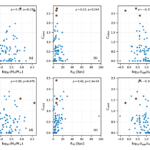
Correlations of crystallization metrics with cluster mass, Galactocentric distance, and a dynamical-age proxy. Top row: Cindex versus log(Mcl/M⊙), RGC, and log10(tage/trh). Bottom row: the N⋆-corrected residual index Cresid versus the same quantities. Spearman rank coefficients and two-sided p-values are printed in each panel. Star symbols mark Tier 1 clusters. — astro-ph.GA
We develop a model-independent framework to quantify phase-space “crystallization”, the degree of ordered radial and kinematic substructure, in 79 Galactic globular clusters using the Gaia EDR3-based membership catalogue of E. Vasiliev & H. Baumgardt (2021a).
We construct a scalar crystallization index, C_index, by combining a radial inhomogeneity metric (z_rad) and a local, cluster-centric tangential-velocity metric (z_vel) standardized against empirical nulls.
The population distribution is strongly non-Gaussian: most clusters are consistent with smooth, equilibrium expectations, while a small high-C tail (C_index >= 2) identifies dynamically complex systems, including NGC 5139 (omega Cen) and NGC 104 (47 Tuc). Correlation and fixed-N tests show that sample size affects detectability, but does not by itself explain all high-rank objects.
Through synthetic injection tests in dynamically “quiet” control clusters, we demonstrate sensitivity to ultra-cold, shell-confined kinematic components, ruling out single-shell structures comprising more than a few to ~ 10-20% of core stars in the best-sampled control clusters.
We find no evidence, within the sensitivity of the adopted diagnostics, for phase-space structures that require explanations beyond known dynamical processes. However, C_index provides a useful tool for ranking clusters by dynamical extremeness, serving both as a diagnostic for internal complexity and as a quantitative metric for prioritizing follow-up dynamical or technosignature-oriented observations.
Bo-Lun Huang, Zhen-Zhao Tao, Tong-Jie Zhang
Comments: 23 pages, 7 figures, 3 tables. Accepted for publication in The Astrophysical Journal (ApJ)
Subjects: Astrophysics of Galaxies (astro-ph.GA); Solar and Stellar Astrophysics (astro-ph.SR)
Cite as: arXiv:2605.06072 [astro-ph.GA] (or arXiv:2605.06072v1 [astro-ph.GA] for this version)
https://doi.org/10.48550/arXiv.2605.06072
Focus to learn more
Submission history
From: Bolun Huang
[v1] Thu, 7 May 2026 11:58:24 UTC (1,220 KB)
https://arxiv.org/abs/2605.06072
Astrobiology, SETI,










Related Posts
Stay Informed With the Latest & Most Important News
Previous Post
Next Post

Advertisement
-
 01Two Black Holes Observed Circling Each Other for the First Time
 -
 02From Polymerization-Enabled Folding and Assembly to Chemical Evolution: Key Processes for Emergence of Functional Polymers in the Origin of Life
 -
 03Astronomy 101: From the Sun and Moon to Wormholes and Warp Drive, Key Theories, Discoveries, and Facts about the Universe (The Adams 101 Series)
 -
 04True Anomaly hires former York Space executive as chief operating officer
 -
 05Φsat-2 begins science phase for AI Earth images
 -
 06Hurricane forecasters are losing 3 key satellites ahead of peak storm season − a meteorologist explains why it matters
 -
 07Binary star systems are complex astronomical objects − a new AI approach could pin down their properties quickly