
Now Reading: A Single Power Law For The TRAPPIST-1 Flare Distribution Across Four Orders Of Magnitude In Energy
-
01
A Single Power Law For The TRAPPIST-1 Flare Distribution Across Four Orders Of Magnitude In Energy

A Single Power Law For The TRAPPIST-1 Flare Distribution Across Four Orders Of Magnitude In Energy

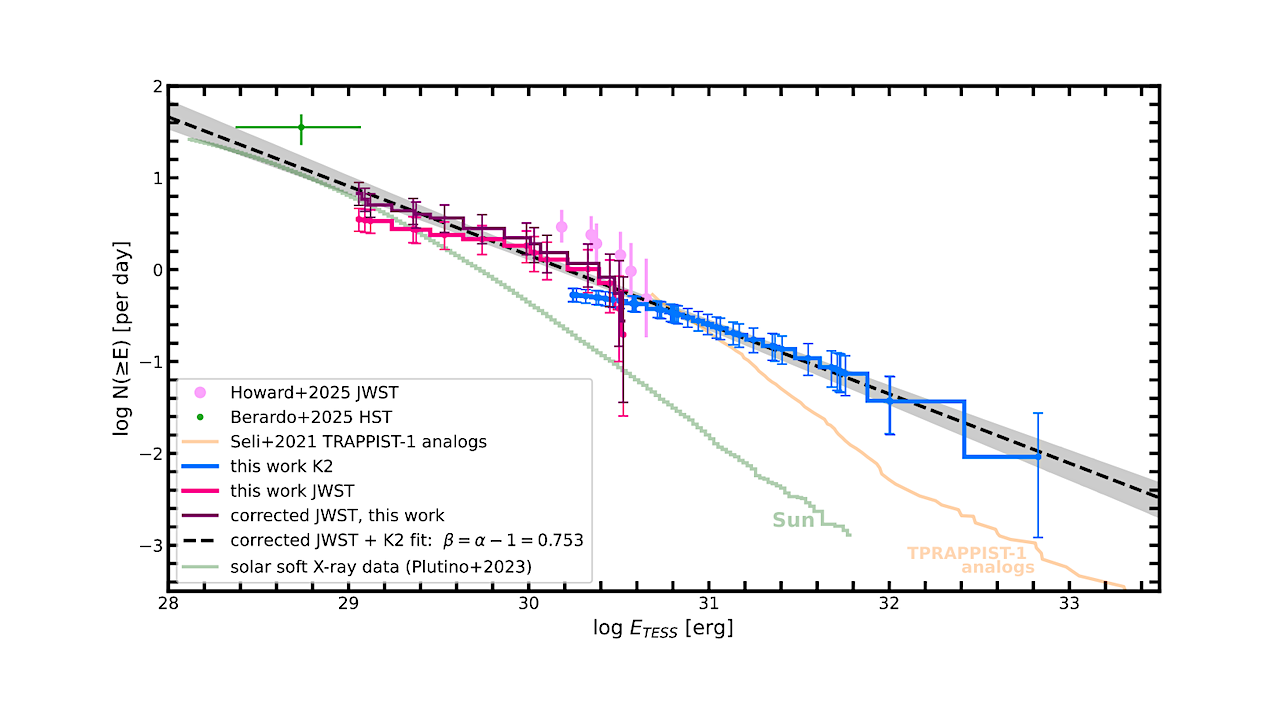
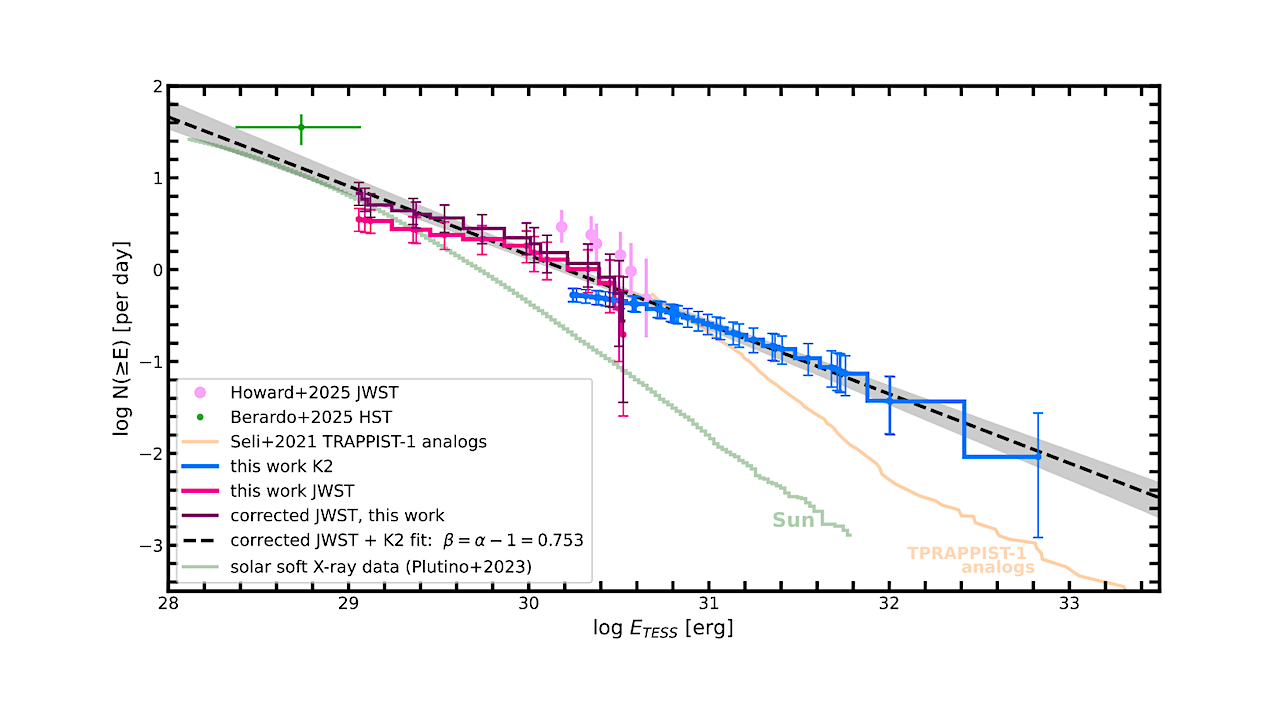
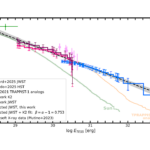
Cumulative flare-frequency distribution of TRAPPIST-1. The cumulative occurrence rate ν(≥ ETESS) is shown as a function of TESS-band flare energy. The K2 FFD from this work is shown in blue, the observed JWST FFD in magenta, and the JWST FFD after applying the injection–recovery completeness correction in purple. The light green curve shows the solar soft X-ray flare distribution, derived from the catalog of N. Plutino et al. (2023) and converted to the TESS band assuming Tflare = 9000 K (M. Kretzschmar 2011). The corrected JWST and K2 samples are consistent with a single power law in ETESS over ∼4 orders of magnitude (dashed black line), with the gray band indicating the 1σ bootstrap uncertainty. At flare energies above ∼ 1029 erg, the flare occurrence rate of TRAPPIST-1 exceeds that of the Sun. — astro-ph.SR
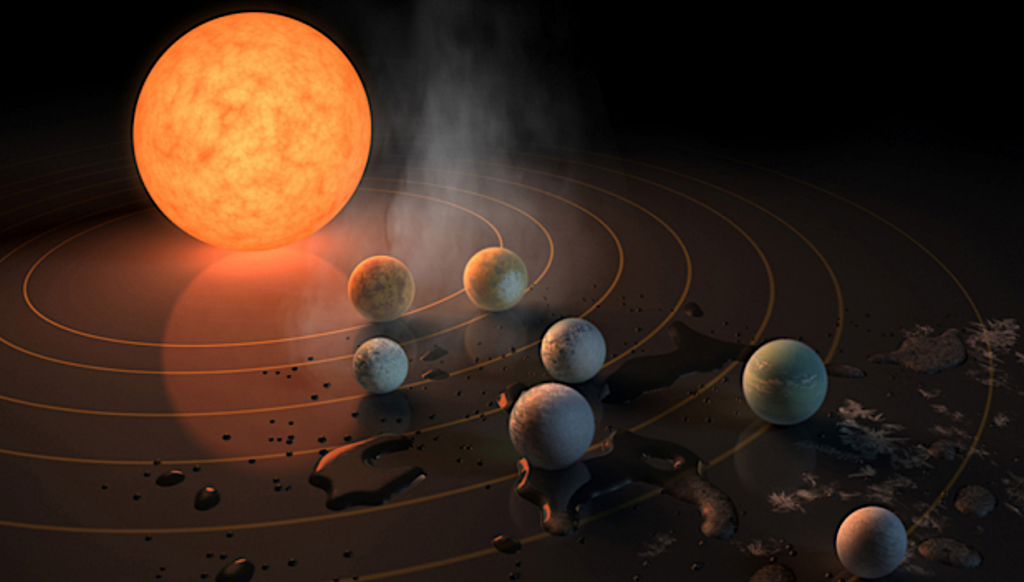
TRAPPIST-1 is an ultra-cool dwarf that flares frequently. These flares shape the surrounding planets’ high-energy irradiation environments, with consequences for atmospheric chemistry and escape, and they can contaminate transmission spectroscopy of those planets.
A quantitative flare-frequency distribution (FFD) spanning the full energy range is therefore essential for both interpreting JWST spectra and modeling the planets’ irradiation histories.
Here we present a unified FFD over four orders of magnitude in energy by jointly analyzing ≈87 hr of JWST/NIRISS and JWST/NIRSpec time-series spectroscopy together with ≈74 days of Kepler/K2 photometry. To enable a consistent comparison across these heterogeneous datasets, we convert all events to energies in the TESS bandpass. For the Kepler-to-TESS conversion we adopt a cooler flare continuum appropriate for ultra-cool dwarfs (Tflare=3500,K).
After correcting for flare-detection sensitivities, the combined JWST+K2 cumulative FFD is consistent with a single power law, N(≥ETESS)∝E−βTESS, with β=0.753 over ETESS≃1029-1033 erg. The slope of the distribution indicates that the time-averaged flare energy budget is dominated by rare, high-energy events rather than by the more numerous low-energy flares. This bandpass-consistent FFD provides a practical basis for JWST transit-spectroscopy planning and for modeling the flare-driven irradiation environment of the TRAPPIST-1 planets.
Valeriy Vasilyev, Alexander I. Shapiro, Nadiia Kostogryz, Chia-Lung Lin, Greg Kopp, Benjamin V. Rackham, Astrid M. Veronig, Olivia Lim, Julien de Wit, Daniel Apai, Laurent Gizon, Sami K. Solanki
Comments: submitted to ApJL
Subjects: Solar and Stellar Astrophysics (astro-ph.SR); Earth and Planetary Astrophysics (astro-ph.EP)
Cite as: arXiv:2605.05468 [astro-ph.SR] (or arXiv:2605.05468v1 [astro-ph.SR] for this version)
https://doi.org/10.48550/arXiv.2605.05468
Focus to learn more
Submission history
From: Valeriy Vasilyev
[v1] Wed, 6 May 2026 21:48:44 UTC (492 KB)
https://arxiv.org/abs/2605.05468
Astrobiology, heliophysics, space weather,










Related Posts
Stay Informed With the Latest & Most Important News
Advertisement
-
 01Two Black Holes Observed Circling Each Other for the First Time
 -
 02From Polymerization-Enabled Folding and Assembly to Chemical Evolution: Key Processes for Emergence of Functional Polymers in the Origin of Life
 -
 03Astronomy 101: From the Sun and Moon to Wormholes and Warp Drive, Key Theories, Discoveries, and Facts about the Universe (The Adams 101 Series)
 -
 04True Anomaly hires former York Space executive as chief operating officer
 -
 05Φsat-2 begins science phase for AI Earth images
 -
 06Hurricane forecasters are losing 3 key satellites ahead of peak storm season − a meteorologist explains why it matters
 -
 07Binary star systems are complex astronomical objects − a new AI approach could pin down their properties quickly