
Now Reading: A Preliminary Exploration Of The Effects Of Baseline Length For The LIFE Space Mission
-
01
A Preliminary Exploration Of The Effects Of Baseline Length For The LIFE Space Mission

A Preliminary Exploration Of The Effects Of Baseline Length For The LIFE Space Mission

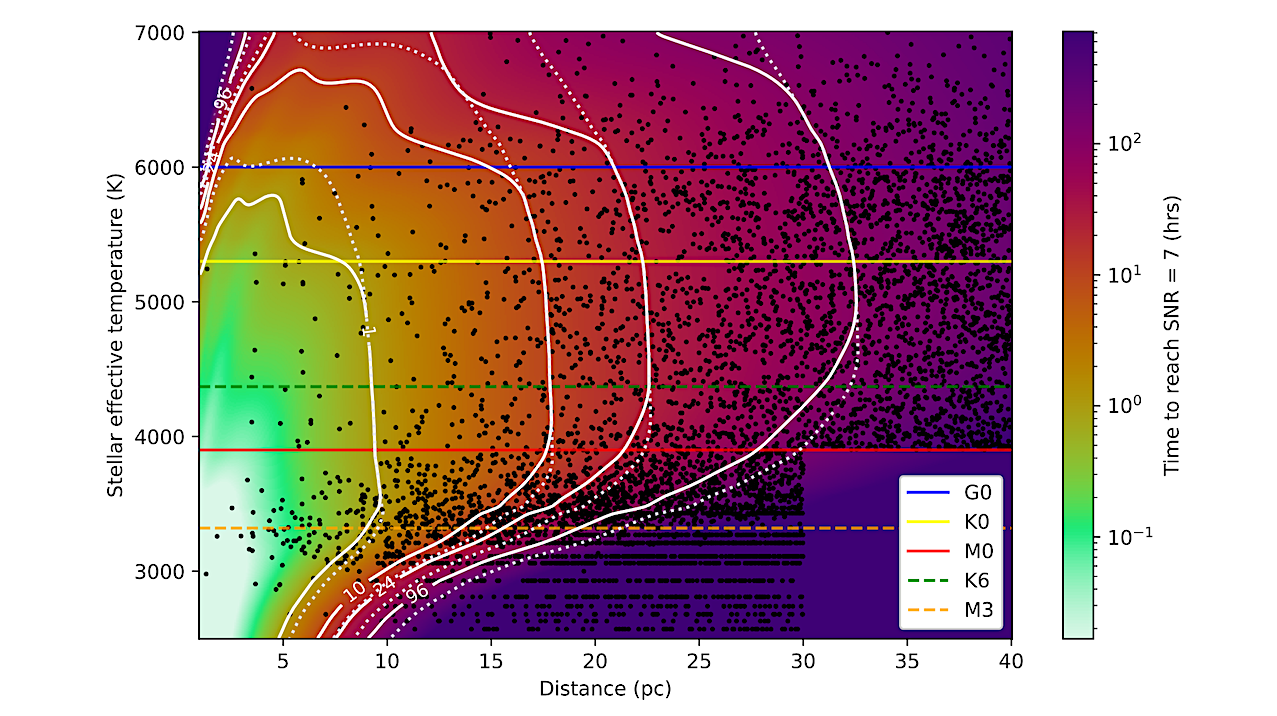

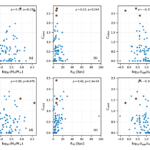
Integration time required for an Earth-twin around a given star to reach an SNR of 7, plotted as a function of stellar parameters. The baseline limits are set at 25-80 m. The LIFE stellar sample is over-plotted in black, and integration time contours are over-plotted in white. Dotted contours show the same integration time contours, but for the 10-100 m case for comparative purposes. Solid horizontal lines show the boundaries between stellar types of F, G, K and M; and dashed horizontal lines show the boundaries between LIFE’s target stellar populations. — astro-ph.IM
By aiming to find and characterise dozens of habitable exoplanets through the technique of nulling interferometry, the LIFE space mission will produce transformational science. One of the key parameters for such an interferometric mission is the nulling baseline length – the distance between nulled apertures, which past studies have assumed to be 10-100m.
Advances in planet occurrence statistics and simulation tools allow us now to revisit this key assumption with significantly more detail, particularly with the intention to reduce the range of baselines considered due to mission implementation concerns. We utilise the LIFEsim mission simulator along with revised mathematical tools to identify whether the range of baselines could be reduced without significantly affecting planet yield and fringe tracking performance.
Along the way, we also determine a new astrophysically motivated technique for choosing which baselines are optimal for a given science target. We find that indeed, LIFE could utilise a considerably shorter range of baselines, such as 25-80m, or even discrete baselines without much (<10%) loss of performance.
Nevertheless, careful trade-offs between performance and implementation simplification must be made, especially considering any spectral weighting that may be required by the scientific goals, and the potential loss of target-specific baseline optimisation.
Jonah T. Hansen, Thomas Birbacher, Felix A. Dannert, Philipp Huber, Andrea Fortier, Adrian M. Glauser, Jens Kammerer, Romain Laugier, Lia Sartori, Sascha P. Quanz
Comments: 32 pages, 20 figures, 1 table; Accepted for publication in the Publications of the Astronomical Society of the Pacific (PASP)
Subjects: Instrumentation and Methods for Astrophysics (astro-ph.IM); Earth and Planetary Astrophysics (astro-ph.EP)
Cite as: arXiv:2605.06648 [astro-ph.IM] (or arXiv:2605.06648v1 [astro-ph.IM] for this version)
https://doi.org/10.48550/arXiv.2605.06648
Focus to learn more
Submission history
From: Jonah Hansen
[v1] Thu, 7 May 2026 17:55:09 UTC (2,078 KB)
https://arxiv.org/abs/2605.06648
Astrobiology,










Related Posts
Stay Informed With the Latest & Most Important News
Previous Post
Next Post

Advertisement
-
 01Two Black Holes Observed Circling Each Other for the First Time
 -
 02From Polymerization-Enabled Folding and Assembly to Chemical Evolution: Key Processes for Emergence of Functional Polymers in the Origin of Life
 -
 03Astronomy 101: From the Sun and Moon to Wormholes and Warp Drive, Key Theories, Discoveries, and Facts about the Universe (The Adams 101 Series)
 -
 04True Anomaly hires former York Space executive as chief operating officer
 -
 05Φsat-2 begins science phase for AI Earth images
 -
 06Hurricane forecasters are losing 3 key satellites ahead of peak storm season − a meteorologist explains why it matters
 -
 07Binary star systems are complex astronomical objects − a new AI approach could pin down their properties quickly