
Now Reading: SES joins Eutelsat in canceling GEO expansion satellites
-
01
SES joins Eutelsat in canceling GEO expansion satellites


TAMPA, Fla. — SES has canceled two satellites Intelsat ordered before being acquired by the Luxembourg-based multi-orbit operator, joining France’s Eutelsat in pulling back from geostationary orbit expansion plans drawn up just a few years ago.
The company canceled the IS-41 and IS-44 satellites ordered from Thales Alenia Space as part of Intelsat’s post-bankruptcy growth plan in 2022, the same year Eutelsat tasked the European manufacturer to build Flexsat Americas, before recently scrapping the program to curb GEO spending.
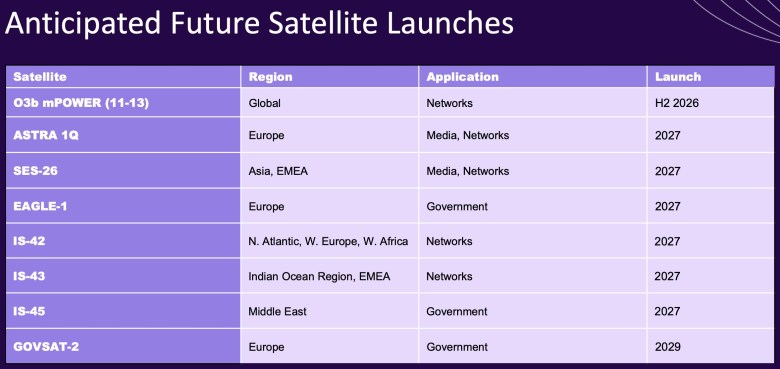
While SES did not name the two satellites it said during a May 12 earnings call were canceled as part of post-merger fleet rationalization efforts, they are now missing from the company’s list of upcoming launches.
The software-defined IS-41 and IS-44 satellites were until recently slated to launch in 2027, two years later than originally planned, to provide broadband across Africa, Europe, the Middle East and Asia.
Eutelsat’s Flexsat Americas was also to be based on Thales Alenia Space’s Inspire platform, enabling it to be reconfigured once in orbit in response to changing mission needs. Once set to launch in 2026, Flexsat was targeting deployment in 2028 before the cancellation.
Fleet rationalization
SES completed its acquisition of Intelsat in July 2025, creating a massive multi-orbit giant spanning more than 100 GEO and medium Earth orbit (MEO) satellites.
Intelsat also has a partnership with the OneWeb low Earth orbit (LEO) broadband satellites Eutelsat operates alongside its GEO business.
“Following the Intelsat acquisition, SES is optimizing across a larger, more resilient satellite fleet and reducing unnecessary duplication,” an SES spokesperson said in response to SpaceNews questions.
“As part of this normalization, SES is canceling two software‑defined satellite orders while retaining ample flexibility through four others and leveraging existing fleet capacity to ensure seamless, uninterrupted service for customers.”
During the earnings call, SES chief financial officer Lisa Pataki said the cancellations followed a review that included where it makes sense to extend the life of existing satellites with in-orbit services.
SES outlined five upcoming GEO life-extension missions in November, scheduled between 2026 and 2029, using servicers from Northrop Grumman’s SpaceLogistics subsidiary, Starfish Space and Infinite Orbits.
The operator still has IS-42 and IS-43 on its manifest, two software-defined satellites Intelsat ordered from Airbus in 2020 as part of the same plan for a 5G-compatible network that can be reconfigured in orbit. Originally slated to launch in 2023, they are now listed for 2027 alongside IS-45, a small GEO spacecraft Intelsat ordered from Swissto12 in 2022 that was initially scheduled for deployment in 2025.

SES reported 847 million euros ($992 million) in revenue for the first quarter of 2026, up 80.5% compared with the same period last year when adjusted for foreign currency variations, following the Intelsat acquisition.
Adjusted earnings before interest, taxes, depreciation and amortization (EBITDA) soared 57% to 404 million euros.
The growth was driven by aviation and government connectivity services, even as traditional GEO-heavy parts of the business faced headwinds in fixed data and video distribution.
SES said it is also progressing with the upgrade of its O3b MEO broadband fleet, with three more mPower satellites due this year and a next-generation network planned by 2030.
Similar pressures at Eutelsat
Eutelsat, which combined its GEO fleet with OneWeb’s LEO broadband network in 2023, reported a similar split May 12 between weakening legacy markets and growth from non-geostationary government and aviation services.
Like-for-like GEO revenues fell 4.3% for the three months to the end of March to 93.5 million euros, while LEO connectivity sales jumped 65% to 62.2 million euros.
Total revenues increased 3.1% to 293 million euros for the quarter.
In February, the French operator said canceling Flexsat Americas would save more than 100 million euros, amid “increased vigilance on GEO spend” while focusing capital expenditure on LEO.
Intelsat had an agreement to use Flexsat Americas as part of its multi-orbit capacity deal with Eutelsat.
More than 440 LEO satellites have been ordered from Airbus to replenish the OneWeb constellation in the coming years. Eutelsat is also preparing to contribute LEO spacecraft to IRIS², Europe’s sovereign connectivity program targeting services around 2030.
The company also plans to lease half the Ku-band capacity on what it calls Flexsat Asia, a satellite Thailand’s Thaicom ordered from Airbus in 2023 for launch in 2027.










Related Posts


Stay Informed With the Latest & Most Important News
Previous Post
Next Post




Advertisement
-
 01Two Black Holes Observed Circling Each Other for the First Time
 -
 02From Polymerization-Enabled Folding and Assembly to Chemical Evolution: Key Processes for Emergence of Functional Polymers in the Origin of Life
 -
 03Astronomy 101: From the Sun and Moon to Wormholes and Warp Drive, Key Theories, Discoveries, and Facts about the Universe (The Adams 101 Series)
 -
 04True Anomaly hires former York Space executive as chief operating officer
 -
 05Φsat-2 begins science phase for AI Earth images
 -
 06Hurricane forecasters are losing 3 key satellites ahead of peak storm season − a meteorologist explains why it matters
 -
 07Binary star systems are complex astronomical objects − a new AI approach could pin down their properties quickly