
Now Reading: SpaceX sets date for first Starship version 3 launch
-
01
SpaceX sets date for first Starship version 3 launch


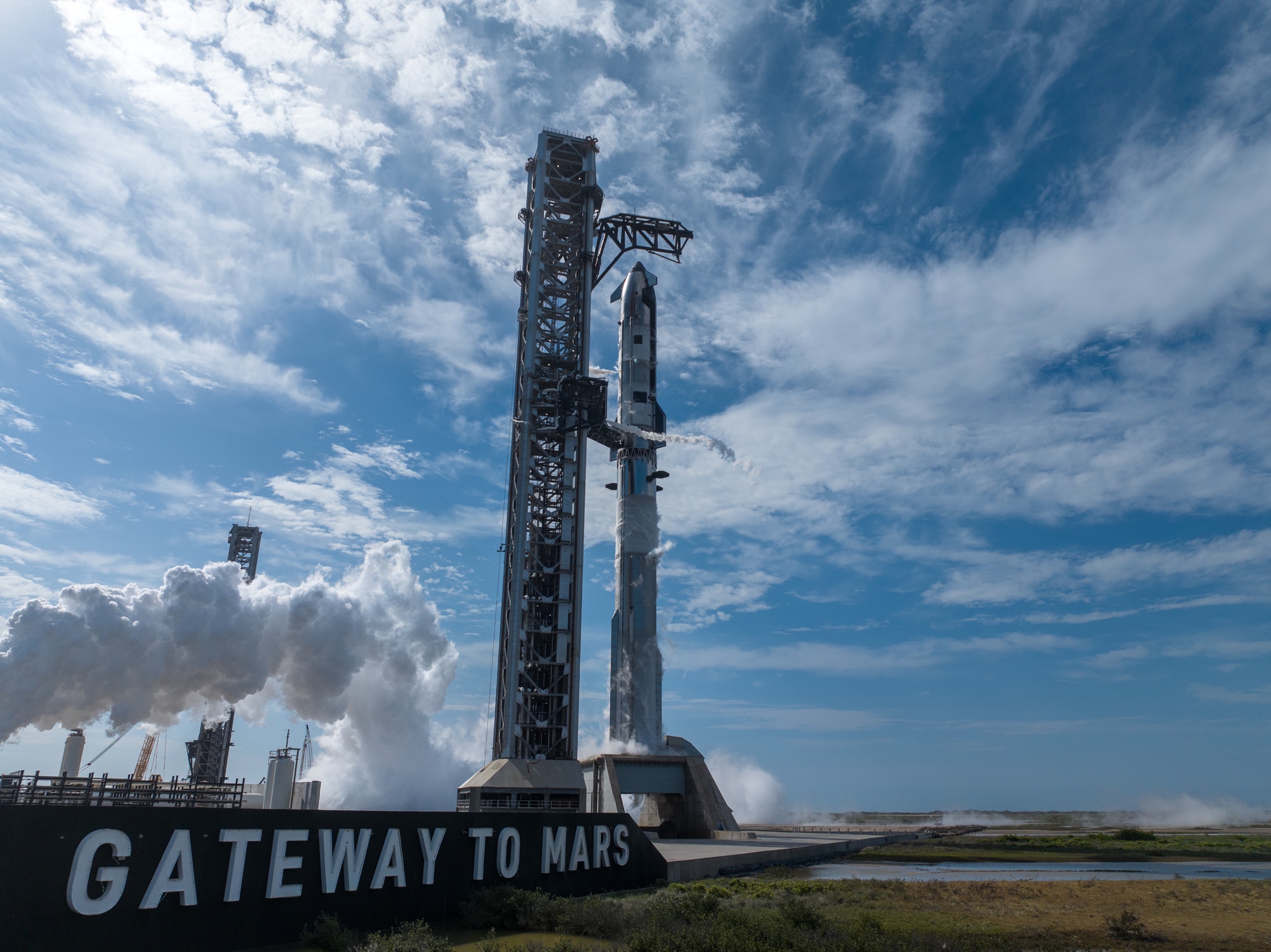

WASHINGTON — SpaceX has set a date for the long-delayed first launch of its next-generation Starship vehicle, which is critical to the company’s ambitions as well as NASA’s lunar plans.
SpaceX announced May 12 that it is planning a launch of the first Starship version 3 vehicle as soon as May 19 from its Starbase facility in South Texas. Liftoff is planned for 6:30 p.m. Eastern.
The announcement came a day after SpaceX performed a wet dress rehearsal, fueling the Starship upper stage and Super Heavy booster on the pad. The company appeared to cut short a similar fueling test two days earlier.
The launch will be the first flight of version 3 of Starship, with upgrades to both stages to improve vehicle performance, such as upgraded Raptor engines. It will also use a new launch pad at Starbase.
“The flight test’s primary goal will be to demonstrate each of these new pieces in the flight environment for the first time, with each element of the Starship architecture featuring significant redesigns to enable full and rapid reuse that incorporate learnings from years of development and test,” the company stated.
The profile for this suborbital launch, called Flight 12, will be similar to some previous ones, but with a few changes. The Super Heavy booster will not attempt a return to the launch site, instead performing a soft splashdown in the Gulf of Mexico.
The Starship upper stage, once in space, will deploy 22 mass simulators that model next-generation Starlink satellites. Two of those spacecraft will have imagery payloads to scan the vehicle’s heat shield, which SpaceX said will test methods of confirming the heat shield’s readiness to support a reentry and return to the launch site on later missions.
Starship will also relight a single Raptor engine, similar to tests on previous flights. During reentry, Starship will test maneuvers intended to intentionally stress the vehicle and also simulate those needed for future returns to launch sites. A single heat shield tile was intentionally removed from the vehicle to test aerodynamic forces on neighboring tiles.
Shortly after completing the previous Starship test flight in October, the last of version 2 of the vehicle, the company projected Flight 12 could take place as soon as January. However, the Super Heavy booster originally built for the flight was damaged in November during testing.
In late January, SpaceX Chief Executive Elon Musk announced on social media that Flight 12 would take place in about six weeks, or early March. However, by early March, Musk said the launch was now four weeks away. In early April, he said the launch was four to six weeks away.
Neither Musk nor SpaceX have disclosed details about the delays, although the company released a mini-documentary last month highlighting the work being done on Starship, including issues during testing of the vehicle and the new launch pad.
Version 3 of Starship is critical for SpaceX because it is the version the company plans to use for orbital missions. That includes deployment of next-generation Starlink satellites as well as Starship’s use as a lunar lander for NASA’s Artemis program.
“That’s really going to be our production rocket,” Kiko Dontchev, vice president of launch at SpaceX, said at a conference in November.
Additional spaceports
SpaceX also addressed reports May 12 that the company is pursuing a large parcel of land in Louisiana that could be used for Starship activities in some way.
A Louisiana state senator, Bob Hensgens, said May 7 he was aware of interest by either SpaceX or Blue Origin in acquiring land in the southern part of the state, near the Gulf Coast. That includes one parcel of 55,000 hectares owned by Exxon but not being used by the oil company.
SpaceX acknowledged the report and, while not explicitly confirming interest in that land, noted it is seeking additional launch sites for Starship.
“It’s no secret that we intend to launch Starship a lot, targeting thousands of flights per year. That cadence will require the ability to launch from many different locations, so we are constantly exploring to find viable sites to expand Starship operations in the future, both domestically and internationally,” the company stated.
Besides Starbase, SpaceX is constructing a Starship launch pad at Kennedy Space Center’s Launch Complex 39A and two pads at Cape Canaveral Space Force Station’s Space Launch Complex 37.
While SpaceX’s comments about interest in international launch sites attracted considerable attention, that interest is not new. In 2017, Musk said in a speech at the International Astronautical Congress that the company would pursue point-to-point travel using the vehicle now known as Starship, showing a video of a vehicle launching near New York and landing a half-hour later near Shanghai.
Such point-to-point travel faces not just technical but also regulatory challenges. Launch vehicles are governed by strict regulations for export control and missile nonproliferation, making it difficult for U.S. companies to operate them outside the country except for close allies, and only after completing negotiations on technology safeguard agreements.










Related Posts
Stay Informed With the Latest & Most Important News
Previous Post
Next Post



Advertisement
-
 01Two Black Holes Observed Circling Each Other for the First Time
 -
 02From Polymerization-Enabled Folding and Assembly to Chemical Evolution: Key Processes for Emergence of Functional Polymers in the Origin of Life
 -
 03Astronomy 101: From the Sun and Moon to Wormholes and Warp Drive, Key Theories, Discoveries, and Facts about the Universe (The Adams 101 Series)
 -
 04True Anomaly hires former York Space executive as chief operating officer
 -
 05Φsat-2 begins science phase for AI Earth images
 -
 06Hurricane forecasters are losing 3 key satellites ahead of peak storm season − a meteorologist explains why it matters
 -
 07Binary star systems are complex astronomical objects − a new AI approach could pin down their properties quickly