
Now Reading: Exploring Enceladus’s Interior Structure Using Electromagnetic Induction
-
01
Exploring Enceladus’s Interior Structure Using Electromagnetic Induction


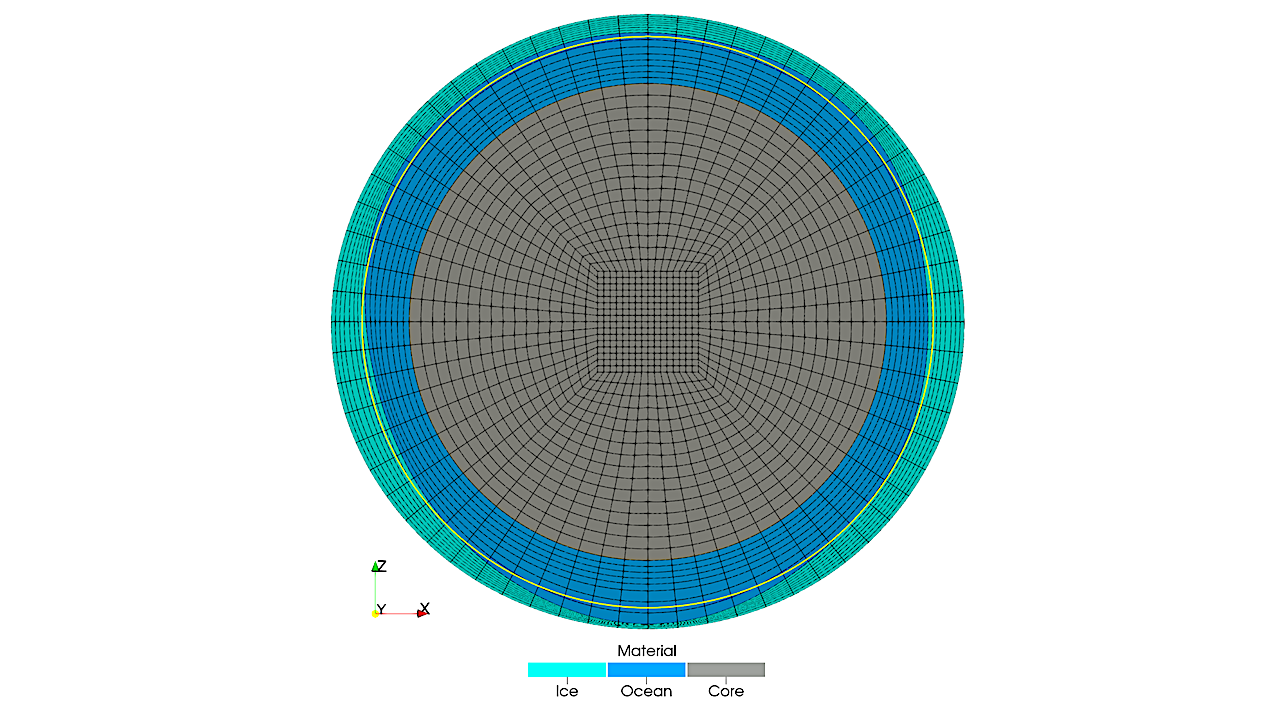
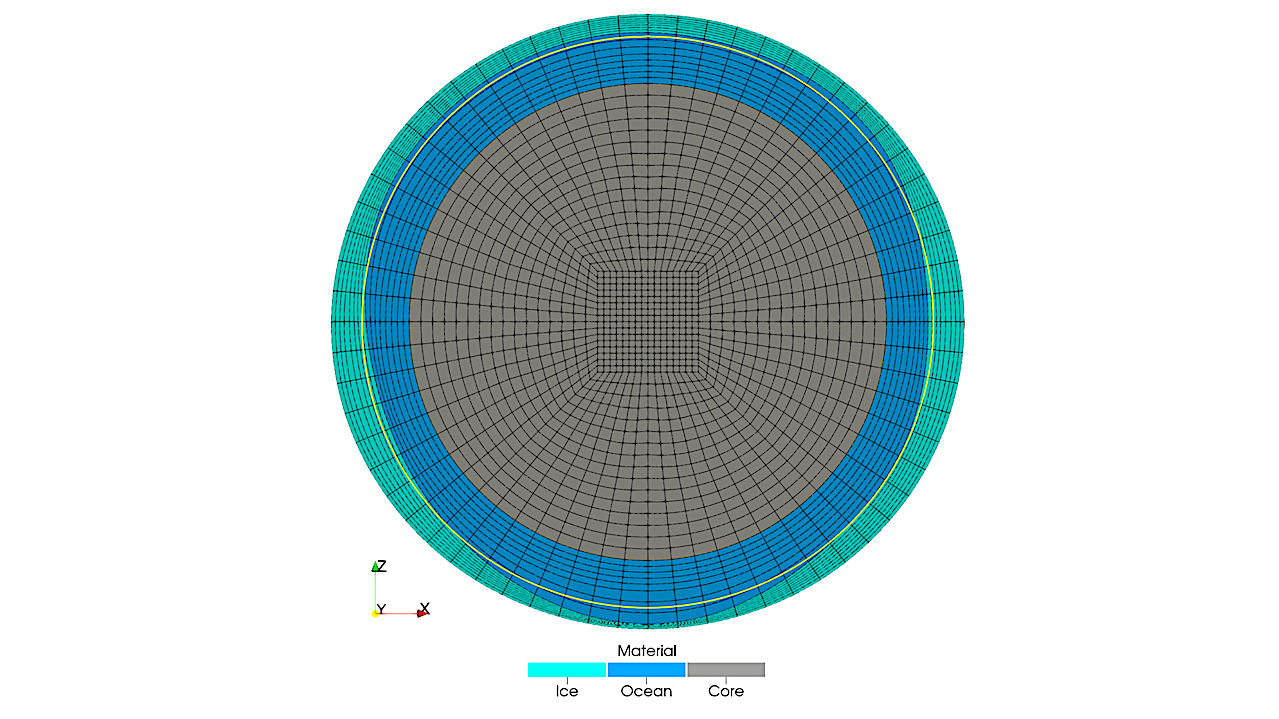
Discrete mesh for the 3-D model with a heterogeneous ice shell thickness. The ice shell surface and base are constrained by models depicted in Figure 1 and described in Table 1. The yellow circle depicts the ice base of the mean ice shell, corresponding to the 1-D model. Three colors denote ice, ocean, and core regions. Each region is assigned a homogeneous electrical conductivity according to Table 2. The total number of cells in the mesh is 126976. — astro-ph.EP
Electromagnetic (EM) sounding can constrain the electrical structure of Enceladus and, in turn, the salinity of its ocean and the porosity, fluid content, and thermal state of its hydrothermally active core.
Here, we assess the feasibility of EM sounding at Enceladus using both global (orbiter) and local (lander) EM induction transfer functions. We provide a physical framework for modeling EM induction for 1-D and 3-D subsurface conductivity models and discuss how transfer functions can be estimated from global or local measurements of the magnetic and electric fields.
We simulate 3-D induction effects arising from variations in ice-shell thickness. The magnitude of these effects in the magnetic field correlates with the ice-shell thickness at the surface and is strongly dependent on the ocean’s conductivity. These magnetic variations, if observed, would favor a moderately to highly conductive ocean, providing lower bounds on salinity and volatile content. The absence of these effects indicates a thicker, more homogeneous ice shell and/or a lower-conductivity ocean. Given plausible magnitudes, a polar-orbiting mission with low-altitude measurements will be required to detect these effects.
In summary, an orbiter will constrain global ocean conductivity using long-period induction and possibly map the ice thickness variations. The detailed EM sounding of both the hydrosphere and the core can be achieved by a lander-based broadband EM sounding at periods ≈101−105 s to probe ocean salinity and thickness, as well as core properties including porosity, fluid content, and temperature.
Alexander Grayver, Joachim Saur
Subjects: Earth and Planetary Astrophysics (astro-ph.EP); Geophysics (physics.geo-ph); Space Physics (physics.space-ph)
Cite as: arXiv:2605.09052 [astro-ph.EP] (or arXiv:2605.09052v1 [astro-ph.EP] for this version)
https://doi.org/10.48550/arXiv.2605.09052
Focus to learn more
Submission history
From: Alexander Grayver
[v1] Sat, 9 May 2026 16:55:24 UTC (6,815 KB)
https://arxiv.org/abs/2605.09052
Astrobiology, Astrogeology,










Related Posts

Stay Informed With the Latest & Most Important News



Advertisement
-
 01Two Black Holes Observed Circling Each Other for the First Time
 -
 02From Polymerization-Enabled Folding and Assembly to Chemical Evolution: Key Processes for Emergence of Functional Polymers in the Origin of Life
 -
 03Astronomy 101: From the Sun and Moon to Wormholes and Warp Drive, Key Theories, Discoveries, and Facts about the Universe (The Adams 101 Series)
 -
 04True Anomaly hires former York Space executive as chief operating officer
 -
 05Φsat-2 begins science phase for AI Earth images
 -
 06Hurricane forecasters are losing 3 key satellites ahead of peak storm season − a meteorologist explains why it matters
 -
 07Binary star systems are complex astronomical objects − a new AI approach could pin down their properties quickly