
Now Reading: HAT-P-70b Through The Eyes of MAROON-X: Constraining Elemental Abundances of Metals and Insights on Atmosphere Dynamics
-
01
HAT-P-70b Through The Eyes of MAROON-X: Constraining Elemental Abundances of Metals and Insights on Atmosphere Dynamics

HAT-P-70b Through The Eyes of MAROON-X: Constraining Elemental Abundances of Metals and Insights on Atmosphere Dynamics

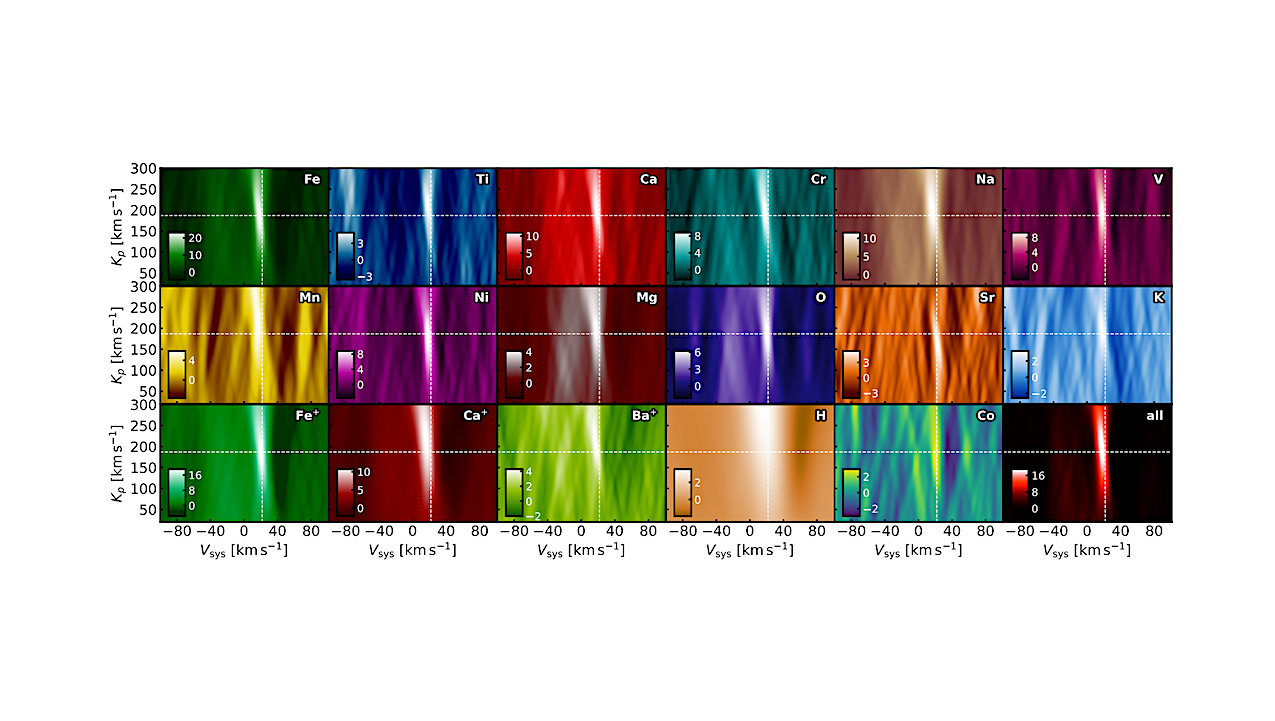

Kp – Vsys maps for species which we claim a detection or a tentative detection in HAT-P-70b’s atmosphere with 2 transits from the MAROON-X spectrograph. White dashed lines indicate the expected position of the signal, assuming a symmetric planet with a static atmosphere. Peaks of the cross-correlation function are shown as white regions near the expected position. The peaks show a slight offset in Vsys, indicative of the presence of strong winds in the atmosphere. The standard deviation is calculated with from a box delimited by Vsys = −100 km s−1 and Vsys = 0 km s−1 — astro-ph.EP
Ultra-hot Jupiters (UHJs) are exceptional laboratories for studying planetary atmospheres under extreme irradiation conditions.
With close-in tidally locked orbits, these planets can have daysides hot enough for metals to be significantly ionized while still maintaining nightsides cold enough for refractory species to potentially condense.
We present an analysis of the ultra-hot Jupiter HAT-P-70b taken with the MAROON-X high-resolution spectrograph. Using cross-correlations, we detect 14 neutral and singly ionized species, including Fe I, Fe II, Ti I, Ca I, Ca II, Cr I, Na I, V I, Mn I, Ni I, Mg I, Ba II, O I, and Sr I, with tentative evidence for H I, Co I, and K I. The absorption signals exhibit blueshifts on the order of a few kms−1, consistent with day-to-night winds.
We further constrain relative abundances with atmospheric retrievals and demonstrate that some inferred elemental abundance ratios depend strongly on modeling assumptions.
In particular, we show that a well-mixed retrieval approach neglecting ionization can strongly bias highly ionizable elements such as Ca and Ti. Accounting for the effects of equilibrium chemistry and thermal ionization generally results in inferred elemental abundance ratios that are closer to expectations for a solar-like composition, although not in all cases.
Interestingly, we find a distinct nickel enrichment on HAT-P-70b, adding to the growing number of UHJ studies where the Ni abundance is seemingly enhanced. Our results underline the importance of considering physical and chemical atmospheric processes such as ionization when interpreting high-resolution transmission spectra of UHJs.
Shi Lin Sun, Stefan Pelletier, Björn Benneke, Bibiana Prinoth, Vivien Parmentier, Jacob L. Bean, Joost P. Wardenier, Yayaati Chachan, Valentina Vaulato
Comments: 23 pages, 11 figures, 5 tables, accepted for publication in AJ
Subjects: Earth and Planetary Astrophysics (astro-ph.EP)
Cite as: arXiv:2605.07873 [astro-ph.EP] (or arXiv:2605.07873v1 [astro-ph.EP] for this version)
https://doi.org/10.48550/arXiv.2605.07873
Focus to learn more
Submission history
From: Shi Lin Sun
[v1] Fri, 8 May 2026 15:30:59 UTC (7,184 KB)
https://arxiv.org/abs/2605.07873
Astrobiology, exoplanet,










Related Posts

Stay Informed With the Latest & Most Important News
Previous Post
Next Post



Advertisement
-
 01Two Black Holes Observed Circling Each Other for the First Time
 -
 02From Polymerization-Enabled Folding and Assembly to Chemical Evolution: Key Processes for Emergence of Functional Polymers in the Origin of Life
 -
 03Astronomy 101: From the Sun and Moon to Wormholes and Warp Drive, Key Theories, Discoveries, and Facts about the Universe (The Adams 101 Series)
 -
 04True Anomaly hires former York Space executive as chief operating officer
 -
 05Φsat-2 begins science phase for AI Earth images
 -
 06Hurricane forecasters are losing 3 key satellites ahead of peak storm season − a meteorologist explains why it matters
 -
 07Binary star systems are complex astronomical objects − a new AI approach could pin down their properties quickly