
Now Reading: Iridium to take over Aireon to expand aviation safety business
-
01
Iridium to take over Aireon to expand aviation safety business


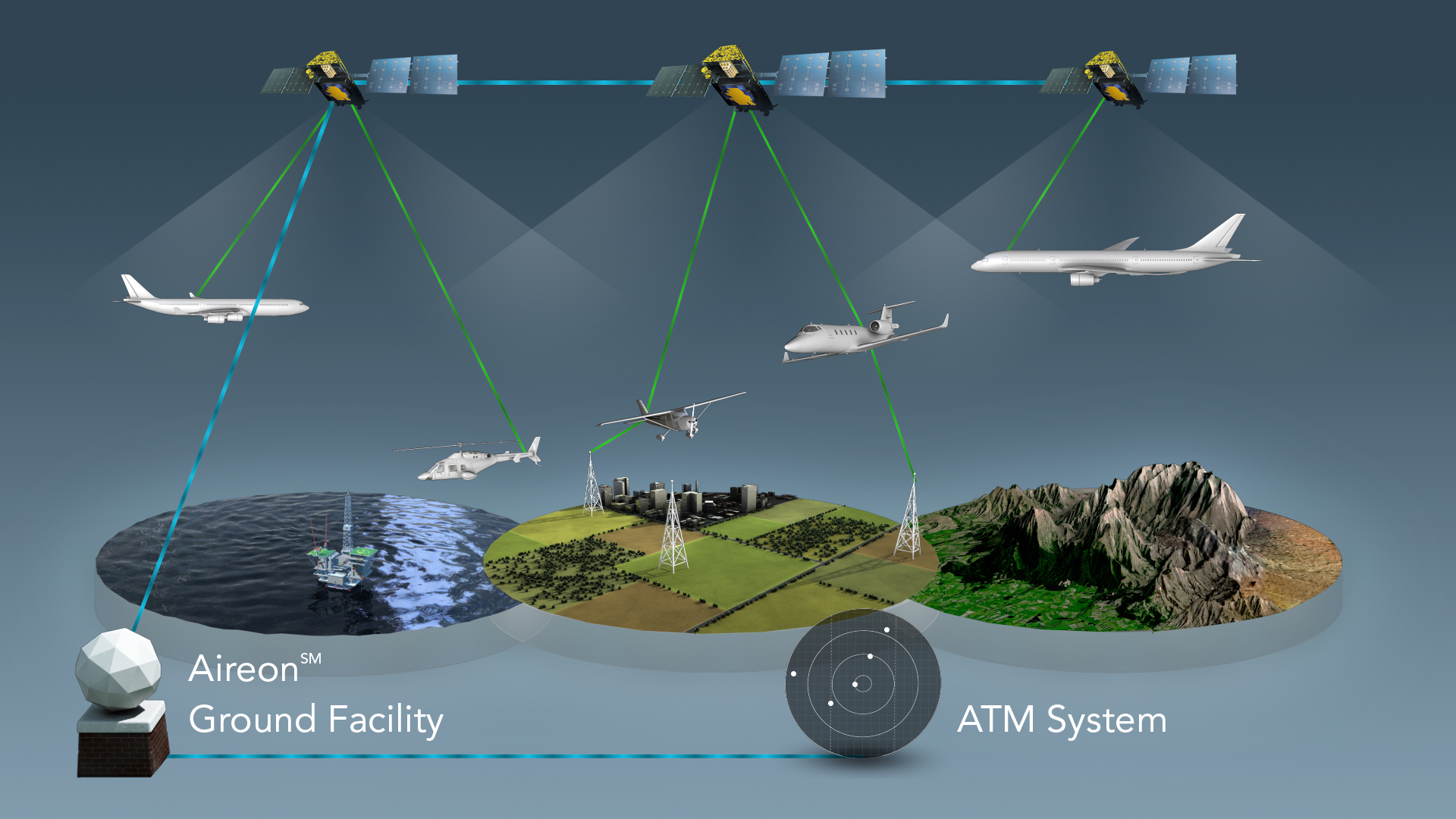
TAMPA, Fla. — Iridium Communications is buying the rest of the Aireon aircraft-tracking venture its connectivity constellation hosts to push further into aviation safety, surveillance and data services.
The McLean, Virginia-based operator said May 14 it has agreed to acquire the remaining 61% of Aireon it does not already own for about $367 million from five air navigation service providers, or ANSPs: NAV CANADA, NATS (England), Naviair (Denmark), AirNav Ireland and Italy’s ENAV.
Aireon has provided a tracking service using the Automatic Dependent Surveillance-Broadcast (ADS-B) signals broadcast by aircraft since 2019, when the last of the 66 operational Iridium Next satellites were deployed in low Earth orbit.
Supported by GPS and other global navigation satellite systems, these signals provide air traffic controllers with more precise flight information and could play a growing role in AI-driven aviation safety and efficiency tools.
“We’re tracking 13,000 aircraft at any given time,” Aireon CEO Don Thoma said during a media briefing. “It’s something on the order of 190,000 flights a day that we’re tracking from takeoff to landing.”
NAV CANADA and NATS plan to extend data services agreements through 2035 as part of the deal, while Naviair said separately it has recently signed a new contract with Aireon for surveillance data supporting Greenland airspace.
AirNav Ireland is still in “the deployment stage,” Thoma said, while Italy’s ENAV had never signed on as a customer.
Aireon expects to sign up more ANSPs, including the U.S. Federal Aviation Administration. Thoma said the FAA’s modernization efforts, including upgrading air traffic control systems, remove one of the roadblocks.
Next-gen services
The NAV CANADA and NATS agreements include provisions to continue cooperating on a space-based VHF communications service to extend pilot-to-controller voice and data communications into oceanic and remote airspace, using radio equipment already on aircraft.
Space-based VHF will require new satellites, Iridium CEO Matt Desch noted during the media briefing, after revealing plans last year to explore a network of small satellites.
While he said Iridium does not need to replace its current network until at least 2035, the company is studying additional missions that could launch before then to add capabilities such as space-based VHF, advanced ADS-B and more resilient positioning, navigation and timing (PNT) services.
In 2024, Iridium took over Satelles, a GPS backup provider that uses the operator’s L-band satellites. Additional payloads could improve the accuracy and resilience of Iridium’s alternative PNT service, Desch continued, potentially making it more accurate than current GPS while remaining harder to jam or spoof.
Taking over Aireon would give Iridium full control of a business that includes GPS jamming and spoofing detection, alongside real-time and historical flight data.
“We have a very rich data set in our satellites,” Desch added, with “66 satellites developing thousands of … data points every second — and we’re now at a point we can mine that to uncover all kinds of interesting things about operating and interference … that we couldn’t do 5-10 years ago.”
Deal dynamics
The purchase price will be paid in two equal installments: half at closing and the rest one year later.
Iridium would also assume about $155 million of Aireon debt when the transaction closes, which they expect in early July, pending regulatory approvals.
According to the companies, Aireon’s revenue has grown at a 10% compound annual growth rate over the past three years. Iridium expects the acquisition to add at least $100 million in annualized service revenue and $30 million in annualized operational EBITDA, or earnings before interest, taxes, depreciation and amortization.
The operator plans to fund the deal with existing financial resources, including borrowings under its revolving credit facility and future cash from operations.










Related Posts


Stay Informed With the Latest & Most Important News
Previous Post
Next Post
Advertisement
-
 01Two Black Holes Observed Circling Each Other for the First Time
 -
 02From Polymerization-Enabled Folding and Assembly to Chemical Evolution: Key Processes for Emergence of Functional Polymers in the Origin of Life
 -
 03Astronomy 101: From the Sun and Moon to Wormholes and Warp Drive, Key Theories, Discoveries, and Facts about the Universe (The Adams 101 Series)
 -
 04True Anomaly hires former York Space executive as chief operating officer
 -
 05Φsat-2 begins science phase for AI Earth images
 -
 06Hurricane forecasters are losing 3 key satellites ahead of peak storm season − a meteorologist explains why it matters
 -
 07Binary star systems are complex astronomical objects − a new AI approach could pin down their properties quickly