
Now Reading: Two Spacecraft Observed Both Hemispheres Of Interstellar Comet 3I/ATLAS Simultaneously
-
01
Two Spacecraft Observed Both Hemispheres Of Interstellar Comet 3I/ATLAS Simultaneously

Two Spacecraft Observed Both Hemispheres Of Interstellar Comet 3I/ATLAS Simultaneously

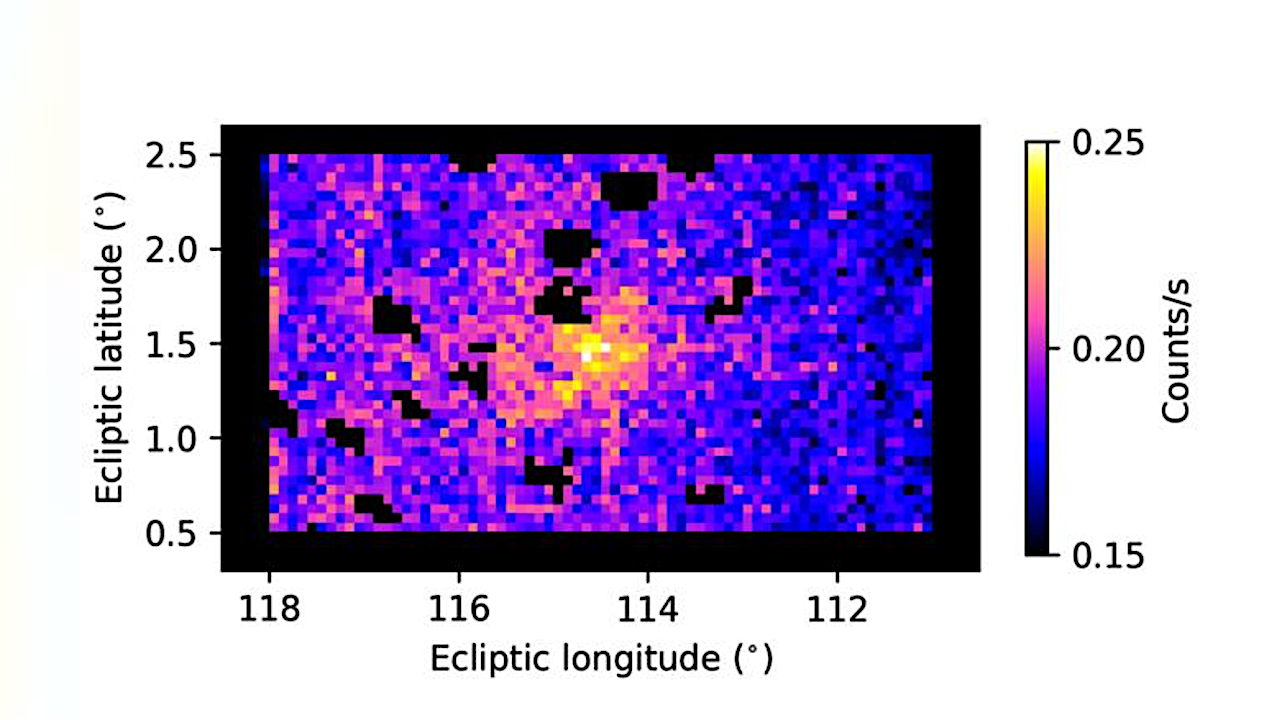
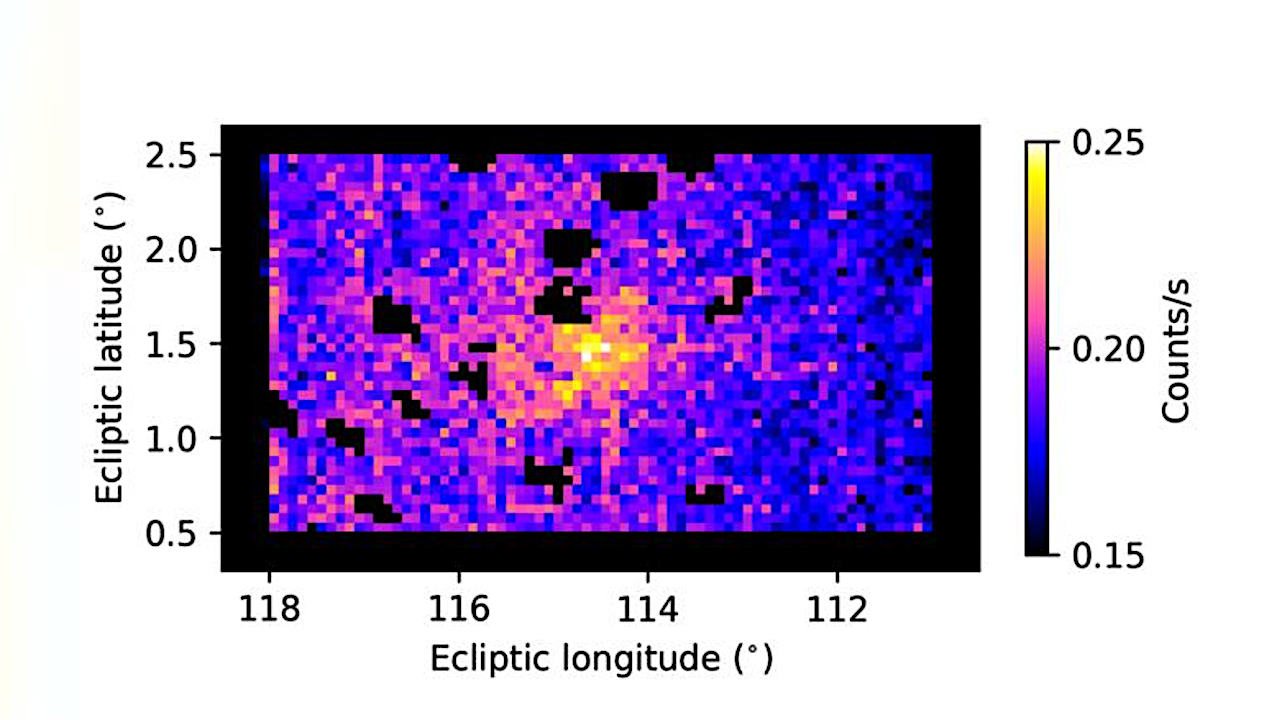
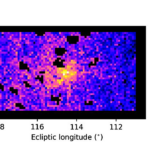
Juice-UVS saw gas and dust elements stretching up to more than 5 million km from 3I/ATLAS’s nucleus on November 25, 2025, when the comet had dimmed considerably relative to November 2 observations. Black spots are where stars appeared in the scanned image, removed here for clarity. Credit: NASA/ESA/Southwest Research Institute
The Southwest Research Institute-led Ultraviolet Spectrograph (UVS) instruments aboard ESA’s Jupiter Icy Moons Explorer (Juice) spacecraft and NASA’s Europa Clipper made unique observations of interstellar comet 3I/ATLAS in late 2025. SwRI leads the UVS instruments on both spacecraft, simultaneously imaging both hemispheres of the comet and detecting the comet’s ultraviolet emissions.
Only the third recognized interstellar object, 3I/ATLAS entered our solar system in July of 2025.
“As the comet passed between Juice and Europa Clipper, we were able to informally coordinate observations between the two spacecraft,” said Dr. Kurt Retherford, the principal investigator of Juice-UVS and Europa-UVS. “Crucially, we observed hydrogen, oxygen and carbon emissions. These elements are produced when gases escaping the comet’s nucleus break apart into atoms when exposed to sunlight.”
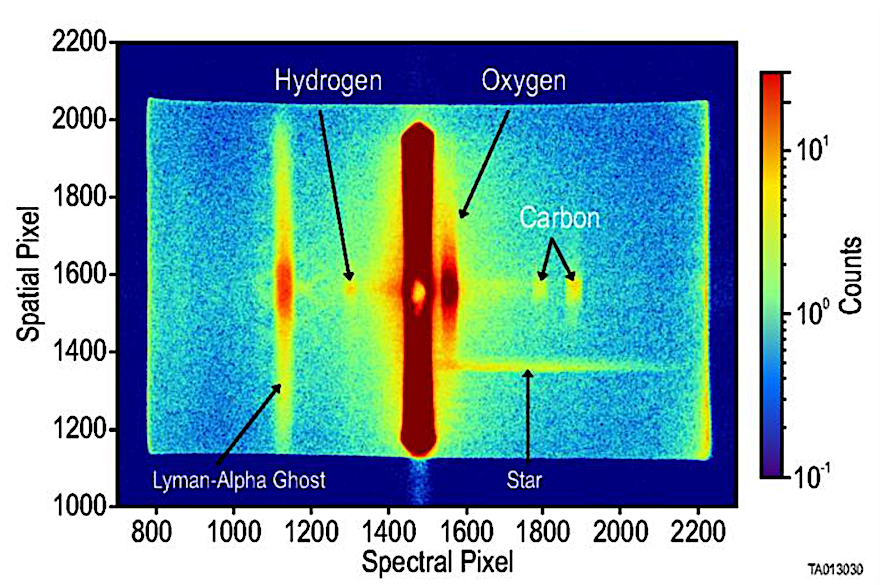
The Southwest Research Institute-led Ultraviolet Spectrograph (UVS) aboard ESA’s Jupiter Icy Moons Explorer (Juice) spacecraft observed the interstellar comet 3I/ATLAS, revealing higher levels of carbon emissions than expected, especially in comparison to native comets. The oxygen signals and hydrogen signals (seen both directly and in an instrument artifact called a “ghost”) inform the rates of outgassing of water just after the comet’s nearest approach to the Sun. Credit: NASA/ESA/Southwest Research Institute
UVS is one of 10 science instruments aboard the Juice spacecraft. The mission has overarching goals of investigating potentially habitable worlds around the gas giant and studying the Jupiter system as an archetype for gas giants in our solar system and beyond.
“Observing the interstellar comet was some exciting bonus science. The resulting rare and unique dataset includes gas emissions and scattered dust,” said SwRI’s Dr. Philippa Molyneux, co-deputy principal investigator for the Juice-UVS instrument. “This was the first time we’ve had simultaneous direct views of a comet’s coma of escaping gas from two directions. Europa Clipper showed us the night side of the comet, with a great deal of scattered dust, while Juice imaged mostly glowing gas on the day side.”
Comets are composed of water ice, dry ice (i.e., CO2 ice) and other materials. As they approach the Sun, comets heat up, and their components escape into space. The researchers found higher levels of carbon emissions from 3I/ATLAS than expected early on, especially in comparison to typical comets from our solar system, corroborating similar findings through other observations about the interstellar comet’s origin and composition. Observing the trends of emissions over several days revealed how the ratios of these molecules changed and how the comet evolved during its journey through our solar system.
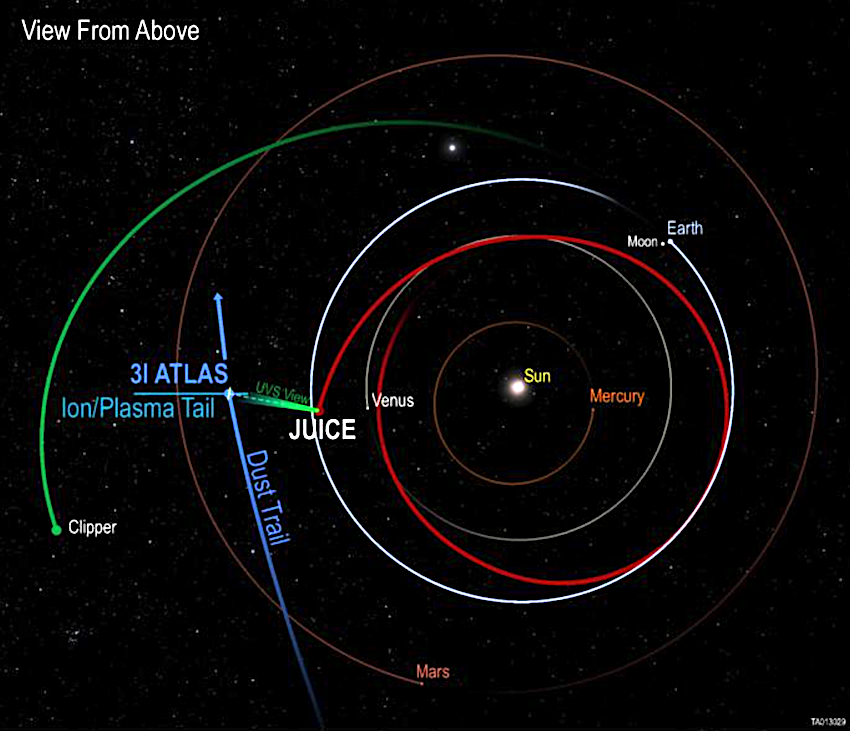
In November 2025, 3I/ATLAS passed between ESA’s Juice and NASA’s Europa Clipper spacecraft. SwRI researchers informally coordinated efforts between the two missions to make unique observations of the interstellar comet. Credit: NASA/ESA/Southwest Research Institute
“By studying the ratio of water ice and dry ice, we can compare the composition of this interstellar comet to comets native to our solar system,” Molyneux said. “This helps us understand if the solar system where 3I/ATLAS formed is similar to ours or different.”
“I think the coordination with Europa Clipper was a fun and impactful demonstration that showed how the two projects could coordinate observation plans,” Retherford said. “And because SwRI’s team is involved in both missions, it was a special highlight for us in terms of working together.”
Juice is the first large-class mission in ESA’s Cosmic Vision 2015–2025 program. The spacecraft and science instruments were built by teams from more than 20 European countries, Japan and the United States. SwRI’s UVS instrument team includes additional scientists from the University of Colorado Boulder, the SETI institute, the University of Leicester (U.K.), Imperial College London (U.K.), the University of Liège (Belgium), the Royal Institute of Technology (Sweden) and the Laboratoire Atmosphères, Milieux, Observations Spatiales (France). The Planetary Missions Program Office at NASA’s Marshall Space Flight Center oversees the UVS contribution to ESA through the agency’s Solar System Exploration Program. The Juice spacecraft was developed by Airbus Defence and Space.
Europa Clipper’s three main science objectives are to determine the thickness of the moon’s icy shell and its interactions with the ocean below, to investigate its composition, and to characterize its geology. The mission’s detailed exploration of Europa will help scientists better understand the astrobiological potential for habitable worlds beyond our planet. Managed by Caltech in Pasadena, California, NASA’s Jet Propulsion Laboratory in Southern California leads the Europa Clipper mission in partnership with the Johns Hopkins Applied Physics Laboratory in Laurel, Maryland, for NASA’s Science Mission Directorate in Washington. APL designed the main spacecraft body in collaboration with JPL and NASA’s Goddard Space Flight Center in Greenbelt, Maryland; NASA’s Marshall Space Flight Center in Huntsville, Alabama; and Langley Research Center in Hampton, Virginia. The Planetary Missions Program Office at NASA Marshall executes program management of the Europa Clipper mission.
For more information, visit https://www.swri.org/planetary-science.
About SwRI: SwRI is an independent, nonprofit, applied research and development organization based in San Antonio, Texas, with more than 3,200 employees and an annual research volume of $966 million. Southwest Research Institute and SwRI are registered marks in the U.S. Patent and Trademark Office. For more information, please visit https://www.swri.org.
Astrobiology, Astrochemistry,










Related Posts

Stay Informed With the Latest & Most Important News
Previous Post
Next Post


Advertisement
-
 01Two Black Holes Observed Circling Each Other for the First Time
 -
 02From Polymerization-Enabled Folding and Assembly to Chemical Evolution: Key Processes for Emergence of Functional Polymers in the Origin of Life
 -
 03Astronomy 101: From the Sun and Moon to Wormholes and Warp Drive, Key Theories, Discoveries, and Facts about the Universe (The Adams 101 Series)
 -
 04True Anomaly hires former York Space executive as chief operating officer
 -
 05Φsat-2 begins science phase for AI Earth images
 -
 06Hurricane forecasters are losing 3 key satellites ahead of peak storm season − a meteorologist explains why it matters
 -
 07Binary star systems are complex astronomical objects − a new AI approach could pin down their properties quickly