
Now Reading: Detection and Characterization of the Temperate Super-Earth Ross 318 b
-
01
Detection and Characterization of the Temperate Super-Earth Ross 318 b


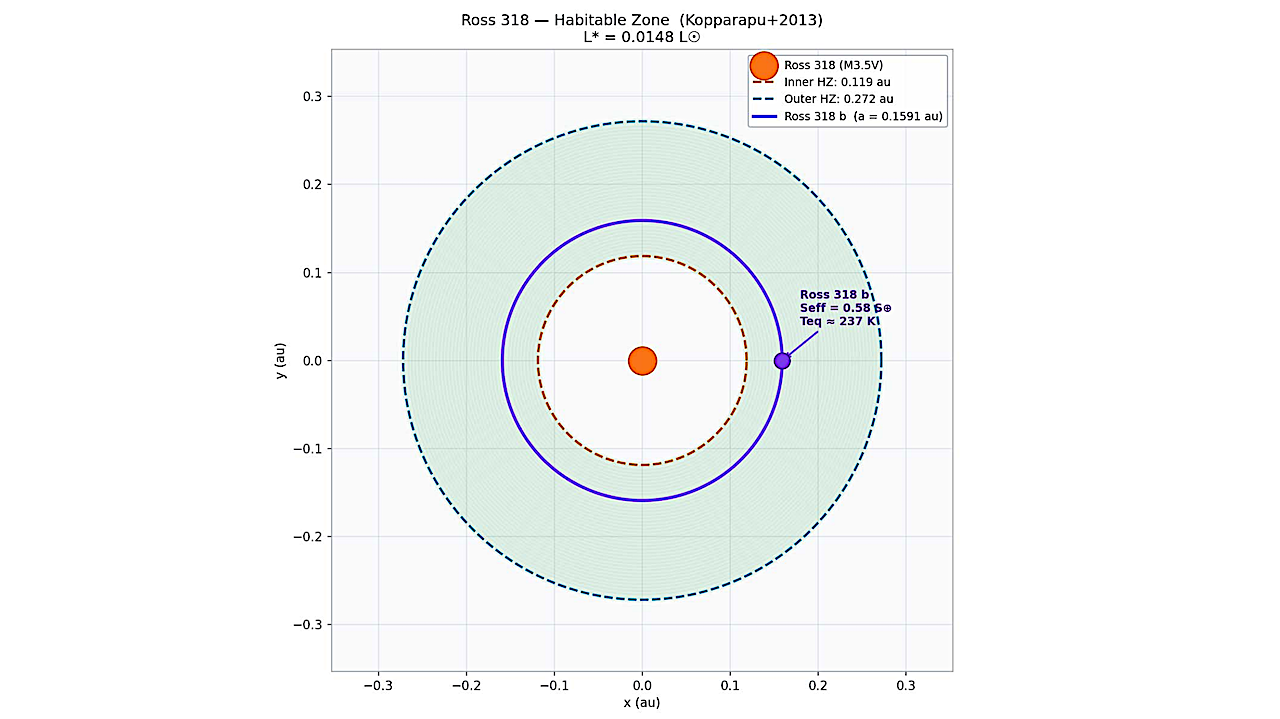
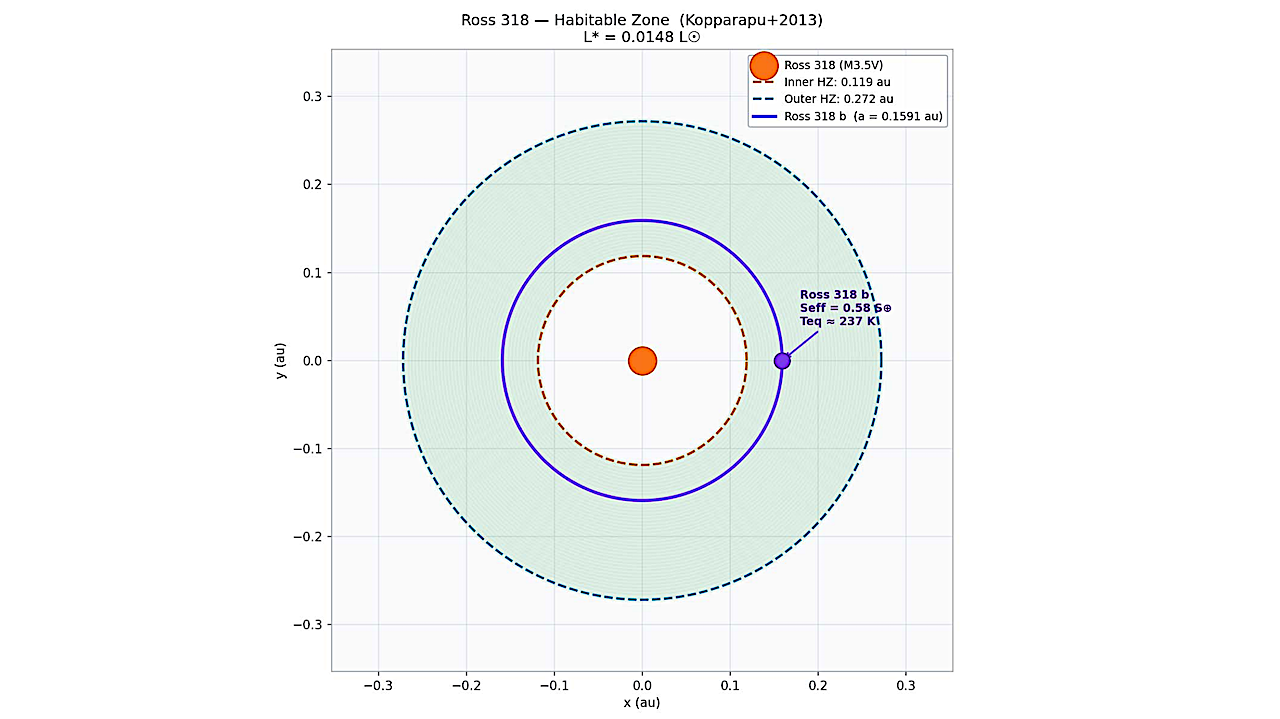
Habitable Zone diagram for the Ross 318 system. The green band indicates the Conservative Habitable Zone boundaries from Kopparapu et al. (2013). The orange star marks Ross 318; the violet circle marks Ross 318 b at a = 0.159 au with Seff = 0.58 S⊕. For comparison, the positions of Venus (0.72 au), Earth (1.00 au), and Mars (1.52 au) around the Sun are indicated. — astro-ph.EP
Ross 318 is an M3.5V red dwarf exhibiting significant magnetic activity and a stellar rotation period of ∼ 51.5 d.
In this work we present a systematic re-analysis of radial velocities (RV) from CARMENES and decade-long HIRES observations, integrated with TESS space-based photometry.
We identify a terrestrial-mass planet, Ross 318 b, with an orbital period P = (39.6299 ± 0.29) d and a minimum mass M sin i = (6.21 ± 0.62)M⊕. The dynamical nature of the signal is confirmed by its temporal coherence over a 15-year baseline and its achromaticity between visible and near-infrared channels.
TESS photometry from Sectors 18, 19, 24, and 25 (218.6 d total baseline, 66 983 cadences) reveals no transit at P = 39.63 d (FAP > 10%, BLS). An injection-and-recovery test demonstrates that a 2200 ppm transit signal corresponding to a 1.74R⊕ body would have been detected with Signal-to-PinkNoise Ratio SPNR > 12, ruling out a transiting geometry with high confidence.
The orbital inclination is constrained to i < 88.5◦ . With an incident stellar flux Sef f ≈ 0.58 S⊕ and bolometric luminosity L∗ = (0.01478±0.00122)L⊙, Ross 318 b falls within the Conservative Habitable Zone, making it one of the most interesting temperate Super-Earths orbiting an M dwarf.
G.Conzo, M.Moriconi, S.A.Corrêa Jr
Comments: 17 pages, 4 figures, 2 tables. Submitted at OEJV
Subjects: Earth and Planetary Astrophysics (astro-ph.EP)
Cite as: arXiv:2605.11123 [astro-ph.EP] (or arXiv:2605.11123v1 [astro-ph.EP] for this version)
https://doi.org/10.48550/arXiv.2605.11123
Focus to learn more
Submission history
From: Giuseppe Conzo Dr.
[v1] Mon, 11 May 2026 18:31:54 UTC (1,028 KB)
https://arxiv.org/abs/2605.11123
Astrobiology










Related Posts
Stay Informed With the Latest & Most Important News
Previous Post
Next Post
Advertisement
-
 01Two Black Holes Observed Circling Each Other for the First Time
 -
 02From Polymerization-Enabled Folding and Assembly to Chemical Evolution: Key Processes for Emergence of Functional Polymers in the Origin of Life
 -
 03Astronomy 101: From the Sun and Moon to Wormholes and Warp Drive, Key Theories, Discoveries, and Facts about the Universe (The Adams 101 Series)
 -
 04True Anomaly hires former York Space executive as chief operating officer
 -
 05Φsat-2 begins science phase for AI Earth images
 -
 06Hurricane forecasters are losing 3 key satellites ahead of peak storm season − a meteorologist explains why it matters
 -
 07Binary star systems are complex astronomical objects − a new AI approach could pin down their properties quickly