
Now Reading: Tracing The Sulfur Depletion In Starless And Pre-stellar Cores
-
01
Tracing The Sulfur Depletion In Starless And Pre-stellar Cores


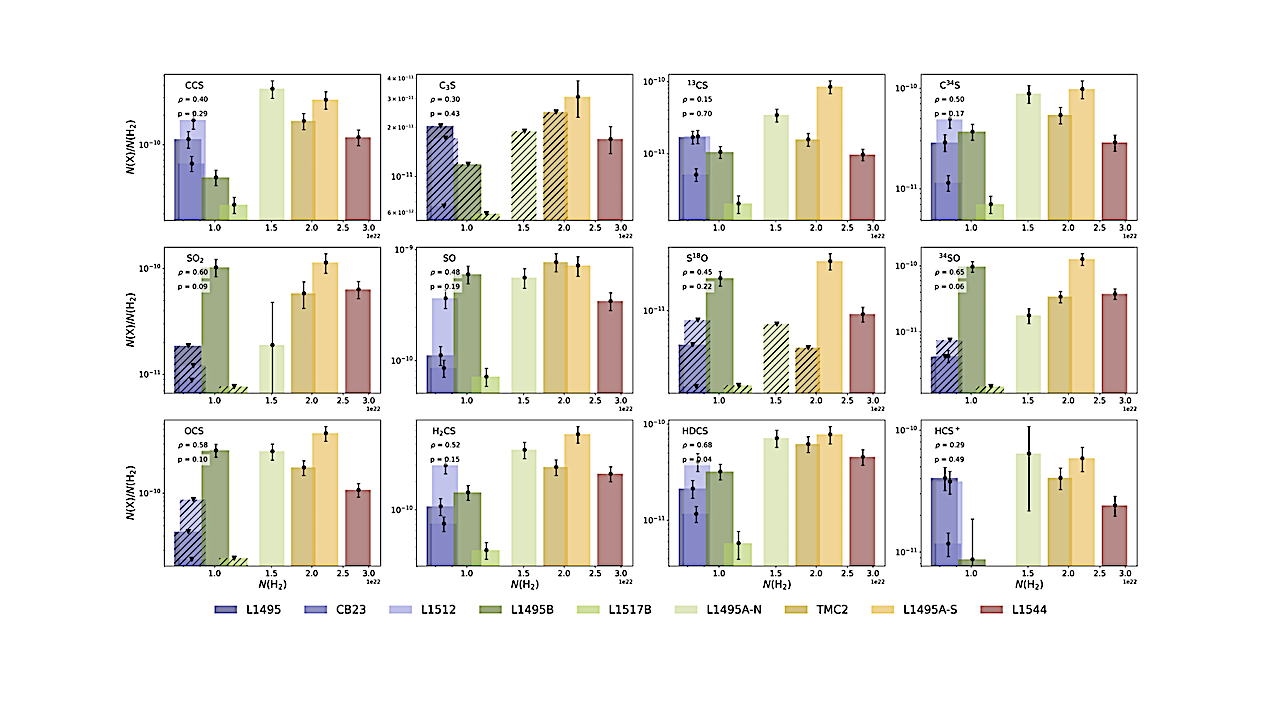

Molecular abundances as a function of the H2 column density. Each panel shows one molecule, with bars representing the derived abundances for the different cores and widths corresponding to half the uncertainty in N(H2). Hatched bars with a downward-facing triangle indicate upper limits (non-detections). Each panel also shows the Spearman rank correlation coefficient (ρ) and the corresponding p-value. — astro-ph.GA
Sulfur is one of the most abundant elements in the Universe, yet the sulfur budget inferred from the observed sulfur-bearing molecules in dense cores is significantly lower than expected.
Starless and pre-stellar cores represent the earliest stages of star formation and provide a laboratory for studying the physical and chemical processes that cause sulfur depletion. We aim to constrain sulfur chemistry in dense cores by measuring abundances of sulfur-bearing molecules and how they reflect core evolution and environmental effects. We observed nine cores in the Taurus Molecular Cloud, targeting 13 sulfur-bearing molecules, including CS, CCS, C3S, OCS, SO, SO2, H2CS, and isotopologs.
Molecular abundances and six abundance ratios were compared to three evolutionary tracers: H2 column density, N2D+/N2H+, and the CO depletion factor. We also compared observations with 0D chemical models with different initial sulfur abundances. We find variations in abundances across cores.
L1517B exhibits low abundances and a high depletion factor, whereas L1495B shows enhanced levels in oxygen-bearing species within the L1495 filament. Ratios tracing carbon- and oxygen-bearing species (CCS/34SO and C34S/34SO) decrease with increasing H2 column density and N2D+/N2H+ ratio. Other species and ratios show weak or no correlation with tracers.
Models reproduce OCS, H2CS, and HDCS reasonably well, but not all species simultaneously, especially between carbon- and oxygen-bearing molecules. The variations and lack of consistent correlations suggest that a single evolutionary parameter cannot describe sulfur chemistry and that the local environmental conditions strongly influence the observed abundances.
Reproducing the full sample of sulfur-bearing molecules would require improved chemical networks and models that account for the core’s physical structure.
L. Schöller, S. Spezzano, O. Sipilä, E. I. Makarenko, P.Caselli, H. A. Bunn, S. S. Jensen
Comments: Accepted for publication in A&A
Subjects: Astrophysics of Galaxies (astro-ph.GA)
Cite as: arXiv:2605.13635 [astro-ph.GA] (or arXiv:2605.13635v1 [astro-ph.GA] for this version)
https://doi.org/10.48550/arXiv.2605.13635
Focus to learn more
Submission history
From: Laura Schöller
[v1] Wed, 13 May 2026 15:02:07 UTC (4,320 KB)
https://arxiv.org/abs/2605.13635
Astrobiology, Astrochemistry,










Related Posts
Stay Informed With the Latest & Most Important News




Advertisement
-
 01Two Black Holes Observed Circling Each Other for the First Time
 -
 02From Polymerization-Enabled Folding and Assembly to Chemical Evolution: Key Processes for Emergence of Functional Polymers in the Origin of Life
 -
 03Astronomy 101: From the Sun and Moon to Wormholes and Warp Drive, Key Theories, Discoveries, and Facts about the Universe (The Adams 101 Series)
 -
 04True Anomaly hires former York Space executive as chief operating officer
 -
 05Φsat-2 begins science phase for AI Earth images
 -
 06Hurricane forecasters are losing 3 key satellites ahead of peak storm season − a meteorologist explains why it matters
 -
 07Binary star systems are complex astronomical objects − a new AI approach could pin down their properties quickly