
Now Reading: SpaceX launches CRS-34 cargo mission to ISS
-
01
SpaceX launches CRS-34 cargo mission to ISS


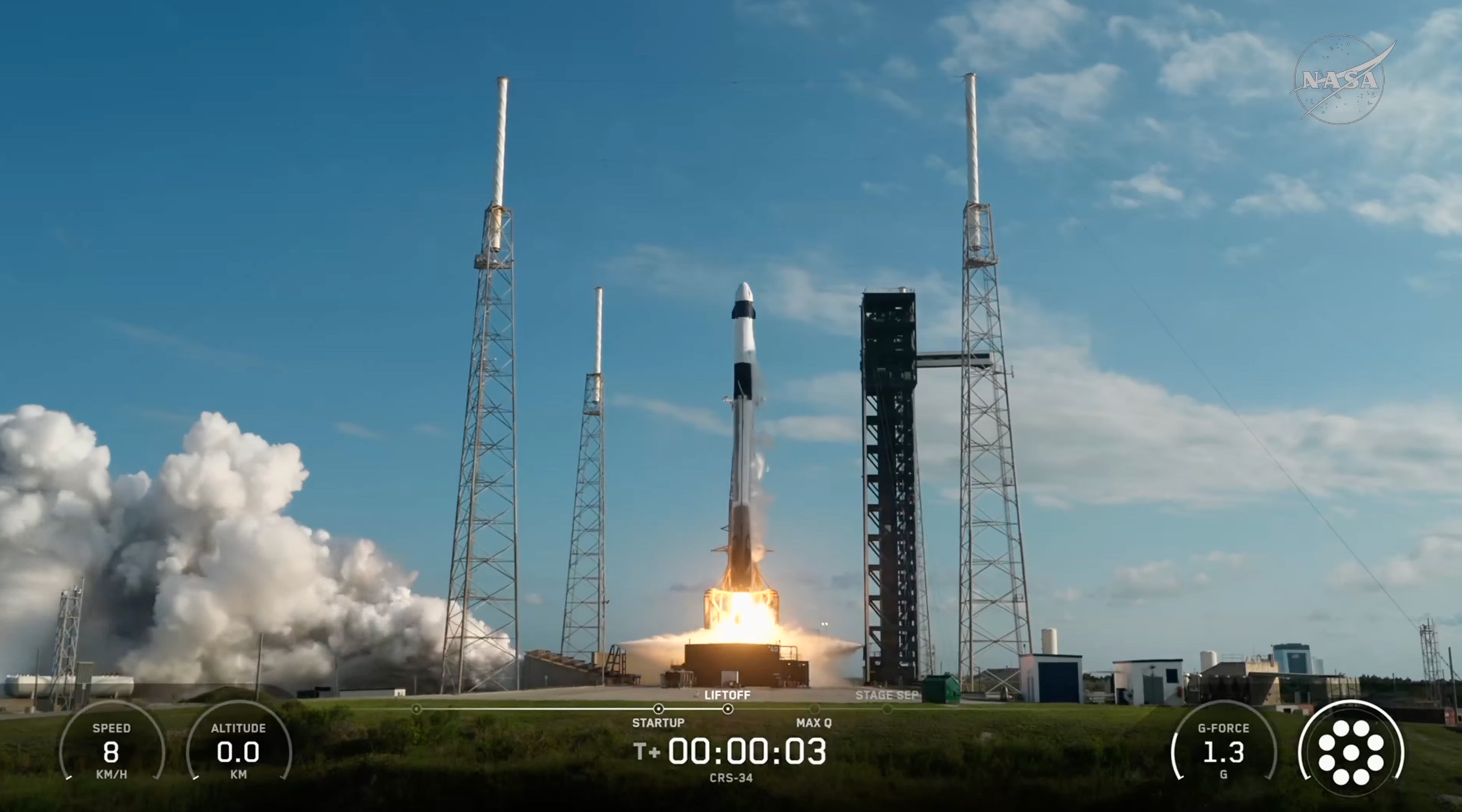

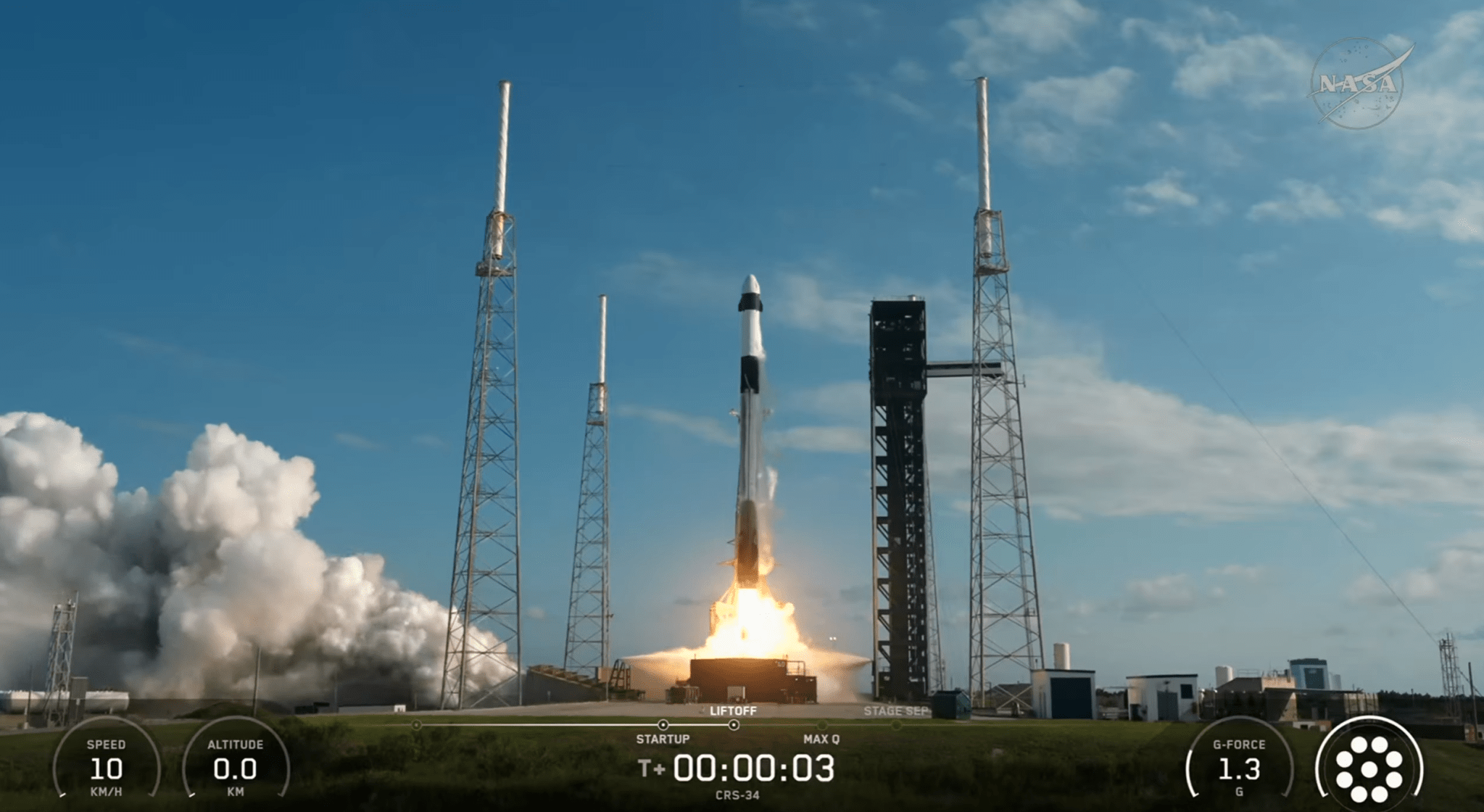
WASHINGTON — A Falcon 9 launched a Dragon cargo spacecraft May 15 carrying nearly 3,000 kilograms of cargo to the International Space Station.
The Falcon 9 lifted off from Space Launch Complex 40 at Cape Canaveral Space Force Station at 6:05 p.m. Eastern. The launch was scheduled for May 12 but postponed a day because of a forecast of poor weather, while a May 13 attempt was scrubbed in the final minute of the countdown because of violations of launch weather criteria.
The Dragon spacecraft separated from the upper stage of the Falcon 9 nearly 10 minutes after liftoff. The spacecraft is scheduled to dock with the station’s Harmony module at about 7 a.m. Eastern May 17.
This is the sixth flight of this cargo Dragon capsule, designated C209, which made its first flight to the ISS in 2021. It is the first cargo Dragon spacecraft to reach this milestone, although the Crew Dragon spacecraft Endeavour has also flown six missions.
Lee Echerd, a senior mission manager at SpaceX, said at a May 11 briefing that the company had already done most of the work certifying the cargo Dragon could fly six missions when it did that work for Crew Dragon. “For this flight, it was essentially a delta certification, looking at the hardware items that are unique to the cargo configuration,” he said.
The CRS-34 mission is carrying 2,948 kilograms of cargo, including an 816-kilogram external payload. That external payload, Space Test Program-Houston 11, is a joint NASA and U.S. Space Force effort that includes experiments such as STORIE, an instrument that will study charged particles in orbit.
There are more than 50 science investigations on CRS-34 for NASA, international partners and the ISS National Lab, said Liz Warren, deputy chief scientist for the ISS program at NASA, at the May 11 briefing. That includes payloads to support NASA exploration programs as well as commercial initiatives.
“I’m not seeing a shift” in the research on the station as it nears retirement around the end of the decade, she said, but rather “a finer resolution and focus” on the work being done there.
CRS-34 is the second of four Dragon missions set to fly in 2026, after the Crew-12 mission that launched in February. Crew-13 is scheduled to launch in mid-September and another cargo mission, CRS-35, is planned for the fall.
Bill Spetch, NASA ISS operations and integration manager, said at the briefing that other upcoming missions to the ISS include the Soyuz MS-29 crewed mission in July, a Progress cargo spacecraft in early September and a Cygnus cargo spacecraft in late fall or early winter.
That schedule does not include Boeing’s CST-100 Starliner, which had been expected to fly an uncrewed test flight to the station this year. Spetch said NASA was “trying to maintain windows” for that Starliner-1 mission this year but has not yet scheduled it as an investigation into problems seen on a crewed test flight in 2024 continues.
Also missing from the manifest is Japan’s HTV-X cargo spacecraft, which made its first flight to the ISS last year. Its launch vehicle, the H3, remains grounded after a launch failure last December, with a return-to-flight mission planned for June. Spetch deferred questions about the next HTV-X mission to the Japanese space agency JAXA, which has not provided a recent update on launch plans.
The CRS-34 launch was the first Falcon 9 mission from Cape Canaveral in two weeks, an unusually long gap. It was the 57th orbital launch of the year by SpaceX: 56 by the Falcon 9 and one by Falcon Heavy. The launch puts the company on a pace for 154 launches this year, fewer than the 165 launches it conducted in 2025.










Related Posts
Stay Informed With the Latest & Most Important News
Previous Post
Next Post
Previous Post
Next Post


Advertisement
-
 01Two Black Holes Observed Circling Each Other for the First Time
 -
 02From Polymerization-Enabled Folding and Assembly to Chemical Evolution: Key Processes for Emergence of Functional Polymers in the Origin of Life
 -
 03Astronomy 101: From the Sun and Moon to Wormholes and Warp Drive, Key Theories, Discoveries, and Facts about the Universe (The Adams 101 Series)
 -
 04True Anomaly hires former York Space executive as chief operating officer
 -
 05Φsat-2 begins science phase for AI Earth images
 -
 06Hurricane forecasters are losing 3 key satellites ahead of peak storm season − a meteorologist explains why it matters
 -
 07Binary star systems are complex astronomical objects − a new AI approach could pin down their properties quickly