
Now Reading: A Climate-Constrained Bayesian Inverse Method for JWST Rocky Exoplanet Eclipse Spectra: A Case Study of LTT 1445A b
-
01
A Climate-Constrained Bayesian Inverse Method for JWST Rocky Exoplanet Eclipse Spectra: A Case Study of LTT 1445A b

A Climate-Constrained Bayesian Inverse Method for JWST Rocky Exoplanet Eclipse Spectra: A Case Study of LTT 1445A b

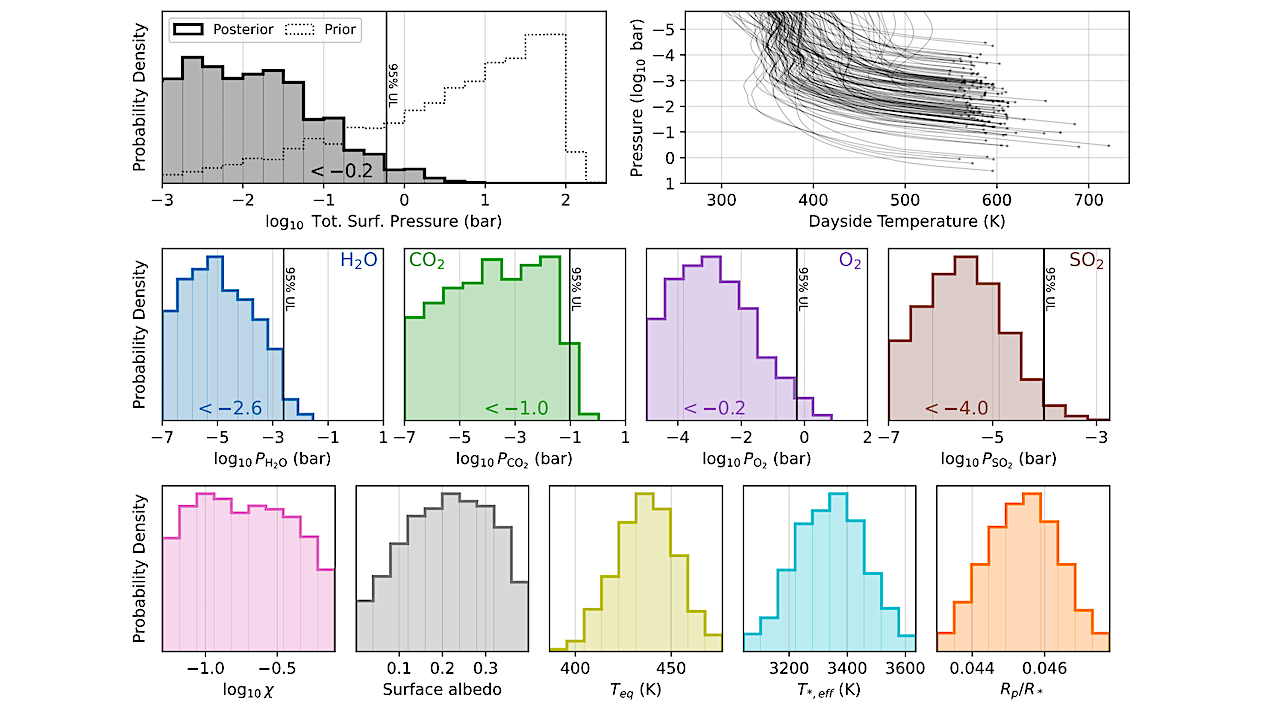
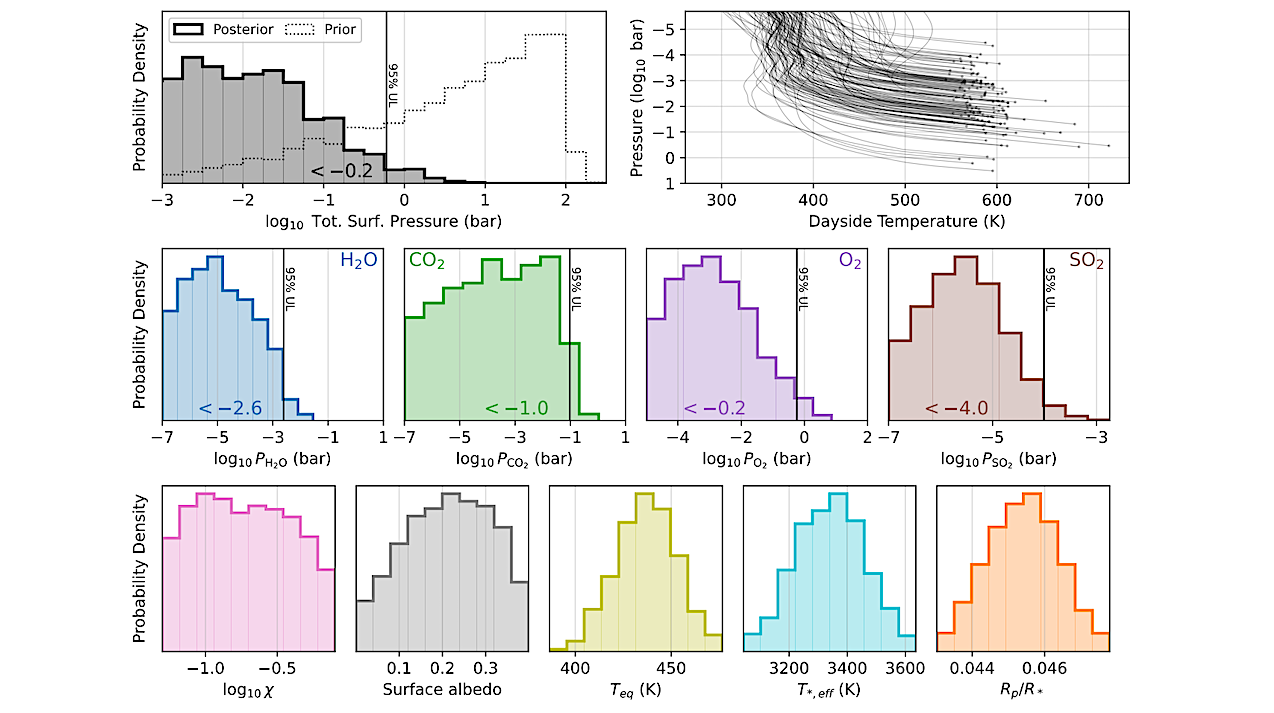
1D marginalized posterior distributions for key parameters in the atmospheric fit to the 16-bin MIRI LRS eclipse spectrum. The top-left panel shows the derived posterior on total surface pressure (solid black line), compared to implicit prior (dotted black line). The top-right panel shows pressure-temperature profiles sampled from the posterior. The climate-constrained inversion places a 95% upper limit of 0.6 bar on the surface pressure. If an atmosphere is present, a tenuous CO2- or O2-dominated atmosphere is most probable. — astro-ph.EP
Determining whether temperate rocky exoplanets orbiting M stars retain atmospheres is currently a central goal of exoplanet astronomy. To this end, the James Webb Space Telescope has begun searching for atmospheres on these worlds with MIRI secondary eclipse spectroscopy and photometry.
Here, we develop a novel climate-constrained Bayesian inference framework that yields atmospheric pressure and composition constraints from these datasets, while accounting for planetary, stellar, and model uncertainties.
Our approach fits observations with model spectra derived from self-consistent pressure-temperature profiles at radiative-convective equilibrium, thus maximizing the information extracted from the data and providing more robust inferences than retrievals that use parameterized pressure-temperature profiles. We demonstrate the framework on the existing MIRI LRS eclipse spectrum of LTT 1445A b (1.34 R⊕ and Teq≈431 K).
An atmosphere does not need to be invoked to explain the data, meaning a bare rock model produces an adequate fit. If the planet has an atmosphere, the 2σ upper limits on surface partial pressures are ≲1 bar for an optically thin gas like O2, N2 or CO, ≲0.1 bar for CO2, ≲10−3 bar for H2O, and ≲10−4 bar for SO2. Scheduled MIRI F1500W observations could detect one of the thicker atmospheres permitted by the existing data (1 bar O2 and 0.01 bar CO2), if a precision of 20 ppm or better is achieved.
This case study demonstrates that climate-constrained Bayesian inversion can turn rocky-planet eclipse spectra into the quantitative constraints necessary to test population-level atmospheric retention hypothesis, like the cosmic shoreline.
Nicholas Wogan, Natasha Batalha, Jegug Ih, Jacob Lustig-Yaeger, Kevin Stevenson
Comments: Submitted to the AAS Journals
Subjects: Earth and Planetary Astrophysics (astro-ph.EP)
Cite as: arXiv:2605.14997 [astro-ph.EP](or arXiv:2605.14997v1 [astro-ph.EP] for this version)
https://doi.org/10.48550/arXiv.2605.14997
Focus to learn more
Submission history
From: Nicholas Wogan
[v1] Thu, 14 May 2026 16:00:04 UTC (509 KB)
https://arxiv.org/abs/2605.14997
Astrobiology, Exoplanet,










Related Posts



Stay Informed With the Latest & Most Important News
Previous Post
Next Post





Advertisement
-
 01Two Black Holes Observed Circling Each Other for the First Time
 -
 02From Polymerization-Enabled Folding and Assembly to Chemical Evolution: Key Processes for Emergence of Functional Polymers in the Origin of Life
 -
 03Astronomy 101: From the Sun and Moon to Wormholes and Warp Drive, Key Theories, Discoveries, and Facts about the Universe (The Adams 101 Series)
 -
 04True Anomaly hires former York Space executive as chief operating officer
 -
 05Φsat-2 begins science phase for AI Earth images
 -
 06Hurricane forecasters are losing 3 key satellites ahead of peak storm season − a meteorologist explains why it matters
 -
 07Binary star systems are complex astronomical objects − a new AI approach could pin down their properties quickly