
Now Reading: Mars As An Exoplanet: Lessons From A Planet At The Edge Of Habitability
-
01
Mars As An Exoplanet: Lessons From A Planet At The Edge Of Habitability


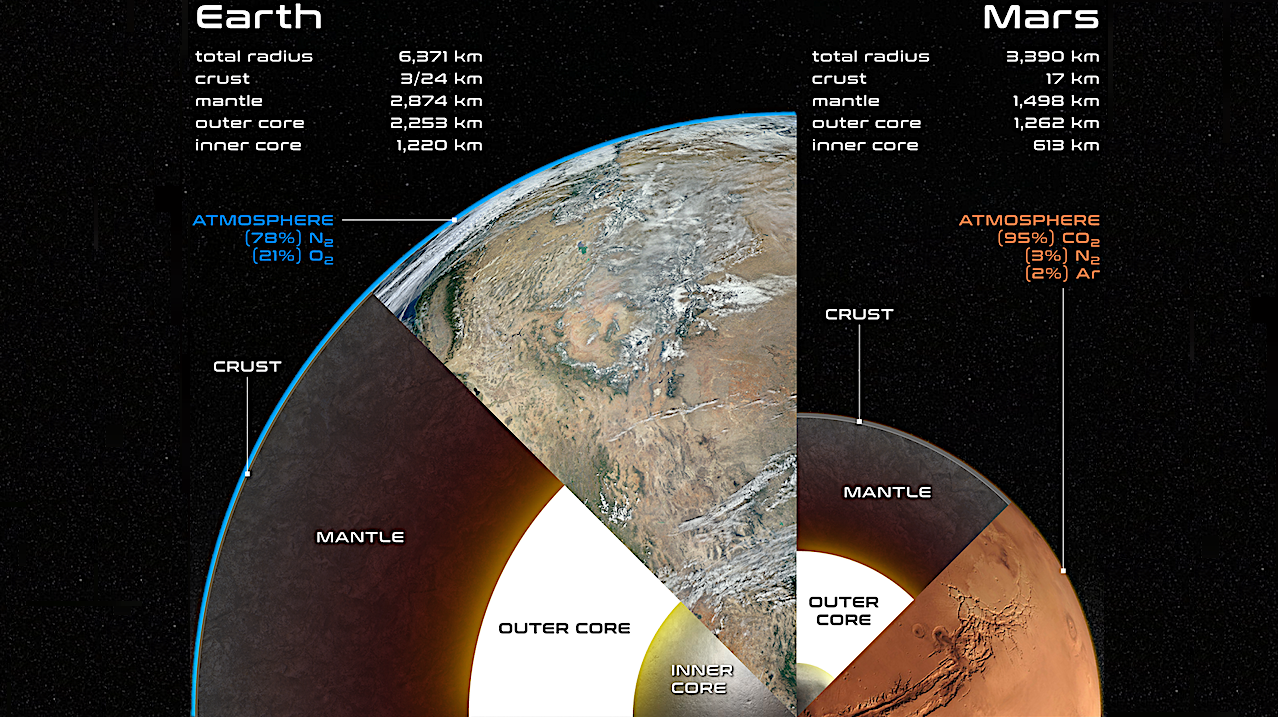
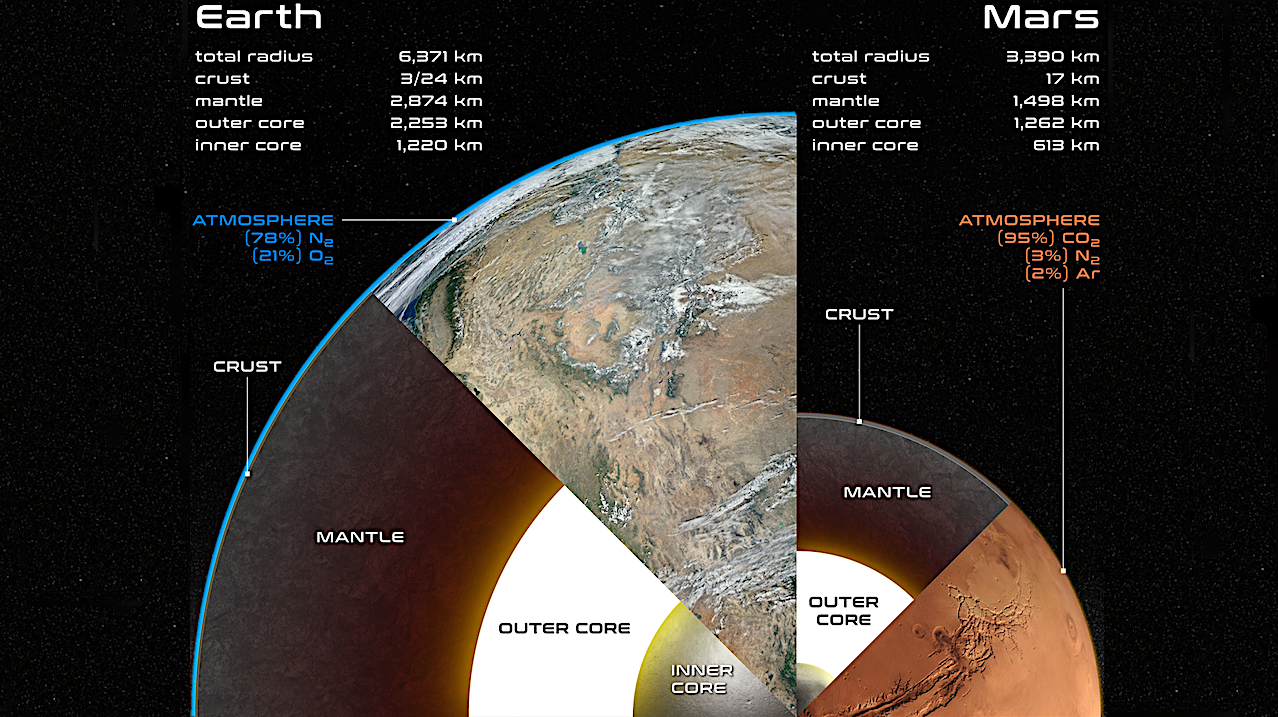
Schematic cross sections of Earth and Mars, showing the major internal components and atmospheric components, to scale. For simplicity, oceanic and continental crust for Earth are not distinguished, nor is the interior structure of Earth’s mantle shown. — astro-ph.EP
Mars is the Solar System’s canonical small, rocky planet that transitioned from early geologic activity and surface liquid water to a cold and arid planet with a thin, cold, CO2-dominated atmosphere.
The evolution of Mars, in the context of such planetary parameters as size, mass, atmosphere, insolation flux, magnetosphere, and impact history, harbor important diagnostics regarding the development and sustainability of habitable surface conditions. In this work, we synthesize how the study of Mars contributes to our understanding of exoplanet processes, such as volatile delivery and loss, photochemistry, climate evolution (including CO2 condensation and atmospheric loss), obliquity forcing, planetary architecture, and the role of intrinsic magnetism.
We also evaluate optimal methods and prospects for detecting and characterizing potential Mars analogs beyond the Solar System. We focus on relevant results from planetary missions (e.g., Mars Reconnaissance Orbiter, MAVEN, Mars Science Laboratory, Mars2020) and observational studies of exoplanet atmospheres with the James Webb Space telescope (JWST) and future facilities.
Through the convergence of these parallel pathways of inquiry, we describe the primary science questions and suggested avenues for characterizing small rocky planets that lie at the edge of potentially habitable conditions.
Stephen R. Kane, Paul K. Byrne, Skylar D’Angiolillo, Michelle L. Hill, Emma L. Miles, David A. Brain, Shannon M. Curry, Joana R.C. Voigt
Comments: 23 pages, 6 figures, 1 table, accepted for publication in the Planetary Science Journal
Subjects: Earth and Planetary Astrophysics (astro-ph.EP)
Cite as: arXiv:2605.18949 [astro-ph.EP] (or arXiv:2605.18949v1 [astro-ph.EP] for this version)
https://doi.org/10.48550/arXiv.2605.18949
Focus to learn more
Submission history
From: Stephen Kane
[v1] Mon, 18 May 2026 18:00:02 UTC (3,216 KB)
https://arxiv.org/abs/2605.18949
Astrobiology, exoplanet,










Related Posts
Stay Informed With the Latest & Most Important News

Advertisement
-
 01Two Black Holes Observed Circling Each Other for the First Time
 -
 02From Polymerization-Enabled Folding and Assembly to Chemical Evolution: Key Processes for Emergence of Functional Polymers in the Origin of Life
 -
 03Astronomy 101: From the Sun and Moon to Wormholes and Warp Drive, Key Theories, Discoveries, and Facts about the Universe (The Adams 101 Series)
 -
 04True Anomaly hires former York Space executive as chief operating officer
 -
 05Φsat-2 begins science phase for AI Earth images
 -
 06Hurricane forecasters are losing 3 key satellites ahead of peak storm season − a meteorologist explains why it matters
 -
 07Binary star systems are complex astronomical objects − a new AI approach could pin down their properties quickly