
Now Reading: A Hycean Interpretation of K2-18b Supported by Photochemical Atmospheric Compositional
-
01
A Hycean Interpretation of K2-18b Supported by Photochemical Atmospheric Compositional

A Hycean Interpretation of K2-18b Supported by Photochemical Atmospheric Compositional

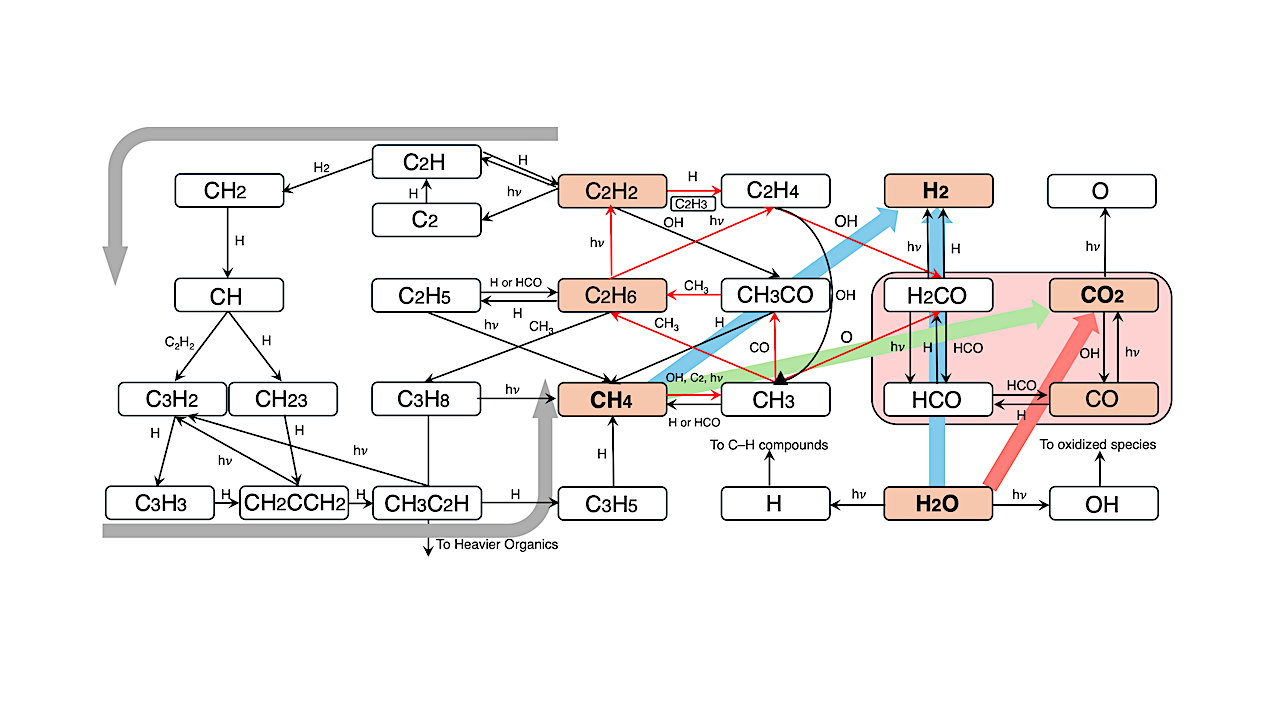
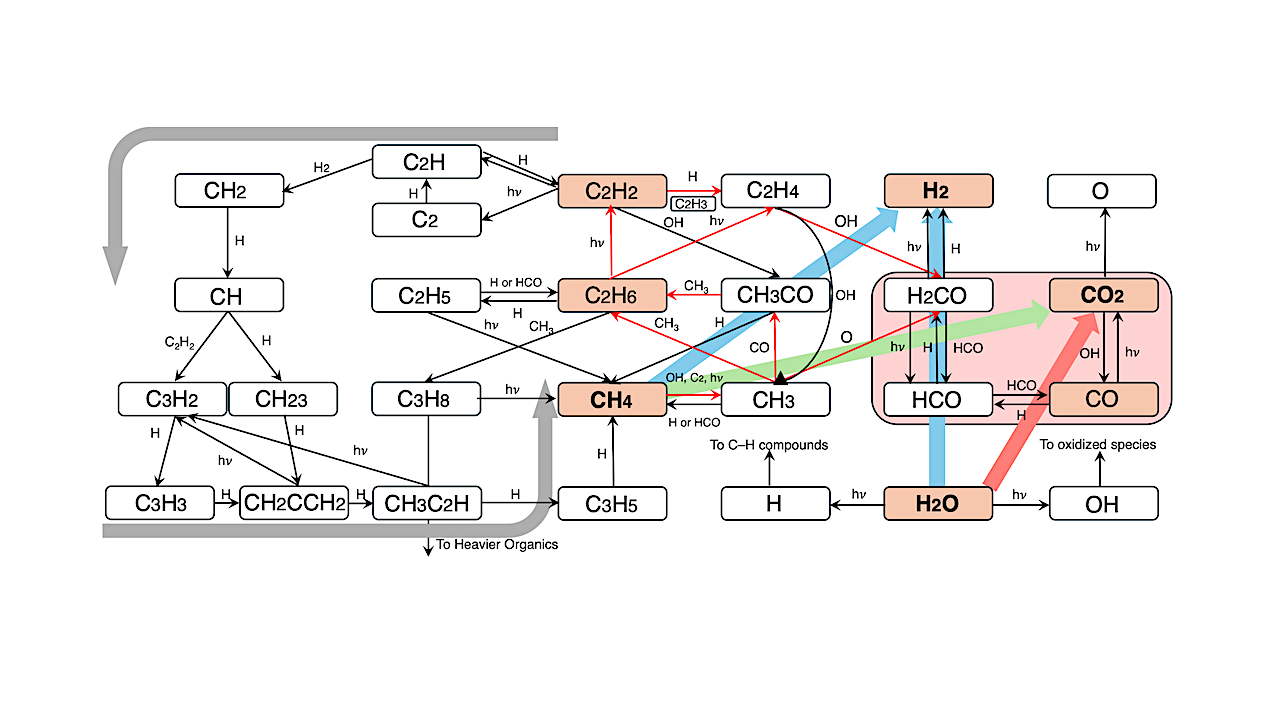
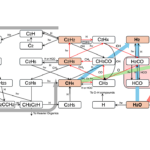
Diagram of the dominant chemical reaction pathways in our photochemical network. Bold text indicates the initial chemical species. Species shaded in light orange correspond to those plotted in Figure 5 and included in the absorption calculations for the transit spectrum shown in the upper panel of Figure 9. Thick colored arrows represent the net transport of atoms: blue for H, green for C, and red for O. The thick gray curved arrow highlights the circulation loop of hydrocarbon (C–H) species. The thin light-red box on the right-hand side highlights the oxygen-bearing CO/CO2 cycle into which a small fraction of carbon leaks from the hydrocarbon loop. Under the CO2-bearing reference case of this study, approximately 99% of the carbon from CH4 remains within the C–H circulation loop (thick gray arrow), while about 1% is directed towards oxidation (red arrows), leading to its consumption. Arrows extending from C3 species imply further polymerization leading to the formation of heavier organic hazes. — astro-ph.EP
The nature of the sub-Neptune K2-18b is debated between Hycean and mini-Neptune interpretations.
We test whether self-consistent Hycean atmospheres are compatible with current JWST transmission spectra by combining one-dimensional photochemical modelling, radiative–convective equilibrium calculations, and forward modelling of transmission spectra.
We assume H2-CH4-H2O atmospheres over a liquid ocean, compute altitude-dependent abundances with a 1D photochemical model, and couple them to P-T profiles that avoid runaway greenhouse states.
Using the CH4-dominated 2.8-4.0 μm band, we constrain wavelength-independent offsets between NIRISS SOSS and NIRSpec G395H for multiple reductions, and then scan grids of CO and CO2 scaling factors, weighted by the CH4-band offset posteriors, to evaluate oxidised-carbon abundances consistent with the 4-5 μm region. Radiative–convective calculations further map pressures and albedos that yield non-runaway climates.
Over a wide range of temperatures and pressures, liquid oceans can exist, and Hycean models with a 1 bar H2 envelope, percent-level CH4 and CO, and CO2 buffered at ∼10−3-10−2 reproduce the NIRISS and NIRSpec spectra from 0.8 to 5.2 μm without invoking DMS or other additional species.
Our photochemical simulations show that H2-CH4-H2O networks generically drive CO to mixing ratios of order 1-2 %. Mass-balance arguments imply that a ∼1 bar H2 envelope with percent-level CH4 requires interior replenishment on gigayear timescales, and the resulting vertical gradients naturally generate flat, CH4-dominated plateaux in transmission.
While mini-Neptune scenarios remain viable, our results show that Hycean configurations are likewise consistent with the data, and current CO and CO2 constraints alone are not yet sufficient to rule out Hycean interpretations of K2-18b.
Takuya Fujisawa, Masashi Shimada, Tatsuya Yoshida, Kiyoshi Kuramoto
Comments: 28pages, 15figures
Subjects: Earth and Planetary Astrophysics (astro-ph.EP)
Cite as: arXiv:2605.17803 [astro-ph.EP] (or arXiv:2605.17803v1 [astro-ph.EP] for this version)
https://doi.org/10.48550/arXiv.2605.17803
Focus to learn more
Submission history
From: Takuya Fujisawa
[v1] Mon, 18 May 2026 03:26:08 UTC (6,401 KB)
https://arxiv.org/abs/2605.17803
Astrobiology, exoplanet,










Related Posts
Stay Informed With the Latest & Most Important News
Previous Post
Next Post


Advertisement
-
 01Two Black Holes Observed Circling Each Other for the First Time
 -
 02From Polymerization-Enabled Folding and Assembly to Chemical Evolution: Key Processes for Emergence of Functional Polymers in the Origin of Life
 -
 03Astronomy 101: From the Sun and Moon to Wormholes and Warp Drive, Key Theories, Discoveries, and Facts about the Universe (The Adams 101 Series)
 -
 04True Anomaly hires former York Space executive as chief operating officer
 -
 05Φsat-2 begins science phase for AI Earth images
 -
 06Hurricane forecasters are losing 3 key satellites ahead of peak storm season − a meteorologist explains why it matters
 -
 07Binary star systems are complex astronomical objects − a new AI approach could pin down their properties quickly