
Now Reading: Artificial Intelligence Aided Design Of Peptides With Custom Secondary Structure Motifs And Reduced Amino Acid Alphabets
-
01
Artificial Intelligence Aided Design Of Peptides With Custom Secondary Structure Motifs And Reduced Amino Acid Alphabets

Artificial Intelligence Aided Design Of Peptides With Custom Secondary Structure Motifs And Reduced Amino Acid Alphabets

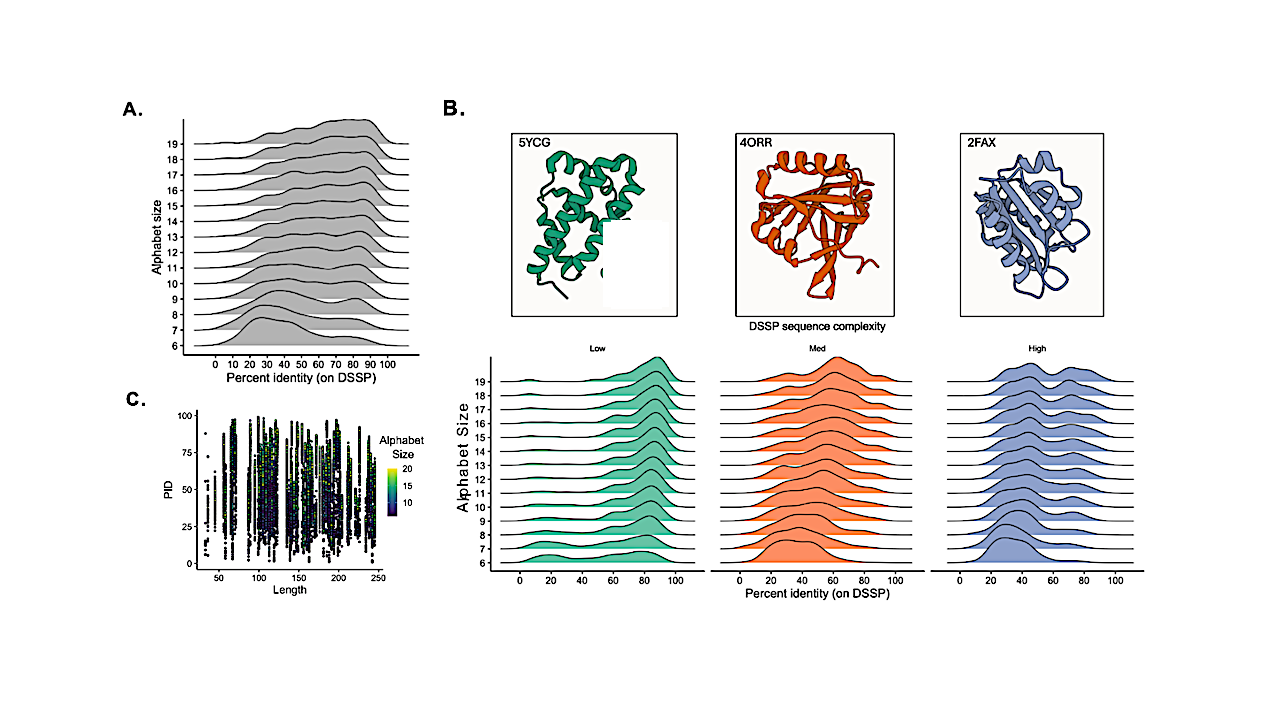
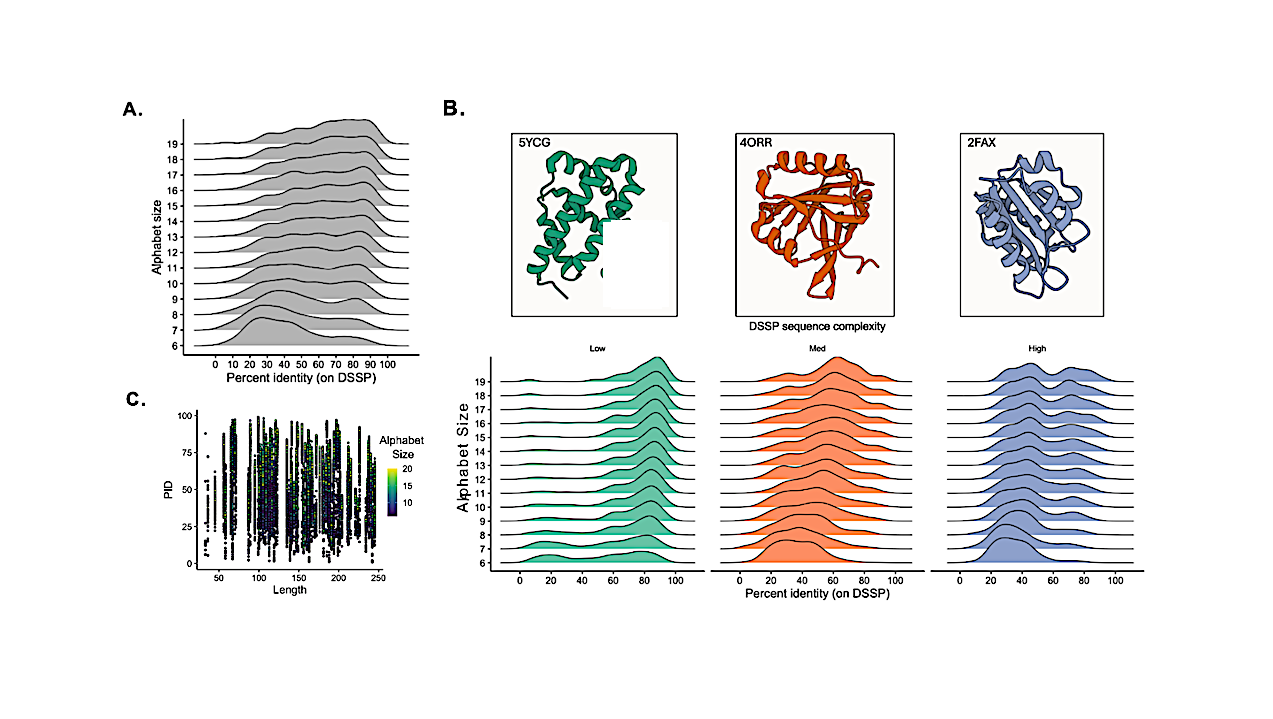
Model accuracy in terms of predicted DSSP secondary structure. A. DSSP sequence percent identity of predicted sequences to target, input, secondary structure. B. Example target structures of low (green) medium (orange) and high (blue) structure complexity proteins (top) displayed in ribbon format. Histograms (bottom) of results for DSSP sequence percent identity of predicted sequences to target, input, secondary structures for low404 (green) medium- (orange) and high- (blue) complexity protein targets. C. DSSP sequence percent identity for predicted sequences across protein sequence length and alphabet size. –biorxiv.org
Proteins are highly diverse functional polymers where the specific sequence of amino acids, selected from a standard genetically-encoded alphabet of twenty (C20), determines the structure and ultimately the function of the resulting folded protein.
This standard alphabet has been identified to be non-randomly distributed in physicochemical properties crucial to both structure-formation and function, often referred to as coverage theory.
While machine learning models have drastically improved protein structure prediction, protein design has yet to have similar development. Here we therefore bridge contemporary biological theory with recent advancements in artificial intelligence (AI) to develop and evaluate a generative AI protein design model, trained on hundreds of thousands of proteins within the RSCB PDB, for custom secondary structure motifs using reduced amino acid alphabets.
Results indicate an overall success in designing novel proteins with desired secondary structure motifs for a broad range of amino acid alphabets. Interestingly this tool often captures the full three-dimensional tertiary structure of a target protein despite training only on physicochemical sequence space and DSSP secondary structure.
The development of this model advances research across multiple disciplines, from general scientific AI/ML architecture development to protein design for biotechnology, astrobiology, and early-Earth evolutionary biology.
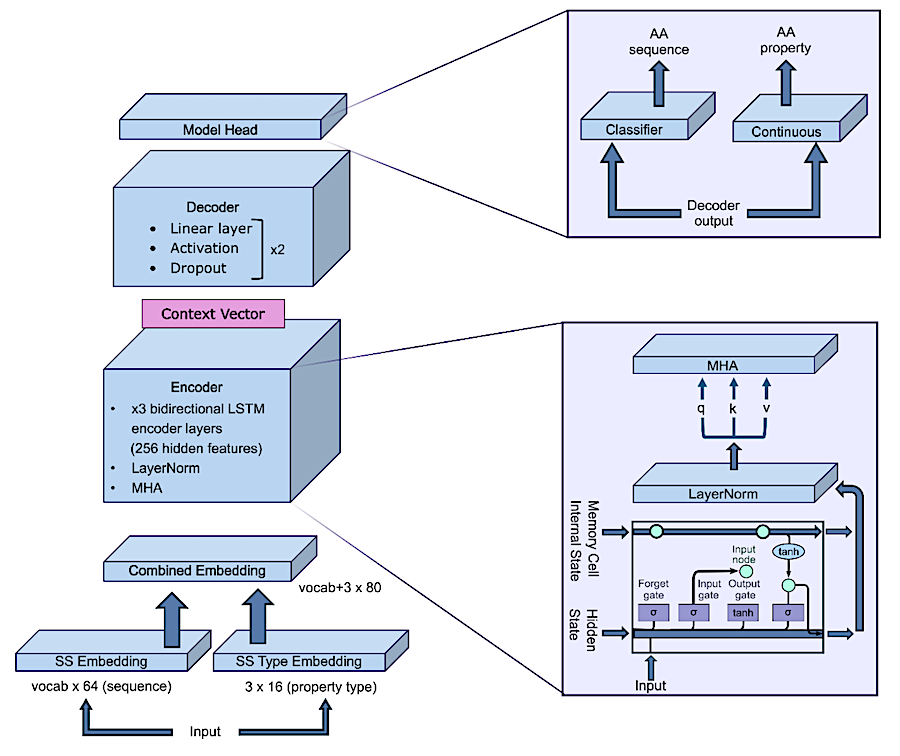
Major components of the bLSTMa encoder-decoder model architecture. Detailed architectures of the Encoder block, primarily made up of LSTM encoder layers and multi-head self-attention (bottom right) and model head, where the Decoder output is separately fed through a classifier and continuous value sequence to predict sequences and their associated properties (top right). — biorxiv.org
Astrobiology, Genomics,










Related Posts
Stay Informed With the Latest & Most Important News
Previous Post
Next Post




Advertisement
-
 01Two Black Holes Observed Circling Each Other for the First Time
 -
 02From Polymerization-Enabled Folding and Assembly to Chemical Evolution: Key Processes for Emergence of Functional Polymers in the Origin of Life
 -
 03Astronomy 101: From the Sun and Moon to Wormholes and Warp Drive, Key Theories, Discoveries, and Facts about the Universe (The Adams 101 Series)
 -
 04True Anomaly hires former York Space executive as chief operating officer
 -
 05Φsat-2 begins science phase for AI Earth images
 -
 06Hurricane forecasters are losing 3 key satellites ahead of peak storm season − a meteorologist explains why it matters
 -
 07Binary star systems are complex astronomical objects − a new AI approach could pin down their properties quickly