
Now Reading: Live coverage: SpaceX to launch 29 Starlink satellites on Falcon 9 rocket from Cape Canaveral
-
01
Live coverage: SpaceX to launch 29 Starlink satellites on Falcon 9 rocket from Cape Canaveral

Live coverage: SpaceX to launch 29 Starlink satellites on Falcon 9 rocket from Cape Canaveral

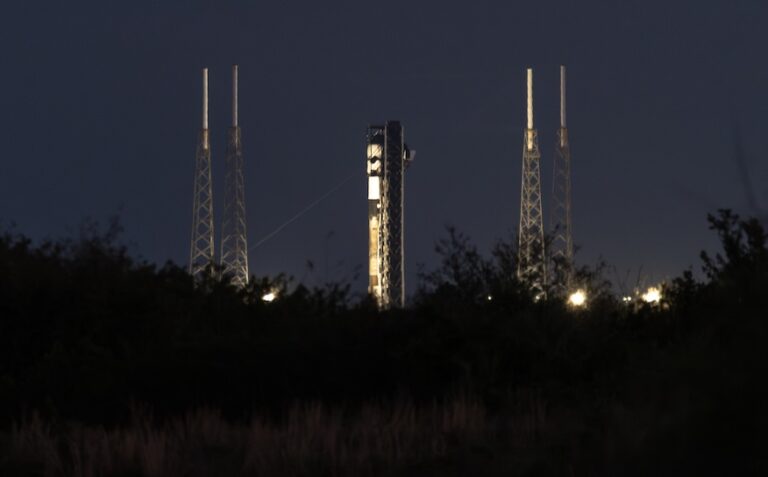
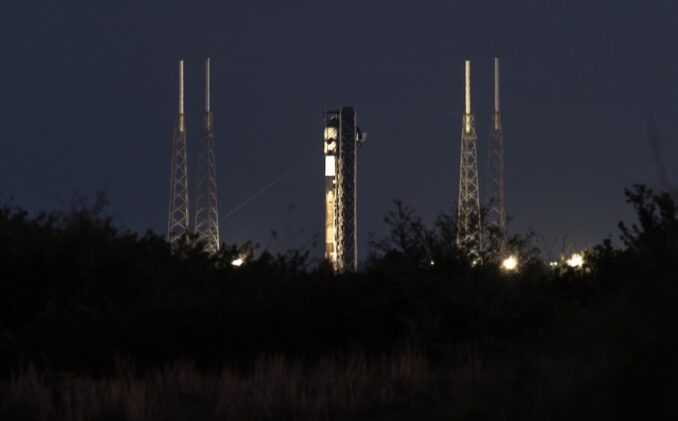
SpaceX is preparing to launch a batch Starlink V2 Mini Optimized satellites on a Falcon 9 rocket from Cape Canaveral Space Force Station early Thursday morning.
The Starlink 10-31 mission will add another 29 broadband internet satellites to the low Earth orbit constellation that consists of more than 10,000 spacecraft. This will be the 46th mission supporting SpaceX’s Starlink program.
Liftoff from Space Launch Complex 40 is scheduled during a window that opens at 5:26 a.m. EDT (0926 UTC). The Falcon 9 rocket will launch on a north-easterly trajectory.
Spaceflight Now will have live coverage beginning about an hour prior to liftoff.
The 45th Weather Squadron forecast a 90 percent chance for favorable conditions at liftoff. Meteorologists said they’re tracking a small chance for interference from cumulus clouds.
“A slow-moving disturbance over the Bahamas is helping supply this moisture and may also generate some convection in the early morning hours,” launch weather officers said. “These showers and associated clouds will be our main concern for violation of weather constraints on both the main and backup windows with focus on the Cumulus Cloud Rule.”
SpaceX will launch the mission using the Falcon 9 first stage booster with the tail number B1077. This will be its 28th flight following missions, like NASA’s Crew-5, CRS-28, and NG-20.
Nearly 8.5 minutes after liftoff, B1077 will target a landing on the drone ship, ‘A Shortfall of Gravitas.’ If successful, this will mark the 150th landing on this vessels and the 613th booster landing to date.










Related Posts
Stay Informed With the Latest & Most Important News
Previous Post
Next Post

Advertisement
-
 01Two Black Holes Observed Circling Each Other for the First Time
 -
 02From Polymerization-Enabled Folding and Assembly to Chemical Evolution: Key Processes for Emergence of Functional Polymers in the Origin of Life
 -
 03Astronomy 101: From the Sun and Moon to Wormholes and Warp Drive, Key Theories, Discoveries, and Facts about the Universe (The Adams 101 Series)
 -
 04True Anomaly hires former York Space executive as chief operating officer
 -
 05Φsat-2 begins science phase for AI Earth images
 -
 06Hurricane forecasters are losing 3 key satellites ahead of peak storm season − a meteorologist explains why it matters
 -
 07Binary star systems are complex astronomical objects − a new AI approach could pin down their properties quickly