
Now Reading: A Uniform Determination Of The Bulk Metallicities And Alpha Enrichments Of Confirmed Exoplanet Systems With TRES
-
01
A Uniform Determination Of The Bulk Metallicities And Alpha Enrichments Of Confirmed Exoplanet Systems With TRES

A Uniform Determination Of The Bulk Metallicities And Alpha Enrichments Of Confirmed Exoplanet Systems With TRES

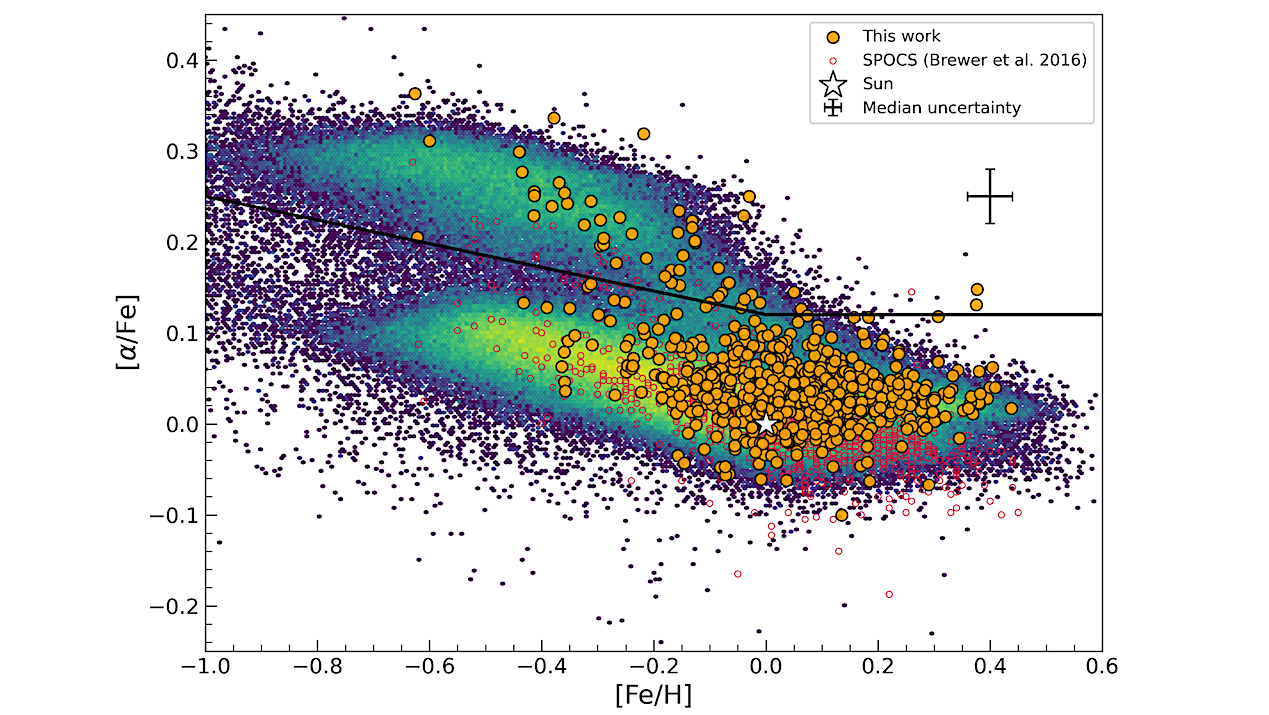
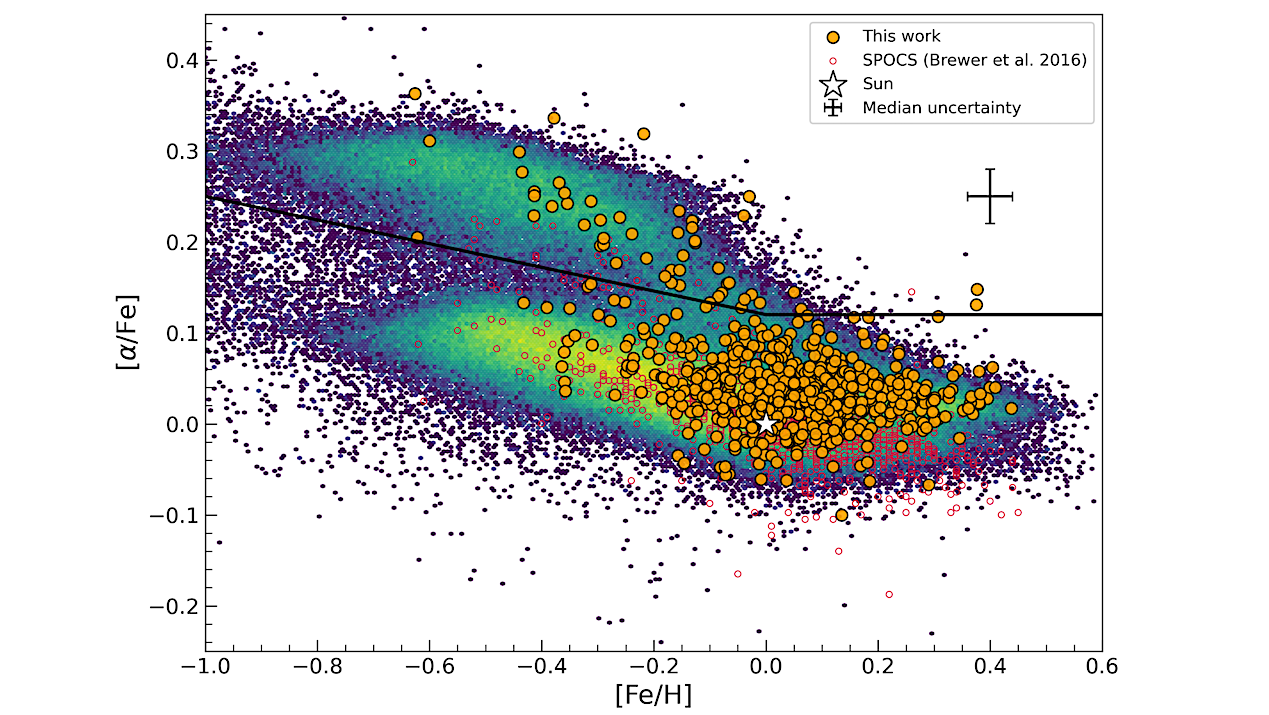
Stellar [α/Fe] versus [Fe/H] for planet-hosting stars analyzed in this work (orange circles). The heat map represents the density of stars from APOGEE DR17 in the [α/M] vs [Fe/H] parameter space for reference. The black line approximately divides the thin and thick disk populations (below and above the line, respectively) as defined by D. H. Weinberg et al. 2019. The red points represent stars from the SPOCS sample from J. M. Brewer et al. (2016). The Sun is over-plotted for reference. — astro-ph.EP
We present a uniform spectroscopic characterization of 625 F, G, and K stars hosting 859 confirmed exoplanets using high-resolution archival optical spectra from the Tillinghast Reflector Echelle Spectrograph (TRES).
We use the neural network spectral code uberMS, which combines spectra with broadband photometry to estimate precise and accurate stellar parameters. We determine stellar effective temperatures, surface gravities, radii, luminosities, projected rotational velocities, [Fe/H] abundances, and [α/Fe] enrichments for most confirmed planet hosts observed by TRES.
This uniform catalog can be used for a broad range of astrophysical studies, particularly to explore links between stellar [α/Fe] and a suite of observed exoplanet properties. Combining our metallicity measurements with galactic kinematics, we identify 58 planet hosts that are likely members of the thick disk.
We investigate the chemical environments of giant-planet formation by comparing the [α/Fe] distributions of giant-planet host stars across different metallicity regimes. We find that subsolar metallicity giant-planet hosts are significantly enhanced in [α/Fe] relative to Fe-rich giant-planet hosts and to the average Fe-poor field star, at high statistical significance.
This suggests that enhanced α-element abundances may partially compensate for low-Fe content and thus enable the formation of giant planets in metal-poor environments. We additionally compare the [α/Fe] distributions of single- and multi-planet hosts and find modest evidence that α-enhanced stars may preferentially host multi-planet systems. Finally, we recover previously observed trends between stellar metallicity and planetary eccentricity.
Romy Rodríguez Martínez, Emily K. Pass, Phillip A. Cargile, Victoria DiTomasso, David Charbonneau, Jason D. Eastman, David W. Latham
Comments: 18 pages, 9 figures, 3 tables; Submitted to ApJ
Subjects: Earth and Planetary Astrophysics (astro-ph.EP)
Cite as: arXiv:2605.11075 [astro-ph.EP] (or arXiv:2605.11075v1 [astro-ph.EP] for this version)
https://doi.org/10.48550/arXiv.2605.11075
Focus to learn more
Submission history
From: Romy Rodriguez
[v1] Mon, 11 May 2026 18:00:03 UTC (7,652 KB)
https://arxiv.org/abs/2605.11075
Astrobiology,










Related Posts
Stay Informed With the Latest & Most Important News

Advertisement
-
 01Two Black Holes Observed Circling Each Other for the First Time
 -
 02From Polymerization-Enabled Folding and Assembly to Chemical Evolution: Key Processes for Emergence of Functional Polymers in the Origin of Life
 -
 03Astronomy 101: From the Sun and Moon to Wormholes and Warp Drive, Key Theories, Discoveries, and Facts about the Universe (The Adams 101 Series)
 -
 04True Anomaly hires former York Space executive as chief operating officer
 -
 05Φsat-2 begins science phase for AI Earth images
 -
 06Hurricane forecasters are losing 3 key satellites ahead of peak storm season − a meteorologist explains why it matters
 -
 07Binary star systems are complex astronomical objects − a new AI approach could pin down their properties quickly