
Now Reading: Active Galactic Nucleus Tori: Potential Birthplace to Millions of Planets
-
01
Active Galactic Nucleus Tori: Potential Birthplace to Millions of Planets


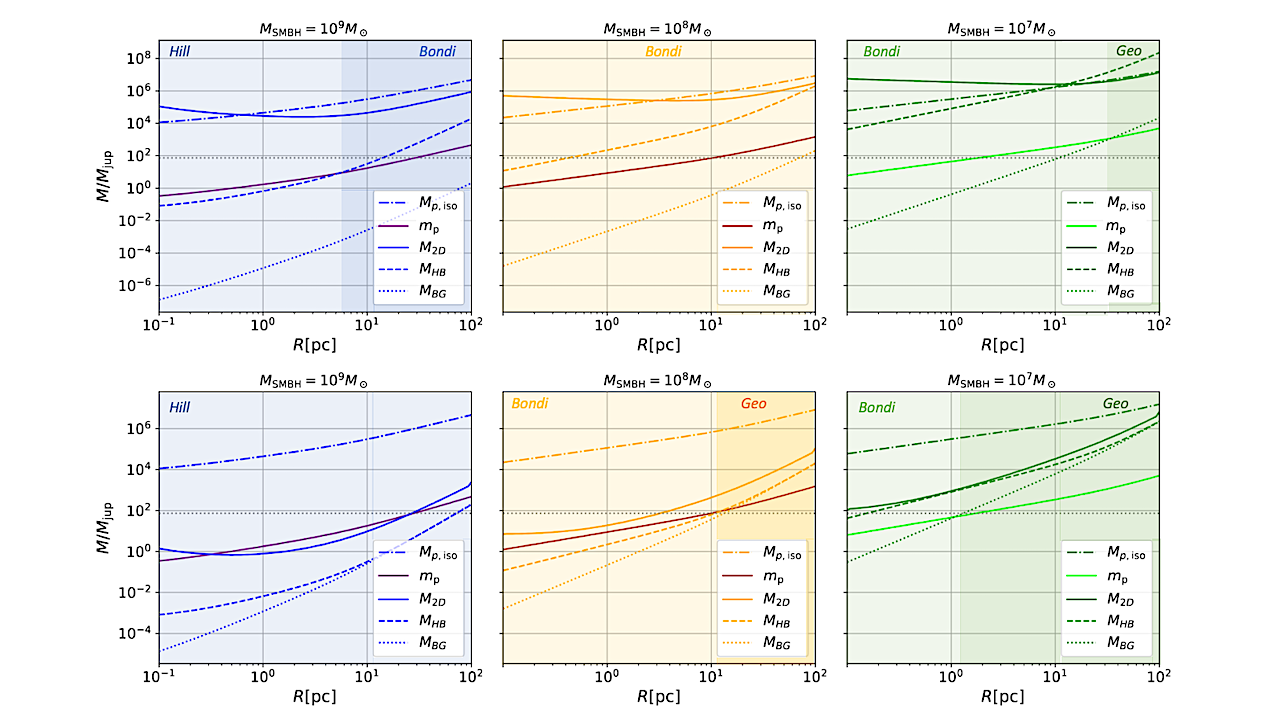
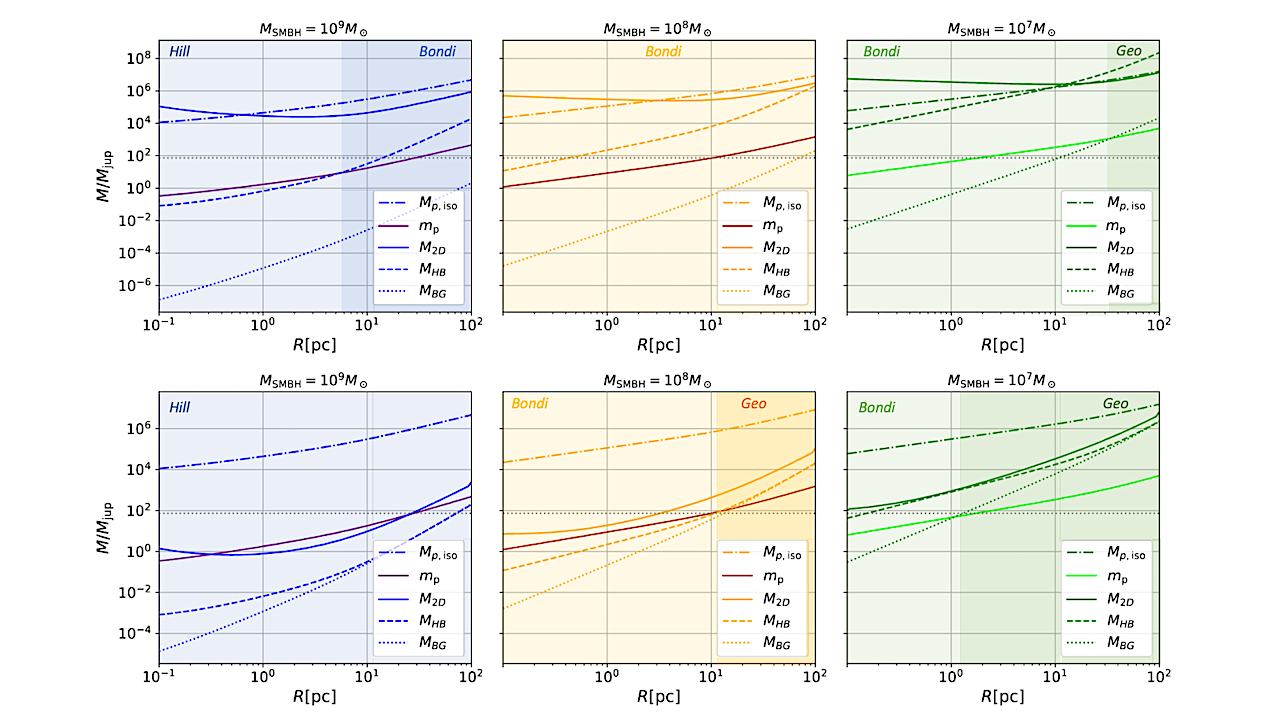
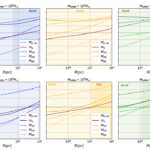
Transition between different accretion regimes as shown by the shading and top labels. From left to right the panels show central AGN masses of 109, 108 and 107 𝑀⊙. The top row shows 𝑣frag = 1m s−1 and the bottom row shows 𝑣frag = 10 m−1 . The symbol 𝑚p gives the characteristic planetesimal mass, 𝑀HB is the transition mass between the Hill and the Bondi accretion regime, 𝑀BG is the transition mass between the Bondi and the geometric accretion regimes, and 𝑀p,iso is the pebble isolation mass. The transition between 2D and 3D accretion is also shown. In general, the objects will accrete in the 3D regime right after formation, except in the 1–10 pc range in the case 𝑣frag = 10 m/s, 𝑀SMBH = 109 𝑀⊙ (lower left). Accretion is also more efficient in the inner disk than in the outer disk, with a progression from Hill, Hill/Bondi, Bondi, and Bondi/Geometric as the central mass object decreases. The horizontal dotted black line is the hydrogen burning limit. — astro-ph.EP
The outer regions of AGN disks have temperatures similar to those of circumstellar disks, permitting dust condensation. Therefore, planet formation and growth could be active in these dust tori through similar mechanisms.
We aim at quantifying the parameter space for the occurrence of streaming instability, and its outcomes in terms of the masses of the objects formed, their total number, and their continued growth via pebble accretion.
We use a a recently proposed disk model with strong magnetization to keep the disk gravitationally stable. We find that the dust grain sizes required for streaming instability are easily attained through coagulation; the dust filaments it produces can contain solar masses, collapsing into tens of millions of planetesimals ranging from Earth to super-Jupiter masses.
These planets are usually born in the 3D Bondi regime of pebble accretion, and have mass-doubling times from 10^3 to 10^7 yrs, though 3D Hill and geometric accretion are also realized. Gas accretion occurs concurrently, and crossover mass can be attained while still in the planetary mass range.
As a result, vigorous accretion can occur, leading to objects with stellar masses — defining a core accretion channel for star formation. The pebble isolation mass is beyond the hydrogen burning limit, so accretion is limited by stellar feedback instead of gap carving.
Our model also predicts a population of exotic objects directly formed above the hydrogen burning limit, yet of pure dust. Our approximate model suggests that AGN dust tori host the largest populations of planets in the universe.
Bhupendra Mishra, Wladimir Lyra, Barry McKernan, Mordecai-Mark Mac Low, K. E. Saavik Ford, Harrison E. Cook
Comments: accepted in ApJ
Subjects: Earth and Planetary Astrophysics (astro-ph.EP); Astrophysics of Galaxies (astro-ph.GA); High Energy Astrophysical Phenomena (astro-ph.HE); Solar and Stellar Astrophysics (astro-ph.SR)
Cite as: arXiv:2605.19241 [astro-ph.EP](or arXiv:2605.19241v1 [astro-ph.EP] for this version)
https://doi.org/10.48550/arXiv.2605.19241
Focus to learn more
Submission history
From: Bhupendra Mishra
[v1] Tue, 19 May 2026 01:22:26 UTC (671 KB)
https://arxiv.org/abs/2605.19241
Astrobiology,










Related Posts

Stay Informed With the Latest & Most Important News
Previous Post
Next Post


Advertisement
-
 01Two Black Holes Observed Circling Each Other for the First Time
 -
 02From Polymerization-Enabled Folding and Assembly to Chemical Evolution: Key Processes for Emergence of Functional Polymers in the Origin of Life
 -
 03Astronomy 101: From the Sun and Moon to Wormholes and Warp Drive, Key Theories, Discoveries, and Facts about the Universe (The Adams 101 Series)
 -
 04True Anomaly hires former York Space executive as chief operating officer
 -
 05Φsat-2 begins science phase for AI Earth images
 -
 06Hurricane forecasters are losing 3 key satellites ahead of peak storm season − a meteorologist explains why it matters
 -
 07Binary star systems are complex astronomical objects − a new AI approach could pin down their properties quickly