
Now Reading: Maximum Lifetime Of The Vegetative Biosphere
-
01
Maximum Lifetime Of The Vegetative Biosphere


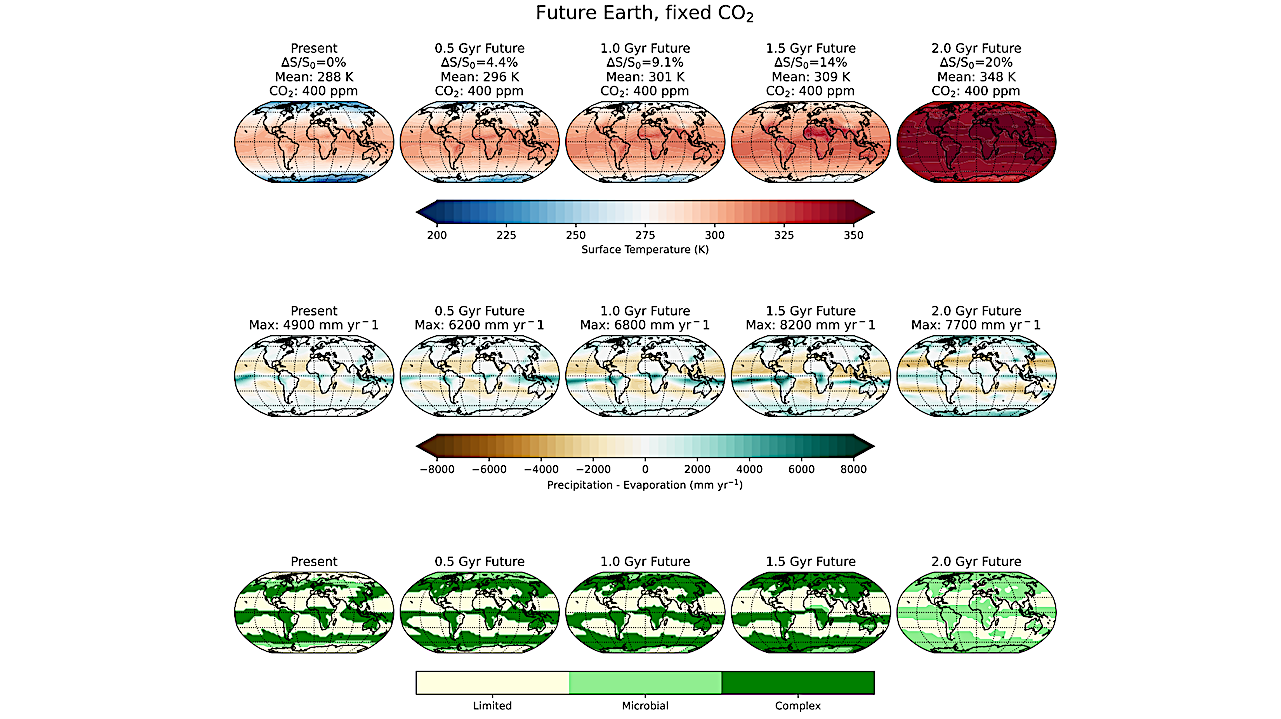
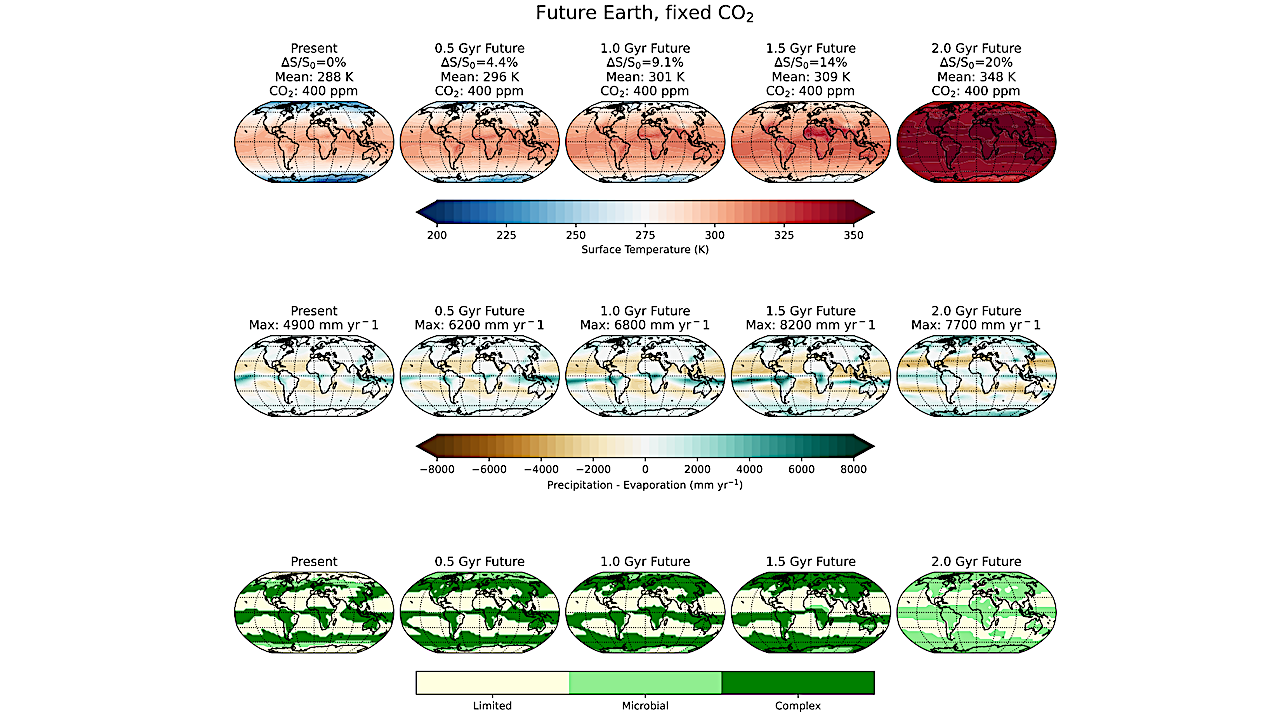
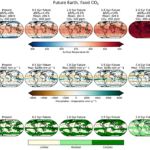
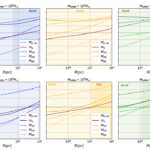
ExoCAM simulations of Earth from the present up to 2.0 Gyr in the future, assuming CO2 remains fixed at 400 ppm. The top row shows surface temperature, the middle row shows precipitation minus evaporation, and the bottom row shows the habitability metric developed by Woodward et al. (2025) (Eqs. (D1) and (D2)). All quantities are 20-year averages after the model has reached a steady-state. Increases in temperature due to a brightening sun cause an increase in habitability up to 1.5 Gyr due to the greening of the poles, but habitability decreases significantly by 2.0 Gyr as Earth becomes too hot for complex vegetative life. This corresponds to a weak temperature dependence of weathering, in which Earth’s CO2 levels do not change even as the climate warms (c.f., Graham et al., 2024). — astro-ph.EP
We use a three-dimensional model to calculate steady-state climates at various intervals in Earth’s future, across a parameter space of increasing insolation and decreasing CO2 mixing ratio.
Comparison with prior results shows an overestimation of warming by one-dimensional models when solar constant is increased and CO2 mixing ratio is fixed. We consider two future trajectories as limiting cases: strong weathering, in which surface temperature remains constant but CO2 is drawn down; and weak weathering, in which CO2 remains constant and surface temperature increases.
Under strong weathering, we find the conventional 10 ppm CO2 starvation limit for C4 photosynthesis occurs at 1.35 Gyr; however, we suggest that crassulacean acid metabolism (CAM) photosynthesis could persist below this limit and note that aquatic macrophytes can utilize dissolved bicarbonate if atmospheric CO2 is low.
If we take the CO2 starvation limit at 1 ppm instead, then the vegetative biosphere could continue until 1.84 Gyr. Thermal limits apply instead under weak weathering, in which Earth would be too hot for most land plants at 1.68 Gyr (>323 K) and too hot for all land plants (>338 K) at 1.87 Gyr. These lifetimes approach the moist and runaway greenhouse limits for Earth.
We discuss other possible mechanisms for extending the lifetime of Earth’s biosphere, noting that both technological intervention and evolutionary processes could enable life to adapt to a brightening sun.
Jacob Haqq-Misra, Eric Wolf
Comments: Accepted by Journal of Geophysical Research – Atmospheres
Subjects: Earth and Planetary Astrophysics (astro-ph.EP)
Cite as: arXiv:2605.22404 [astro-ph.EP] (or arXiv:2605.22404v1 [astro-ph.EP] for this version)
https://doi.org/10.48550/arXiv.2605.22404
Focus to learn more
Submission history
From: Jacob Haqq-Misra
[v1] Thu, 21 May 2026 12:32:10 UTC (3,385 KB)
https://arxiv.org/abs/2605.22404
Astrobiology,










Related Posts
Stay Informed With the Latest & Most Important News
Previous Post
Next Post
Previous Post
Next Post
Advertisement
-
 01Two Black Holes Observed Circling Each Other for the First Time
 -
 02From Polymerization-Enabled Folding and Assembly to Chemical Evolution: Key Processes for Emergence of Functional Polymers in the Origin of Life
 -
 03Astronomy 101: From the Sun and Moon to Wormholes and Warp Drive, Key Theories, Discoveries, and Facts about the Universe (The Adams 101 Series)
 -
 04True Anomaly hires former York Space executive as chief operating officer
 -
 05Φsat-2 begins science phase for AI Earth images
 -
 06Hurricane forecasters are losing 3 key satellites ahead of peak storm season − a meteorologist explains why it matters
 -
 07Binary star systems are complex astronomical objects − a new AI approach could pin down their properties quickly