
Now Reading: The Habitability Trade-off: Chemical Decoupling And Quenching In Massive Galaxies
-
01
The Habitability Trade-off: Chemical Decoupling And Quenching In Massive Galaxies


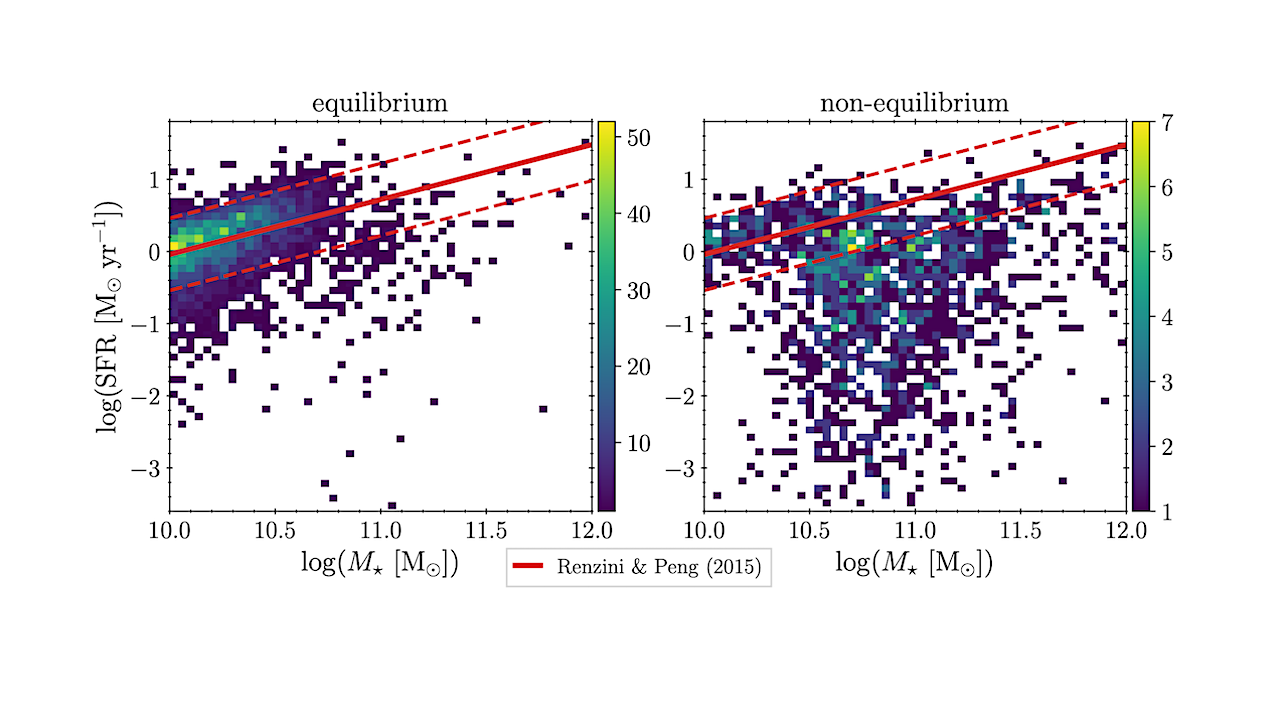
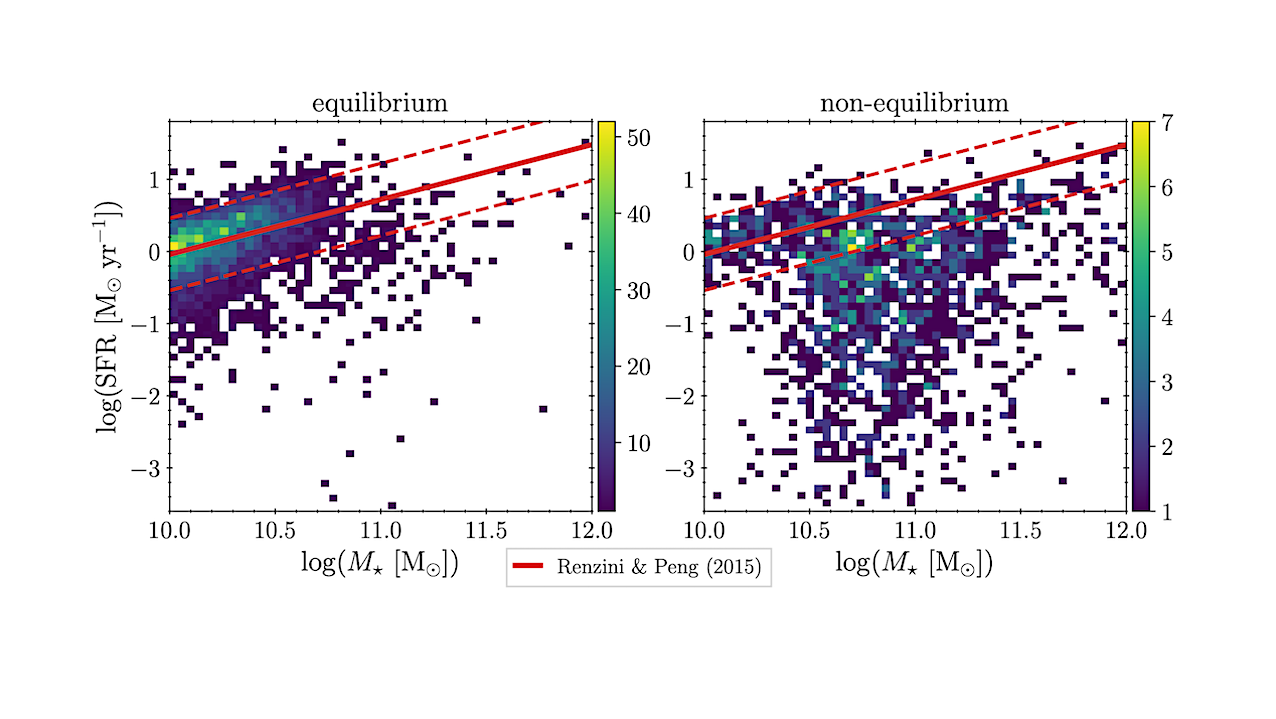
SFR as a function of stellar mass for equilibrium (left) and non-equilibrium (right) galaxies. The solid red line indicates the SFMS from Renzini & Peng (2015), with dashed lines showing the adopted scatter. Colour maps indicate the number of galaxies per bin in each panel; note that the colour scales differ between the equilibrium and non-equilibrium panels, reflecting the different sample sizes. — astro-ph.GA
Massive galaxies experience complex evolutionary processes, including mergers and gas accretion, which can disrupt the chemical equilibrium between their stellar and gaseous components.
Using the IllustrisTNG (TNG100) simulation at z=0, we investigated the prevalence and physical properties of such chemically decoupled systems within the massive star-forming galaxy population.
We identify a substantial subpopulation (∼31.5% of the sample) that exhibits systematic stellar-gas decoupling, characterised by a metal-rich stellar component coexisting with a diluted gas reservoir. These non-equilibrium galaxies are closely linked to recent merger activity and partial quenching, and display systematically suppressed star-formation rates and reduced gas fractions, consistent with a transitional evolutionary phase.
We then examined the implications of this phase for galaxy-scale habitability prescriptions by applying a terrestrial planet abundance proxy that combines stellar mass, gas-phase metallicity, and the rate of sterilising events. Despite their diluted gas reservoirs, non-equilibrium galaxies dominate the high end of the inferred present-day habitability proxy distribution, exceeding equilibrium systems by more than an order of magnitude.
We interpret this as a habitability trade-off: the same gas dilution and quenching processes that reduce the efficiency of future terrestrial planet formation simultaneously create a transient phase of suppressed radiation hazards for existing planets.
The Andromeda galaxy (M31) shows qualitative similarities to this chemically decoupled population, suggesting that galaxies exiting their peak star-forming phase represent a distinct and highly relevant demographic for galaxy-scale habitability. Galactic habitability is therefore intrinsically time-dependent.
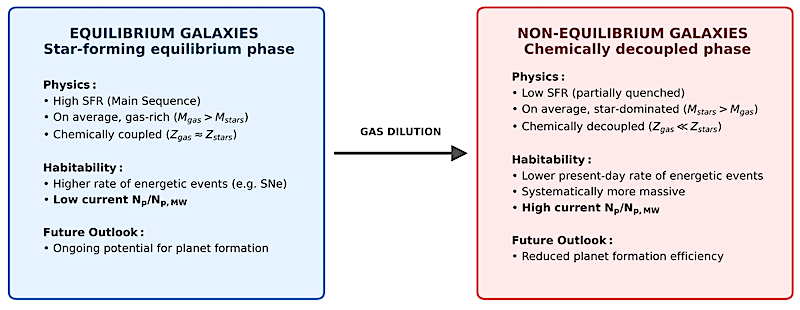
Schematic summary of the two galaxy populations identified in this work. This diagram is intended as a qualitative interpretation of the evolutionary phase associated with chemical decoupling. — astro-ph.GA
Ana Mitrašinović, Nataša Pavlov, Branislav Vukotić, Stanislav Milošević et al.
Comments: accepted for publication in Astronomy & Astrophysics
Subjects: Astrophysics of Galaxies (astro-ph.GA); Earth and Planetary Astrophysics (astro-ph.EP); Solar and Stellar Astrophysics (astro-ph.SR)
Cite as: arXiv:2605.22510 [astro-ph.GA] (or arXiv:2605.22510v1 [astro-ph.GA] for this version)
https://doi.org/10.48550/arXiv.2605.22510
Focus to learn more
Submission history
From: Ana Mitrasinovic
[v1] Thu, 21 May 2026 14:00:20 UTC (2,256 KB)
https://arxiv.org/abs/2605.22510
Astrobiology, Astronomy,










Related Posts


Stay Informed With the Latest & Most Important News
Previous Post
Next Post
Previous Post
Next Post

Advertisement
-
 01Two Black Holes Observed Circling Each Other for the First Time
 -
 02From Polymerization-Enabled Folding and Assembly to Chemical Evolution: Key Processes for Emergence of Functional Polymers in the Origin of Life
 -
 03Astronomy 101: From the Sun and Moon to Wormholes and Warp Drive, Key Theories, Discoveries, and Facts about the Universe (The Adams 101 Series)
 -
 04True Anomaly hires former York Space executive as chief operating officer
 -
 05Φsat-2 begins science phase for AI Earth images
 -
 06Hurricane forecasters are losing 3 key satellites ahead of peak storm season − a meteorologist explains why it matters
 -
 07Binary star systems are complex astronomical objects − a new AI approach could pin down their properties quickly